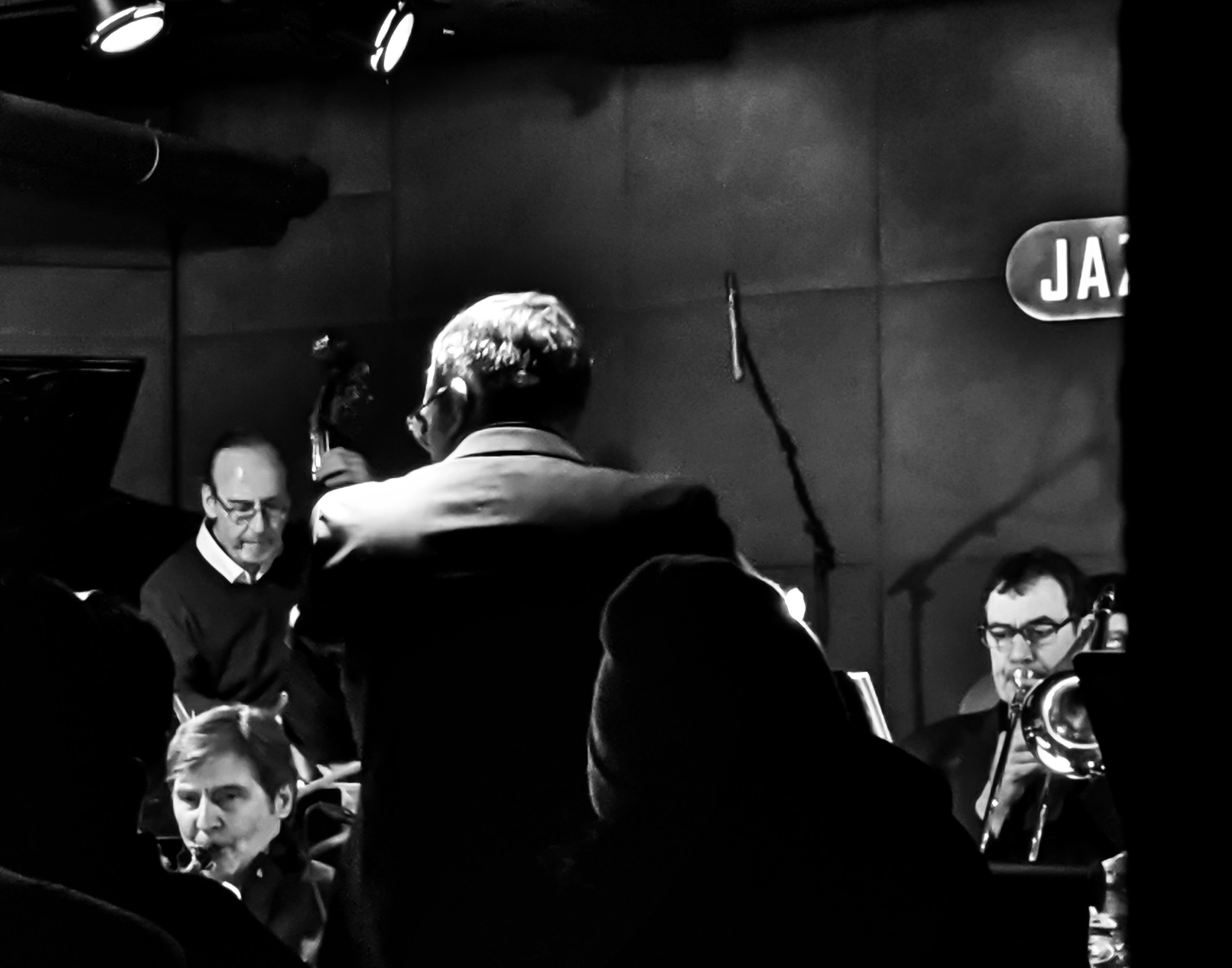
Curation is an act of love, when you’re doing it right. Trombonist John Mosca, longtime comrade of Brookmeyer said, while introducing “Ding Dong Ding,” which he played with the Mel Lewis band during its triumphant late ‘70s run, said “There’s no better curator or champion for Bob’s [Brookmeyer] music than Ryan [Truesdell].”
Truesdell and his crack 18-piece band proved that again and again in their final set of a two-night run at Manhattan’s Jazz Standard on a blustery January night, a belated 80th birthday party for Brookmeyer, the great composer, arranger, and player who changed the shape of jazz, especially large group jazz, since the ‘60s. As much as jazz is the first American art form, the big band feels like a peculiarly American animal.
The music is a masterful evocation of what a big band could be at its heights, fresh and alive, and warm. Rippling shocks of chromatic heat revealed sublime beauty, more than once I felt I was peering into a blast furnace full of precious stones. But that visceral, massed sound always parted for the primacy of some of the sweetest melody you’ll ever hear – Scott Robinson’s river-of-life bass clarinet on “Django’s Castle; ” Drew Gress’ funky flamenco bass runs on “Verticals; ” John Mosca and Riley Muhlekar’s dance-battle brass on “The Fan Club; ” Gary Versace’s lilting piano, insistent on the intro and light as a lullaby at the end of “Ding Dong Ding.”
Truesdell wove a thread through pieces of Brookmeyer’s dating back to the Gerry Mulligan Concert Band until not long before he passed away. He gave us enough of that ranging sound world to feel like we got it. And, as a renowned arranger himself, he highlighted Bob’s ability to let people shine in his own compositions and to bring out the key facets in others. I’m a Cole Porter freak who grew up with a grandmother who idolized Sarah Vaughan. It’s no exaggeration to say I’ve heard 100 versions of “Love For Sale” – that might be conservative. The version of “Love For Sale” they closed with, with the exquisite Wendy Giles on vocals – I missed Brookmeyer’s late Standards record, to my chagrin – made me feel like I was hearing it with fresh ears. I won’t say I was crying but I wouldn’t deny it under oath.
Beyond the musical mix, Truesdell nailed the mix of personalities in the instrumental blend, their connections to each other, and Bob as a person. He let the players introduce songs with rambling, hilarious personal anecdotes, and cultivates an atmosphere that feels as though we’re lucky enough to be at a real birthday party, even including Brookmeyer’s widow. May we all be so lucky to have people who love us as much as the love in that Wednesday room.
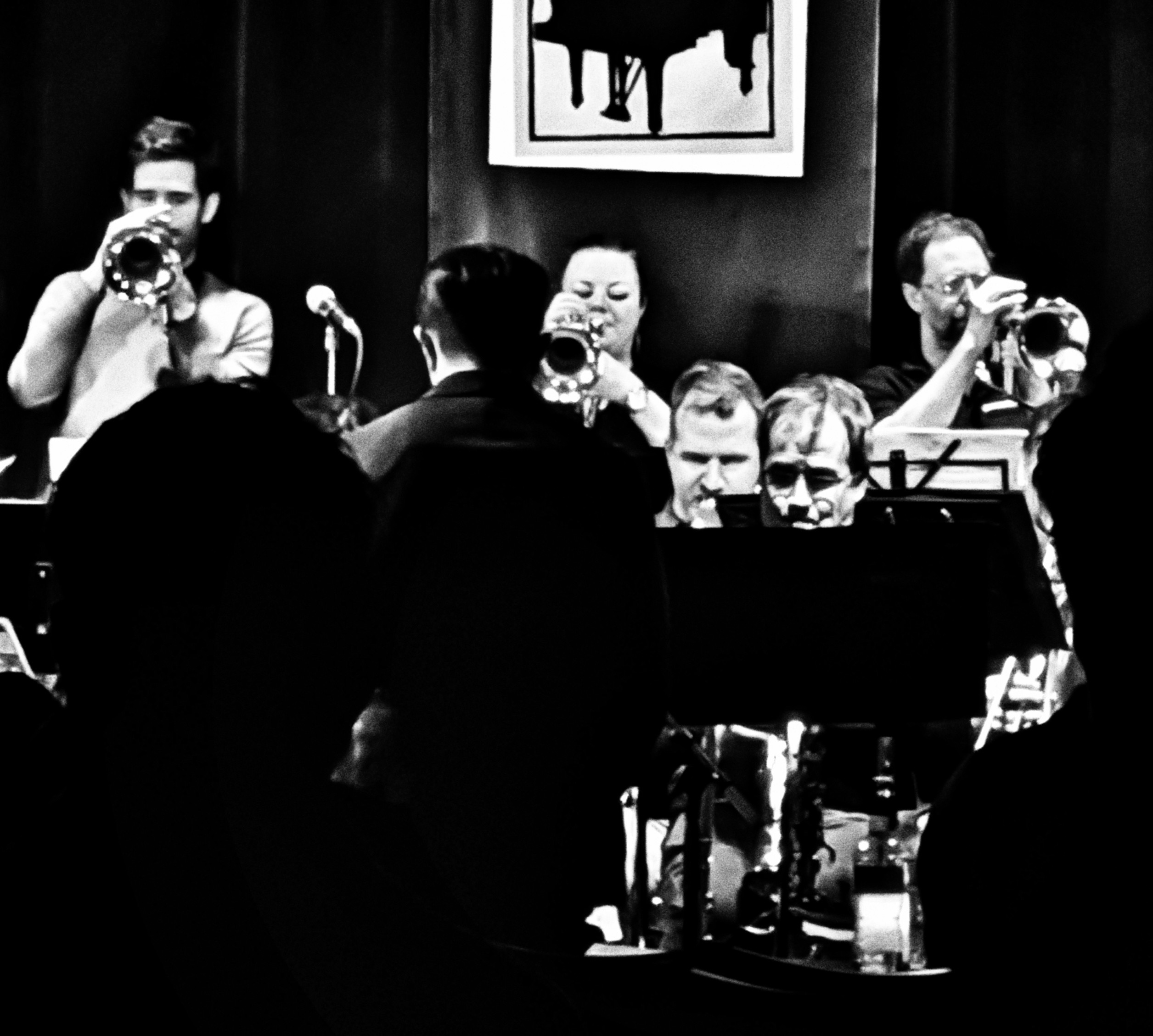
Darcy James Argue’s Secret Society shone a bright light on another angle of the promise and beauty of the big band the next night at Jazz Gallery. I’m an unabashed stan for Argue’s work, discovering him through his blog and responding to Infernal Machines, seeing two premieres at BAM and hitting my year–end list many times. Appropriate for the week of APAP, he and his co-conspirators ran us through a whiplash-dazzling deep dive into the band’s rich catalog.
The band tore into this material with an uncommon passion and fire, fused to the wisdom of players who know the tunes in at a cellular level and the camaraderie that doesn’t come easy. Early gems like “Dymaxion,” brand new pieces including “Ebonite” commissioned by his hometown Vancouver Jazz Festival, “The Hidden Hand” from his epic Real Enemies, every pitch sailed over the fences.
Argue’s debt to Ellington paid off with tailored, perfect solos rising out of the landscapes he sculpted as though they couldn’t come from anywhere else. Highlights in that regard came in Carl Maraghi’s rippling bari work on “Dymaxion,” and Alexa Tarantino’s tough and supple soprano on “Ebonite.”
The highlight for me came with the most direct Ellington homage – Argue’s response to “Diminuendo in Blue,” “Tensile Curves.” This was my second journey through that piece, riddled with astonishing playing with particular attention to Ingrid Jensen and Matt Holman’s trumpets, Sam Sadigursky’s clarinet, and Sebastian Noelle’s guitar. It’s the rare tribute with heavy conceptual underpinning, where knowing the technical aspects deepen your appreciation without being required and the even rarer 40-minute composition that never flags or lets your attention drift.
Similar to the Brookmeyer (one of Argue’s teachers), the stage overflowed with love and respect for the players as people. My time following that band has turned me onto as many great players as those Ellington and Basie records I grew up with – Nadje Noordhuis, Jacob Garchik, Ryan Keberle, Sam Sadigursky, people whose other work I’ve sought and loved. These two shows got this trip off to the righteous start it needed, plugging back into the battery after some dark months.
 Screen of Distance