More thinking about absent friends and the circles they ran in, especially as this weekend brought news a missing friend’s body was found. RIP Lane Campbell. And this weekend was the anniversary of another friend’s death, Melissa Bontempo. Two of the biggest music fans I was ever lucky enough to know among many, many other fine qualities.
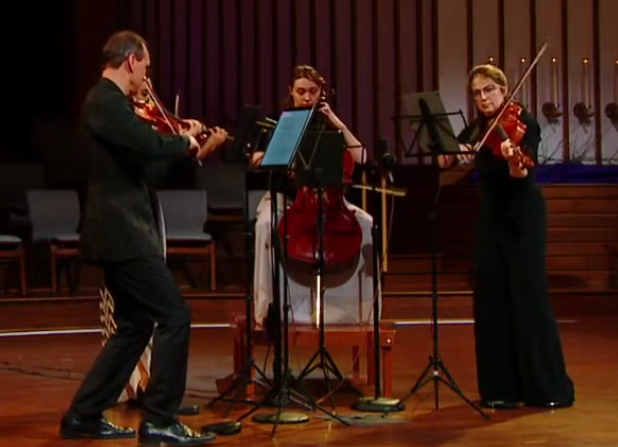
From left; Charles Wetherbee, Marisa Ishikawa, Ariana Nelson, Korine Fujiwara; taken from stream and edited
Carpe Diem String Quartet – Ancestors on 03/07/2021
Carpe Diem String Quartet have been one of the Columbus music scene’s gems for 15 years, straddling the line between the classic quartet repertoire and brand new work from living composers. Their stream this week was a brilliant example of how well they work both sides of that line.
The quartet kicked off their program with the founding father of the modern string quartet. Their jubilant thrill-ride take on Haydn’s “Opus 76, No. 1,” amplified and underlined the sense of invention and play and the different forms rubbing against and sparking with one another, sacrificing none of the piece’s intense emotional impact.
They closed with Erberk Eryılmaz’s dazzling fireworks display and deep dive into the folk music of Thrace, “Tracian Airs of Besime Sultan.” Bold spinning dances and sudden fires as the quartet zoomed in and out of the most microscopic details, shining a light on them like an Elizabeth Bishop villanelle then pulling back to show us the whole undulating landscape.
As great as those pieces were, I came for the world premiere in the middle and it more than lived up to my high expectations. Mark Lomax II has been at the highest tier of Columbus’s best composers for a long time. The world got to experience that brilliance with wider recognition of his epic 400: An Afrikan Suite in 2019.
When interviewing him about that masterpiece for a preview, it surprised me that Lomax had less luck breaking into the classical/chamber music worlds, with quartets and even a ballet that weren’t produced. With recent connections to the Wexner Center and the Johnstone Fund, that’s happily started to change in recent years. This world premiere of the entirety of “String Quartet No. 1” continues that much-needed corrective arc.
Partly inspired by his Grandfather and two other elders who were important to him, Lomax also made connections to the more than 500,000 people we lost this year in a soaring four-movement work of tribute and memory that never succumbs to despair. The opening movement uses long tones and swirling harmonies to evoke a home-going ceremony, rapturous cries bubble up and recede.
The second movement, “Reflection,” ripples with bouncing pizzicato and dialogue between the strings. Some of the most joyous writing and playing in the entire piece shows up here and the kind of uncanny tightness you only see in this sort of ensemble from players who know one another this intimately; this was the section of the piece that reminded me most of Lomax’s jazz writing, the catchy but always surprising rhythms and the sense of trust in the players.
“Acceptance,” the third movement, orbits around a haunting, evolving viola melody from Korine Fujiwara as the rest of the quartet creates a world for that line to inhabit. “Soul in Flight” ends the piece with high, sliding, and soaring lines swirling around a singing cello from Ariana Nelson.
It’s remarkable work from one of my favorite composers and, looking at death again both near and far as I said in the preface, it was exactly the balm I needed on a down Sunday evening. A brilliantly arranged and ordered program that makes me want to get out and see something as soon as I responsibly can.
Thinking a lot about absent friends lately, and I’m sure that colored these choices. But usual winter melancholy and spiraling showed up, so I tried to counteract that with as much dancing as possible. Courtesy of Hype Machine, a merch table for this playlist: https://hypem.com/merch-table/42OpOdyNgQoMcq1KHEqQ45
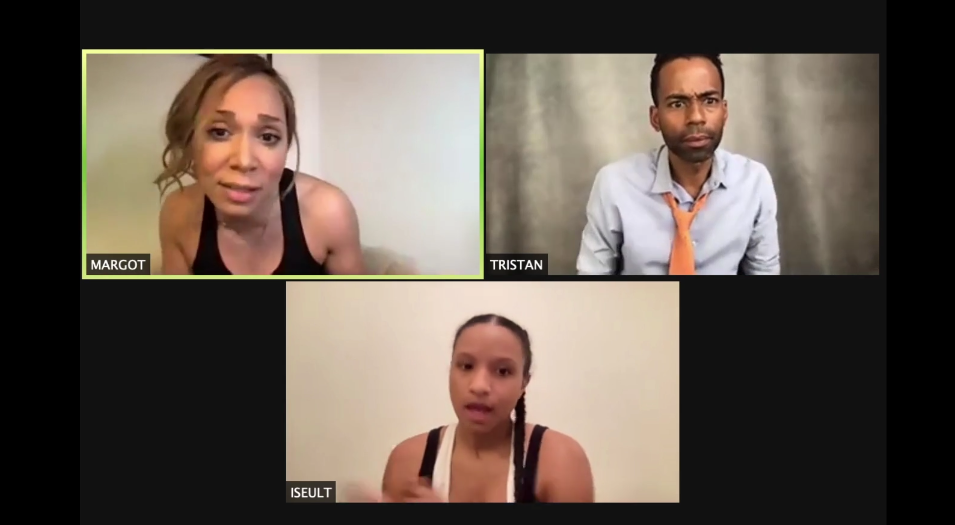
Clockwise from top left: Sarah Hollis, Chris Gardner, Naïma Hebrail Kidjo; taken from stream and edited
Iseult et Tristan by Pia Wilson
One of the great landmarks of New York underground experimental theater, La MaMa ETC, continues bringing exciting, vibrant work as it transitions to a digital space. Monday’s entry in the Experiments series was a brilliant example of how classic, almost archetypal stories can be repurposed and still resonate in our shared here and now.
Writer Pia Wilson resurrected the centuries-old love triangle of Iseult (Naïma Hebrail Kidjo), Margot (Sarah Hollis), and Tristan (Chris Gardner). She placed these old-as-time feelings in the milieu of contemporary New York with Iseult as a boxer, fresh out of rehab, under the tutelage of her retired boxer sister and her sister’s man struggling with some issues of his own.
Sympathetically directed by Susan Dalian in this zoom reading, the specifics of the setting hit with the concentrated fury of targeted punches as the characters danced around each other and their own pain. Lines drew blood like Iseult’s devastating “How do you do your life sentence in a cage of skin and blood? I don’t know how to do this life sentence.”
My first art exhibit of the year and it felt like the first air in my lungs after being submerged in dark water. All the art institutions here are doing a great job with capacity limits, timed ticketing, contact tracing. Those steps make me feel mostly comfortable doing an activity that gave me the most joy before the pandemic even while I’m not as at ease doing it, always watching to see who is in the room and how close we are to one another.
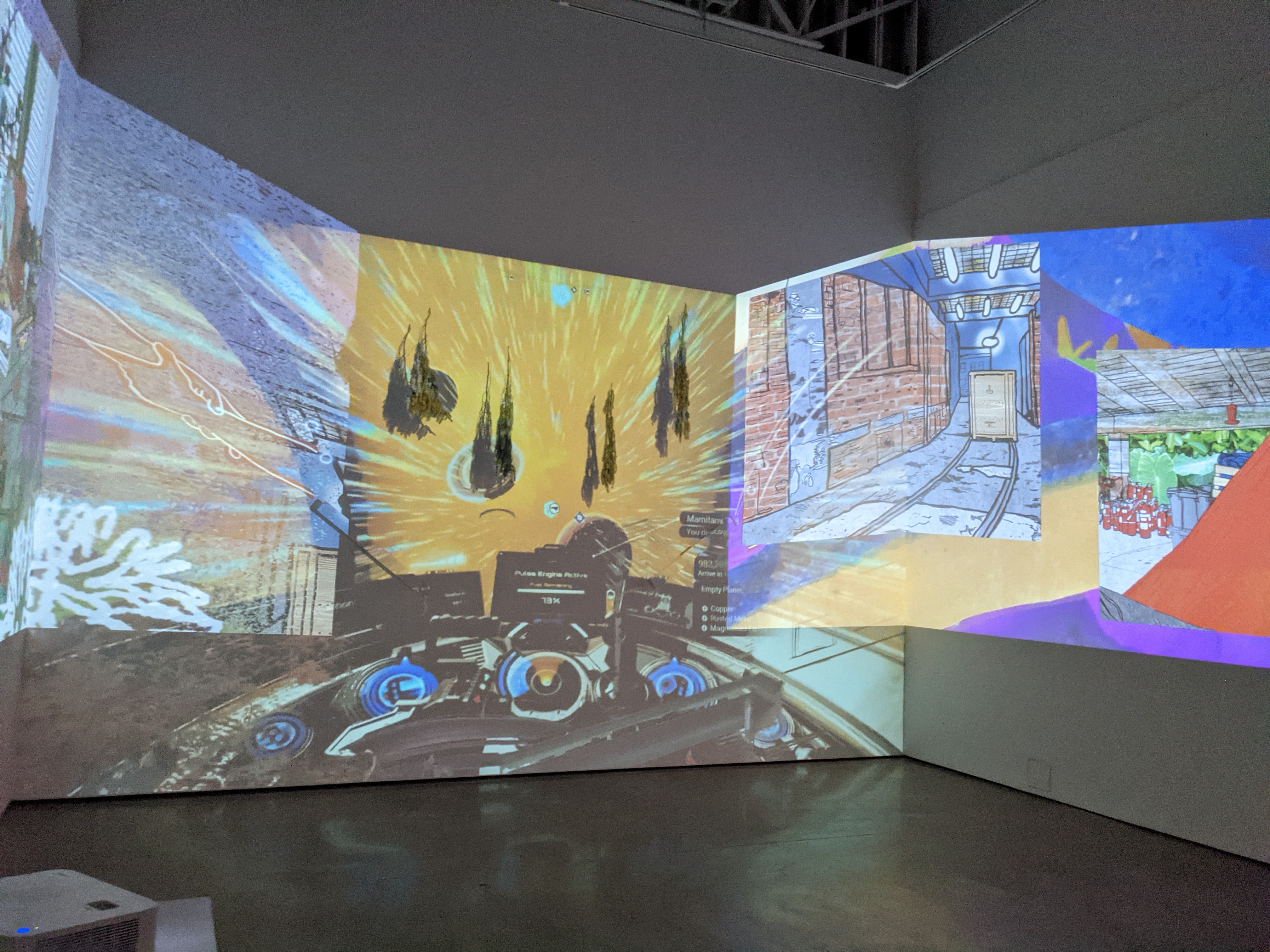
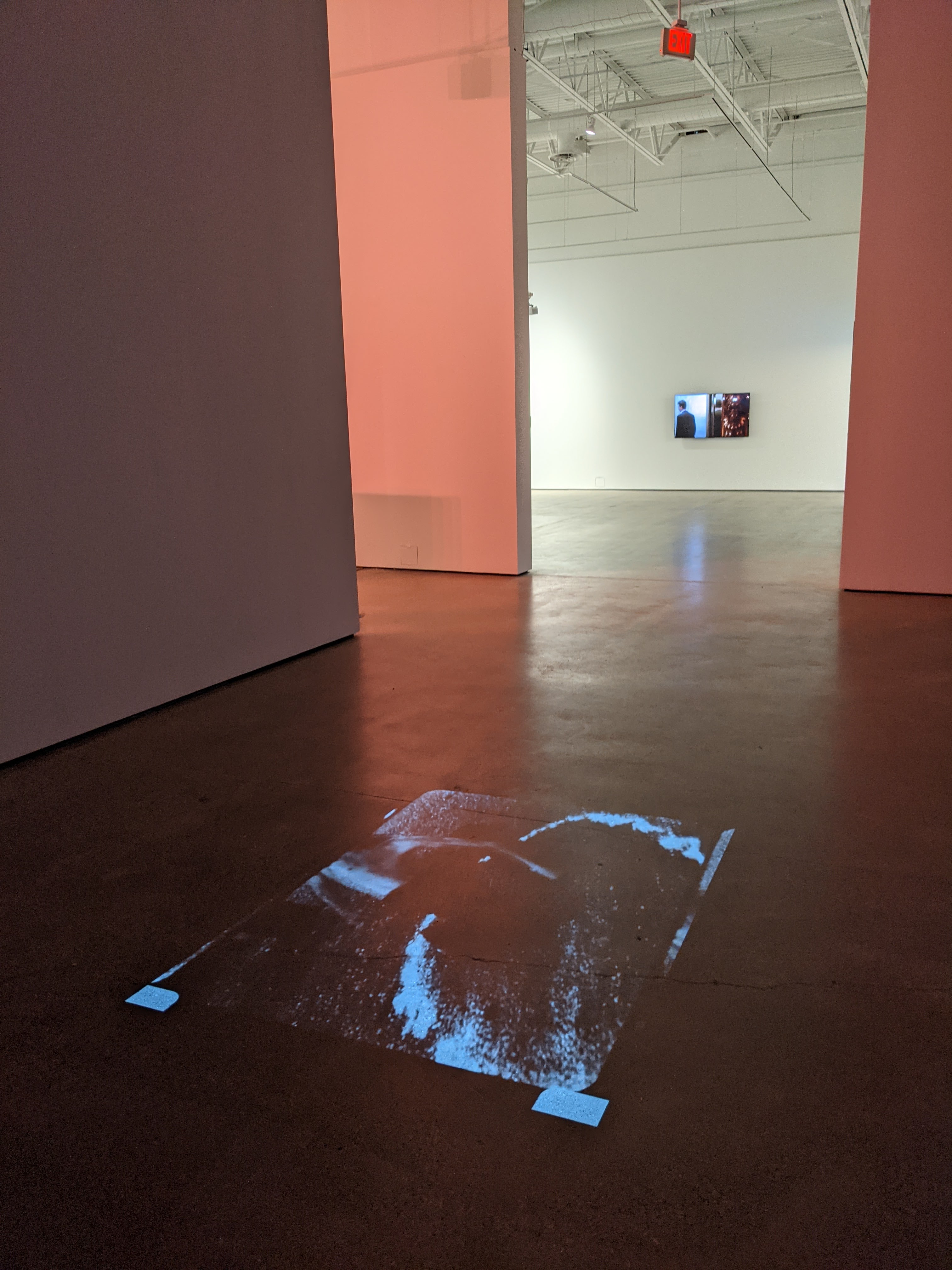
For the last several years, the Columbus College of Art and Design’s main exhibition space, Beeler Gallery, has carved out its own vital, unique space in our crowded art world. This multi-artist exhibition, November, was curated by alum Heather Taylor for the uncertainty and challenge of the 2020 election and pushed back due to a record-high wave of cases.
These works stand up to the different but still present anxiety and tension of the moment because they were built already dealing with the layers of historical rage, sadness, and mistreatment. The unifying thread among these pieces is the sad certainty that what we all went through wasn’t a blip but a coalescence, a locus, a culmination; a clear-eyed desire to understand and respond to move forward.
Each of the artists brought something personal and sharp to this call and Taylor’s curation – and whichever preparators she worked with – shines in the way they speak to one another. Benjamin Willis’ gripping self-portraits in a warm, textured light played with Dawn Kim’s punching layers of The Apprentice soundtrack over a C-Span litany of contenders walking into Trump Tower in early 2017.
Some of the highlights were full-room installations. Bobby T. Luck’s Drapetomania, or The Disease Causing Negroes to Run Away presented a breathtaking collage knocking the breath out of my lungs. Luck plays with our inability to connect and the sea of media buffeting us at every step and forcing a hard look at who chooses the prevailing images of a group – in this case, specifically black Americans – and why.
Calista Lyon used old-school overhead projectors to dive into colonialism’s impact on the Crimson Spider Orchid, stitching together history and an almost apocalyptic warning in deep duende, amplified by the nostalgia of that humming light and the pink cast of the walls.
There’s so much to unpack in this triumphant exhibition and it runs for one more week (through March 6, 2021). For details and to reserve timed tickets, visit https://www.ccad.edu/events/november
Farewell, Ace of Cups: Muswell Villebillies on 02/27/2021
Anne rightly points out that one key to not losing your mind in this time when we can’t see each other up close is finding ways to mark the things we’d usually get together to celebrate or mourn. The value of that approach was affirmed and its limits tested this Saturday as Marcy Mays said goodbye to her time owning Ace of Cups.
For the last decade, Ace made itself indispensable to the Columbus rock and roll scene, filling a specific gap. We had great clubs since Little Brothers closed but we missed that size of room with a rock-centered booking approach but casting a wide tent (and using the best existing bookers in town) while also being open for bar hours and serving as a central clubhouse for many of us.
Ace of Cups’ greatest successes came from its unshakable faith in and deep love for our shared community – Columbus’s and the larger rock and roll scene. I lost count of the number of birthdays (including Anne’s and her Mom’s) we celebrated, the people we mourned, the out-of-town friends who wanted to come back, and the great times we shared. I also lost count of the number of musicians who wanted to play Ace – sometimes hadn’t been to Columbus in many years – because of their longstanding friendship with Marcy going back to her days in Scrawl.
That sense of community was all over this final show as Ace transitions to a new owner – Conor Stratton who comes highly recommended by every friend of mine involved and with a proven track record including the exciting Yellow Springs Springfest. First, by continuing a long partnership with neighbors Lost Weekend Records, owned by scene stalwart (and the gold standard for stage managers) Kyle Siegrist, for Lost Weekend’s 18th-anniversary celebration.
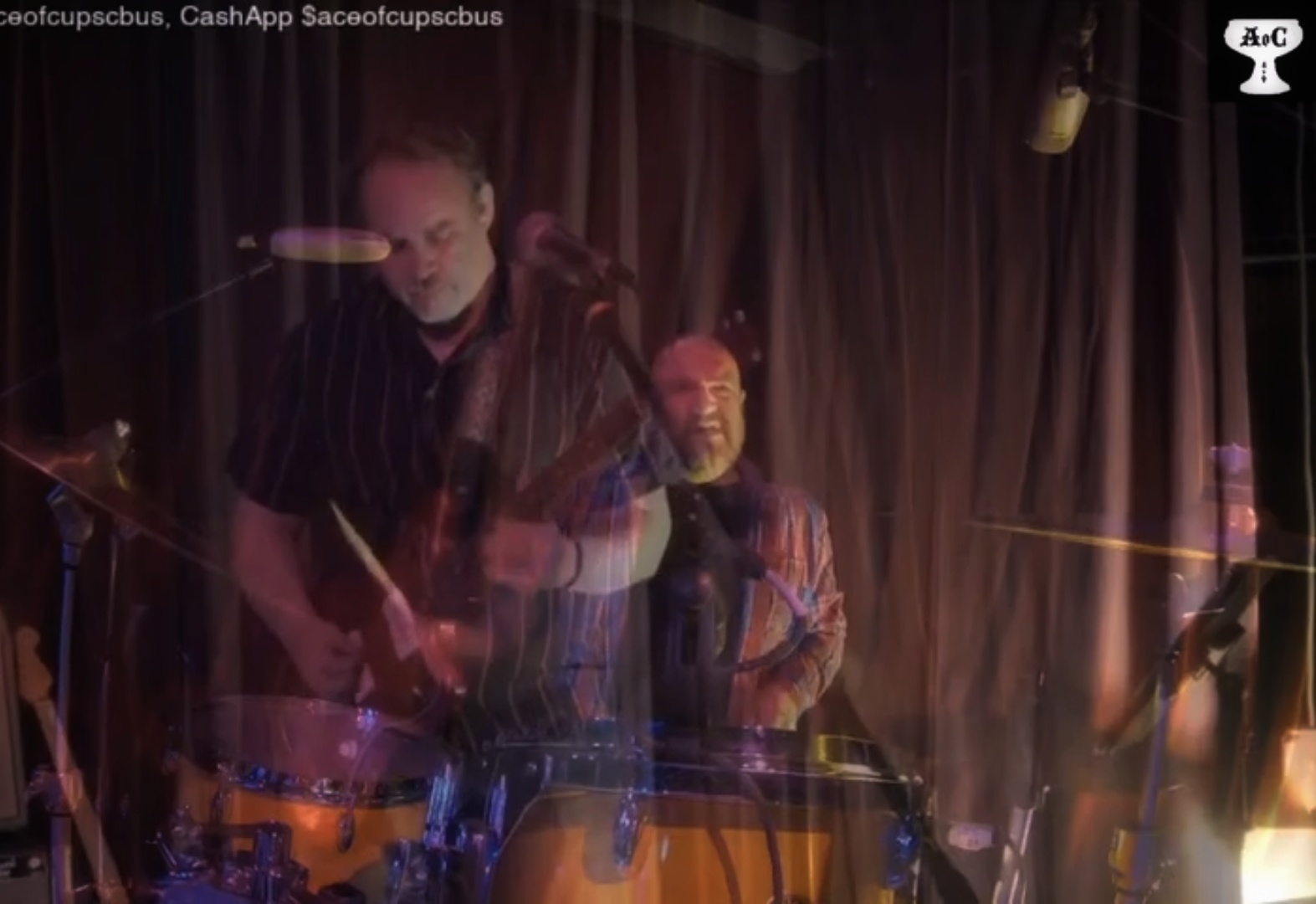
That community pumped through the veins of this show in the people playing too. The core of two of this town’s favorite cover-bands-for-people-who-hate-cover-bands, The Randys (Dave Vaubel and Jon Beard) and Popgun (Joey Hebdo and Tony McClung) teamed up with guitarist and producer of too many bands to count Andy Harrison in a gloriously fun Kinks tribute act, the Muswell Villebillies, aided by key members of New Basics Brass Band, Tim Perdue on trumpet and Tony Zilinick on trombone and sousaphone, on key tunes.
The players had a great time leaning into some of the great pop songs of the middle of the 20th century and the Kinks’ wide-ranging appetite for fusing disparate, sometimes discarded styles and making something new out of them along with the almost ravenous taste for melancholy in these songs made for an appropriate sendoff to a place we love so much.
That hunger for connection in tunes like “All of My Friends Were There” with its lines about “I’m thinking of the days – I won’t forget a single day, believe me;” “Picture Book;” “Party Line” with its warm paranoia, “I wish I had a more direct connection,” cut deeper than I expected, watching from my couch.
The set drove home that longing – not being in the room to hug people and give it a proper goodbye as I did with other rooms I loved so much in their last days, Little Brothers and Larry’s here, Lakeside Lounge in New York immediately come to mind – on tunes tailor-made for it, Ray Davies’ wincing look at childhood on “Come Dancing” and a wrenching turn through one of the most beautiful songs of the 20th century, “Waterloo Sunset,” with guest vocals by Mays.
Part of what made this band work so beautifully is the best work of most of these players comes in reconfiguring and enlivening structures. There weren’t a lot of deconstructionist impulses on display and you don’t want it for this kind of repertory band. The key to breathing life into these classic songs is trusting them and loving them on their own terms and the distinct players’ skillsets and ability to find space within both the song and the unit of the band shone brightly.
McClung’s heavy post-Elvin Jones drumming – I’ve compared him to Columbus’ “Tain” Watts a few times – snaps everything into place here, with the supple rhythm section rounded out by Vaubel’s crisp, melodic bass and Beard’s blood-pumping surges on barrelhouse piano, silent-cinema organ, and beer-garden accordion.
Within that framework, Hebdo leaned into the aggressive affectation of Davies’ phrasing, not making the mistake of trying to make things more natural to our ears, turning over the words and their rhythm as they were set in stone. Harrison’s crackling guitar and gets space to play as the horns lift everything up with punctuation and announcement.
I’ll miss you, Ace. I look forward to seeing what you bring us in the future. And I look forward to catching this band when I can dance with my friends and sing along in the open air.
Seth Soulstein from Hotel Good Luck, image taken from official website of the production
Hotel Good Luck by Alejandro Ricaño, presented by Cherry and New Ohio Theater
I’ve liked New Ohio’s work for a long time – they’re always on the short list of companies I check for whenever I’m in New York – and they have taken their ethos of brand new work that simultaneously vibrates with the pulse of the avant-garde and packs a deep emotional punch and found a path to present that vital work in our distanced environment and sacrificing very little in translation.
The newest, striking example of this crucial work came in partnership with the Cherry Artists Collective. Hotel Good Luck, from acclaimed Mexican playwright Alejandro Ricaño, hit hard in a stream from an empty theater in Ithaca, with an empathetic translation by Jacqueline Bixler and directed by Samuel Buggeln.
Hotel Good Luck uses the vibration of that empty theater to braid the metaphors of parallel universes and the solitary DJ for maximum loneliness. Bobby (Seth Soulstein) hunches over his turntables, spraying patter into the void and spinning records like a French version of “My Generation” when he discovers a gateway into other universes.
The irrevocability of death is baked into the Minotaur’s maze Bobby runs, backed by haunting cello lines and the confounding guidance of his psychologist and quantum physicist Larry (Desmond Bratton, also composer of the original music he plays).
The work also teases the frustration of figuring out where in the world – which world – any of us belongs. As Bratton declaims, right as answers start to appear in front of our hero but without solidity, “You be a disc jockey without listeners and I’ll be a therapist without patients! There is no original universe, Bobby. There is a universe you belong to but I don’t know how you get back there.”
The two performances and Buggeln’s beguiling direction, creating enough space to drift through but always knowing when to focus, made this dazzling play sing.
From left: Adrian Lester, Danny Sapani, from Hymn. Image taken from official website of the production
Hymn by Lolita Chakrabarti, presented by Almeida Theater
My first – alas, so far only – trip to London made me fall in love with so much I expected to (The Tate Modern, The V&A, Southbank) and things that weren’t even on my radar before. Almeida is top of that latter list, a contemporary theater doing everything right, from the cafe to sightlines to starting on time to their selection of work.
Playwright Lolita Chakrabarti hit my radar through one of my favorite institutions, St Ann’s Warehouse in Brooklyn. In 2013, St Ann’s presented the American premiere of Red Velvet, based on the true story of Ira Eldridge, the first black American to play Othello on the West End, starring Chakrabarti’s husband Adrian Lester, fresh off a smoking-hot London run.
Rolling the dice on an actor I was a fan of and a presenter who’d never let me down, I was enraptured. Later, I saw and reviewed a very good production at Ohio State’s theater department, proving the play wasn’t reliant on just that symbiotic relationship between star and writer.
Almeida’s transitioned to virtual shows that pack almost the same punch as being in their theater and I was overjoyed to wake up in time to catch the new Chakrabarti play, Hymn, streamed at 10 am my time (3 pm in London), starring Adrian Lester as Gilbert, the only known son of a local dry cleaner and upstanding member of the community, and Danny Sapani as the half-brother he didn’t know he had until a notice of their father’s funeral brings their orbits into collision.
In a taut 90 minutes, Hymn delves into what family and friendship mean, and the tracks left by the enormous shadow of a charismatic and loved father. Those impressions hit the two men in different ways but confirm presence and absence can both be suffocating and everything we live through has to be navigated.
The piece is bookended – after a whiplash prologue of Benny (Sapani) at the end of his rope, roaring at a bartender – by two eulogies, each delivered by one brother. The struggle to sum up a life in a few well-chosen words reverberates through the acid-burned snapshots that string the rest of the play together.
Music strings together this sudden, late-life friendship, staring from Sapani’s righteous takes on an evocative “Lean On Me,” and a furious read of the ominous Temptations classic “Papa Was a Rolling Stone,” through ‘80s classics like Full Force’s “Alice, I Want You Just For Me,” “Rapper’s Delight,” and a big UK hit I had to look up, “Street Tuff” by Rebel MC and Double Trouble, even into an ironic twisting of “Gettin’ Jiggy With It.”
The script brilliantly lets the physicality of these two men imply whole lives we only see glimpses of and highlights how little we – especially men – know each other, how hard we have to dig. McIntyre (who also directed The Writer which I saw at Almeida) uses the sparse set to evoke space and time, melting the scenes together organically with almost imperceptible transitions until suddenly the transition is a crash.
Grappling with self-awareness sparks heartbreaking moments at the end of the play. A haunted Lester saying “It’s the silence that breaks your heart,” looking at a suit in plastic. Sapani, summoning all his strength, sums up his brother with “The pieces of your life you think are missing are not necessarily the right ones…Gil tried so hard to play his notes in the right order but there is no right order, is there?”
We all have to reckon with that lack of a right order to find any semblance of peace. Hymn knows the joy in trying to live, if we let ourselves, but never forgets how much work it requires.
Frank Lacy’s Trombonivers at Smalls, image taken from stream and edited
Frank Lacy’s Trombonivers at Smalls
One of the great things about Smalls in its public incarnation was – through their late-night jam sessions – they provided more public showing-your-ass stage time for young players than anywhere else in the current state of moneyed Manhattan, while still having the core house band be professional enough that if things went south it didn’t go on so long it drove the post-midnight crowd back up to 10th Street.
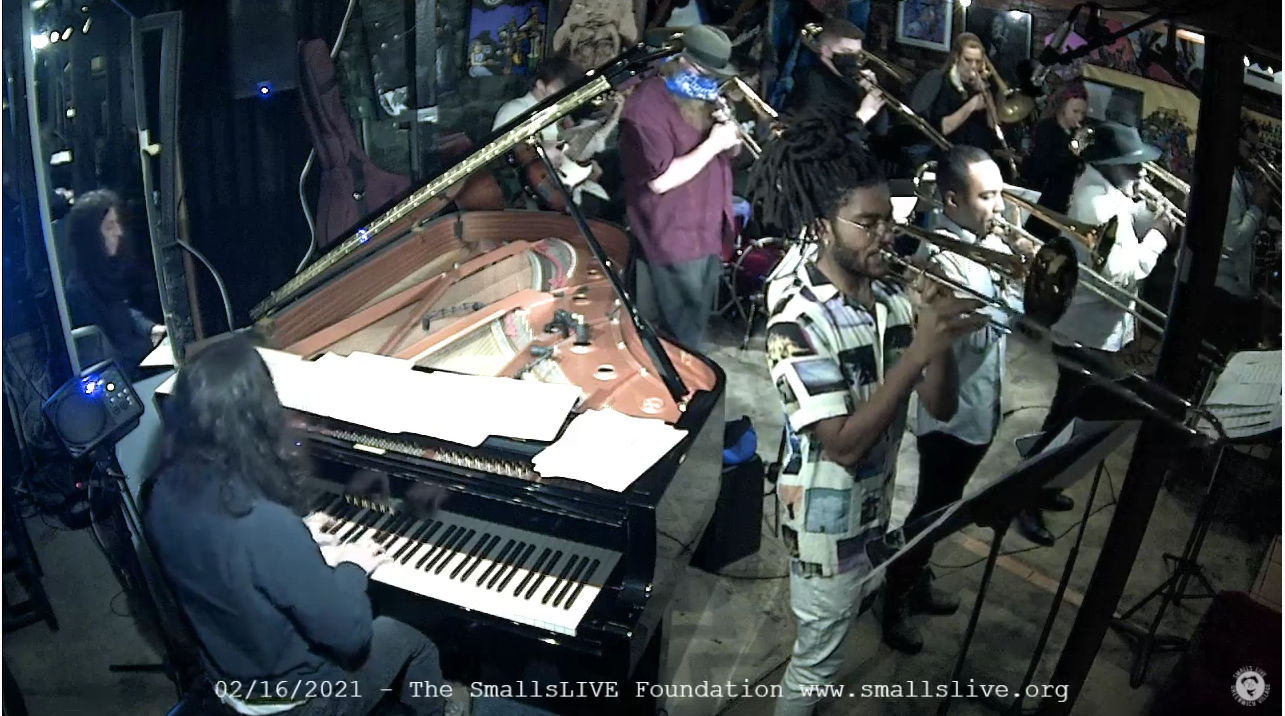
Great trombone player and bandleader Frank Lacy also has a reputation as a great teacher and encourager of young talent. For a vibrant Smalls set that brought tears to my eyes and made me dance around the room, he convened 8 fellow trombone players across the spectrum of experience – Corey Wilcox, Rashaan Salaam, Corey Wallace, Colman Hughes, Alevtina Wilcox, James Rodgers, Jacob Melsha, Maxine Troglauer – along with a sizzling rhythm section of Felix Moseholm on bass, Evan Sherman on drums, and Jon Elbaz on piano.
Appropriate for Fat Tuesday, that instrumentation soared through strutting New Orleans material with teeth like Ellis Marsalis’s “Nostalgic Expressions.” They also played with dynamics, harmonies like slow molasses seeping into a holy river then evaporating into colored smoke on a ballad original of Lacy’s. That ballad, with an insinuating, punchy bassline from Moseholm melted into one of the great ballads, Monk’s “Crepuscule for Nellie, with the horns capturing all that kaleidoscopic color, bouncing back and forth between dramatic punctuation and a silken waltz.
Probably my favorite – or at least most surprising – tune from the set was a funky dance take on Wayne Shorter’s “Palladium,” a highlight from the first Weather Report record I bought as a kid. Explosions of dive-bomb harmony with a thick, sultry bottom and a particularly smoking drum solo from Sherman which hinted at the Latin elements of the original without falling into cliches.
Livelabs: On Love by Mfoniso Udofia presented by MCC Theater
I saw a reading of Mfoniso Udofia’s In Old Age in a Chelsea rehearsal space as part of a Page 73 reading series. I’ve never been so glad I made one choice over the carnival ride multiplicity of delights on a New York City afternoon; within five minutes, I knew this is one of the great voices of my time.
For all its troubles and difficulty, this enforced streaming age – at its best – makes these voices available to a wide range of people all at once. MCC’s Livelabs series does a great job bringing new work at affordable prices through its youtube channel. I got reacquainted with Udofia’s crackling writing with its layered depth of feeling via On Love, expertly directed by Awoye Timbo.
These vignettes turned the prism of love around and played with different refracted light, between Eros and Agape, from Ludus to Mania, exposing the very different impressions these loves leave and how thin the barriers between them are. With a crackling cast spanning superstars like Keith David to Broadway heroes like Anastacia McClesky and rising Off-Broadway mavens Antwayn Hopper, everyone delivered.
Using perfectly carved moments. On Love opened us to these characters hinted at whole worlds and lives. There wasn’t a person I met for these few minutes I didn’t want to know for a full-length play. I want to see every person in this – especially those new to me – in something else. And more than anything else, this made me hungry for more of Udofia’s writing.
Tim Easton, taken from stream and edited
Tim Easton – The Truth About Us 20th Anniversary
In early 2001, Columbus’s treasured son Tim Easton made his entrance onto a wider national stage with his second solo album, The Truth About Us. For this debut with ascendent alt.country label New West Records, Tim Easton recruited an all-star lineup, including producer Joe Chiccarelli (Lone Justice, Steve Wynn, Oingo Boingo) and the core of Wilco at the time (multi-instrumentalist Jay Bennett, bassist John Stirratt, and drummer Ken Coomer as the backing band.
Easton and Chiccarelli augmented that sturdy core with guests of the highest order – Mark Olson and Victoria Williams singing on one track, Petra Haden’s haunting violin, Bruce Kaphan’s pedal steel, Kat Maslich on vocals, and local confederates like Chris Burney (who’d been playing bass for him on the road and would soon lead underrated Warner Brothers rock act The Sun).
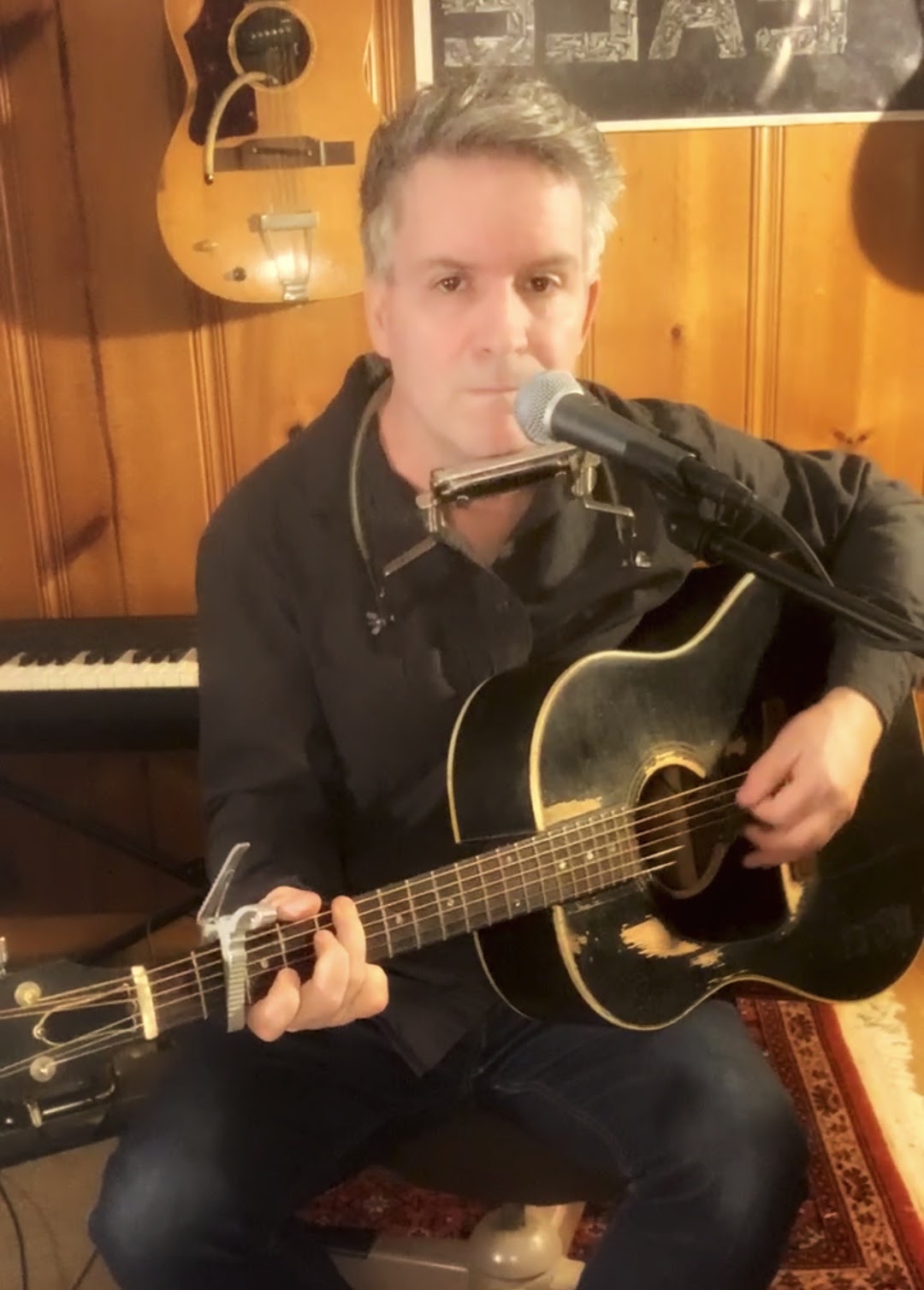
Like many songwriters, Easton uses this pandemic to webcast from his home – including trying out new songs and dialoguing with old friends like JP Olsen. Last week, in honor of its 20th anniversary, he revisited The Truth About Us from front to back. He peppered the set with reminisces about its making – including fond recollections of everyone who worked with him on it.
That hour and a half was a powerful nostalgia trip, remembering trudging through the snow to Little Brothers for the release show – great Cleveland band Rosavelt backing and opening for Easton – with my roommate at the time. It also reminded me how well the songs hold up two decades later.
At its best, The Truth About Us grapples with the very concept of truth and its value. Trying to understand people’s motivations, and his own, to get out of the writer’s own way, while also trying to find their place inside an “us.”
Around the time of this record, I saw many shows – frequently local – and listened to a lot of records with my friend Heather, now based solidly in LA. Easton’s deceptively easy-going manner and charm put her off, feeling like its truths weren’t as hard-fought as her favorite writers: “It’s all good, but it comes too easily to him.”
The one song she made an exception for was the second song on The Truth About Us: “Carry Me,” a plea for forgiveness and an accounting. The tune hides a knife in its gentleness: a catchy, fingerpicked lilt that drifts from “People love you like a diamond in their hand, but they don’t know that diamond like I do” through “It was selfish to think you’d be better off just ‘cause I wanted to be further along,” into “Here comes that old devil midnight and I have not slept in days.” Hearing him do this one again, with just that acoustic guitar, chilled my blood.
“Happy Now,” always one of my favorite hooks Easton wrote – in a period he wrote more jangling, haunt-your-sleep choruses than anyone else in town – reasserted a psychological weight I didn’t give it credit for at the time. I’d never seen a Rauschenberg combine when I heard that song, and I’d barely graced the surface of cut-ups as a form, so the accretion of collaged emotional details took me a while. Stripped from the Byrds chime of the guitar and the grooving Kinksish organ on the record, the depth of feeling hit harder.
Verses paint people in crisis, a tattoo parlor owner’s wife screaming at him, “You’re ruining me somehow”; a man jumping a roof to find the same callous disregard in death – “He wanted them to miss him, that was part of the plan, but nobody ever even gave a damn. Are you happy now? They were laughing as you went down;” a woman in her front yard praying with the prayers answered by, “Nobody knew what to do or what to say; the traffic light changed, and we just drove away.” s the chorus taunting “Are you happy now” with the sinking suspicion the narrator’s turning on himself.
The obsessive ramble that always recalled Elizabeth Bishop to me, “I Would Have Married You,” retained its keening, searching power in this format. Easton rightly called out the magnificence of Petra Haden’s violin – this was the first I’d heard of her, and her playing drove me to pick up my first That Dog record – Maslich’s harmonies and Kaphan’s moaning steel.
Easton’s affection for people and memory for detail is the not-so-secret engine that’s powered his career and created the longevity he enjoys. This evening was a reminder of that joy, as much as the record is. Nowhere does that manifest more than in his long-running friendship with JP Olsen. The two songs on The Truth About Us not penned by Easton come from Olsen: “Bad Florida,” a standout on my sleeper pick for best Columbus album, Burn Barrel’s Reviled!, and last-call promise from Olsen’s band The Beetkeepers, “Don’t Walk Alone.” The latter closes the record and imbues Olsen’s razor-sharp words and sly melody with a greater earnestness as he bolsters the anthemic qualities of the chorus with surging backing vocals and my favorite Haden string parts here. That anthem recast clings to his arrangement, even with the elements stripped away.
This is still viewable on Tim Easton’s official Facebook page.
I unabashedly want every venue to make it through to the other side of this. I want the places in my neighborhood that are clubhouses for other musicians, for loudmouths like me, where I’m likely to randomly stop in and discover something thrilling, like Dick’s Den and Ace of Cups to still welcome us all with a heavy pour and friendly faces. I want the places that make me feel old and bring stuff that’s setting kids’ hair on fire to keep giving us all hell – Cafe Bourbon Street, No Place Gallery (give to their fundraiser to relocate), all the house shows.
But it’s no secret there’s a special place in my heart for the Natalie’s family, Natalie and Charlie Jackson, but also their fantastic staff. As soon as they opened the first location in Worthington, this was a model of venue we just didn’t have in Columbus: the closest comparisons were to City Winery (at the time only in NYC) or the Jazz Standard, where sound and the listening environment were given the same kind of care as excellent food and service.
And within six months, it became apparent we were on the roadmap of acts that hadn’t come to town since Dan Dougan’s Little Brothers closed: Big Sandy, Robbie Fulks, Scott Miller, Barrence Whitfield. Artists raved about it to other people. Soon, they established synchronicity with another booker I’ve talked about as the only reason Columbus is such a strong market for the kind of storytelling roots music I love: Alec Wightman and his Zeppelin Productions.
I’d follow what Wightman books anywhere, and I have, through the uncomfortably tight Columbus Music Hall to the booming Mannerchor, dancing with ghosts in the Valleydale Ballroom, all some of the best shows I’ve seen anywhere, in any city. But there was a unique and comfortable magic when he started bringing things to Natalie’s, even when I had to be on my game to ensure I wasn’t shut out of a seat.
Natalie’s was also hit harder than many venues because the pandemic came only a few months after they expanded into a second, larger, more flexible location. And while there were a few new-venue jitters, seeing a Zeppelin show – Chuck Prophet solo acoustic – early in 2020 made me hungry to watch this venue grow into the same kind of love I have for their Worthington room.
The pivot to live streams has been well-done in this climate, keeping the high sound and production values standards we know and love from their venues. And it speaks to the sterling reputation of both booker and room that Zeppelin assembled a who’s who of towering figures in roots rock and Americana to donate a short video to help out Natalie’s.
These songs usually came accompanied with sweet words about the space. Many artists – including Tom Russell, who started Alec Wightman booking shows – brought brand new work. Artists did huge hits: Kevin Welch with a song he wrote for Chris Stapleton in a stripped-down, tough, and lovely version. Artists known for their high energy rocking, like Sarah Borges and Rosie Flores, brought more nuanced, shaded sides of their personae.
A couple of artists brought gleeful, surprising covers. Chuck Prophet and Stephanie Finch did “The Little Black Egg,” known to most music fans for its inclusion on Nuggets but with extra resonance as Ohio was one of the few markets it was a real hit. Ward Hayden and the Outliers romped through a joyful, winking version of Ernest Tubb’s “Thanks a Lot.”
And it’s maybe not surprising the performance reverberating in my bones a couple days later as I write this was by Bruce Robison and Kelly Willis. They did Robison’s song “Lifeline” off their first duo record, Cheaters’ Game.
Bruce Robison and Kelly Willis, taken from stream and edited
As soon as I heard it, it was one of my favorite songs in a catalog packed with contenders. It’s prime Robison, a story song with enough left unsaid for magic to get in, about the ways we connect, like it or not – “There was a crackdown in the street tonight: the stars and the boys ended up in a fight. One step over the line, he says that his Daddy knows mine.” The ways we hunger to connect, “True love comes in the dark, by the rocks and the trees and the rocks in the dark.” The ways we fail to connect, studded with indelible images, “She used to curl up like the steam from a train.”
The taunting darkness as the last verse ends and the final chorus opens were what stuck with me, the tricky balancing act of hope as an act of survival. The way Robison and Willis sing “So damn hard to find…” with a delicate enjambment change the meaning into “Find you” then repeat “Find you” until the previous line almost falls away, getting louder and more powerful, no longer “Find a little lifeline but “Find you a little lifeline – a little bit of hope. In the deep, dark night, need a little bit of rope.” None of us can wholly save each other, and we can’t save ourselves alone, but we can all provide a little rope, in one way or another.
Thank you, Natalie and Charlie and Alec – and Bruce Robison and Kelly Willis and all the other artists – for reminding me of that. I hope my small contribution added to that hope.
From left: Joe Lovano, Tyshawn Sorey, Bill Frisell. Taken from stream and edited
Tyshawn Sorey/Joe Lovano/Bill Frisell at the Village Vanguard
I’ve waxed rhapsodic about the live streams coming from the legendary Vanguard before, but this weekend’s performance exceeded even my outsized expectations.
I discovered tenor saxophonist Joe Lovano and guitarist Bill Frisell when I was in High School, a solid 15 years into their active careers. They hit creative strides – Lovano on Blue Note Records and Frisell with Nonesuch, as leaders – that period. My burgeoning love for their work led me to the first time I ever heard the drummer Paul Motian: a trio record in this same location that came out a couple of years earlier when I was 15.
This trio date at the Vanguard links these two giants with one of the brightest lights in jazz and chamber music on drums. Tyshawn Sorey’s playing carries the torch of Motian along with a hundred other influences he distills into something fresh, astonishing, and unmistakable.
The same childhood friend who hipped me to Frisell, Mike Gamble, turned me onto Sorey right after college. I was an immense, drooling fan – anyone who’s read my work has seen him dot year-end lists in almost any year I managed to overlap an NYC trip with a performance of his: Fieldwork at the old Jazz Gallery with Gamble and our other High School buddy, poet Dave Gibbs; Paradoxical Frog at Cornelia Street; as a leader at the Vanguard.
This set vibrated with the spacious, organic magic that’s a trademark of these players. I frequently have a more challenging time paying attention to a live stream than being there in the room – too many distractions – this set had the opposite effect: I couldn’t pay attention to anything else except to write some notes down.
Moments that left my jaw agape, and me gasping came in torrents and also with the perfect, mesmerizing placement of a night’s sky full of stars. Sorey hitting three notes on the vibes, playing off Frisell’s comping, between some skittering, delicate and intense cymbal work, changed the whole texture of Lovano’s dark, lush melody. An unaccompanied Lovano rolling around a theme to amplify the right textures until the band comes in with a clatter and the tune turns into a tightrope knife dance.
A breathtaking set as good as I’ve ever seen anywhere, and something that makes me lucky for the few pleasures we have in these times, and so fortunate people make art despite it all.
Soul Rebels Brass Band, taken from stream and edited
Soul Rebels Brass Band featuring Roy Hargrove at Brooklyn Boowl, presented by FANS
FANS’ streaming arrangement with Brooklyn Bowl and jamband outlet Relix has given many of us the opportunity to see killing archival sets and throw some money at hurting bands and venues right now.
This 2015 end of a three-night run that paired New Orleans funk titans the Soul Rebels with trumpet master Hargrove was sticky, sweaty rapture. Nothing’s ever as good as being in a room with those slurred, fiery notes washing over a crowd that feels like one undulating body but the sound and videography here gave a hell of a taste.
Watching this, I flashed back to a visceral, burning memory of seeing Soul Rebels Brass band take the Newport to church opening for Trombone Shorty, on a December night, as they raged through tunes like Michael Jackson’s “Rock With You,” D’Angelo’s “Spanish Joint” and originals like “Turn It Up.”
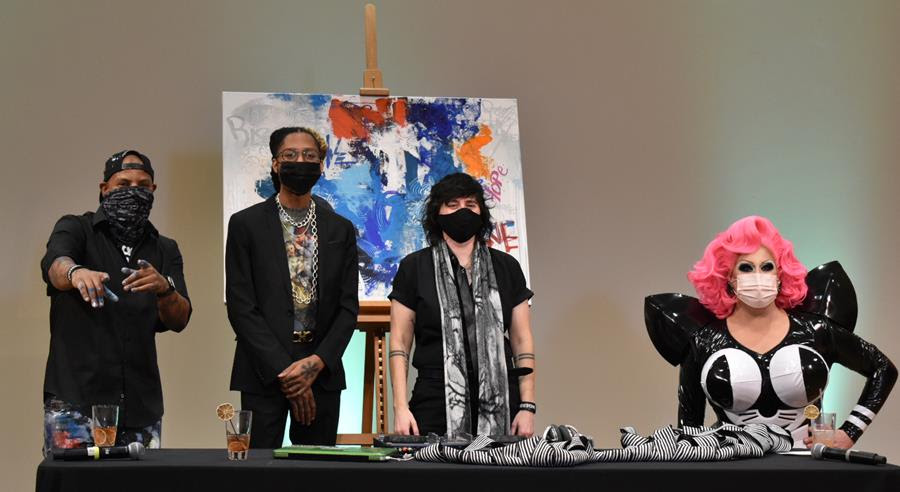
From left: Lance Johnson, Hakim Callwood, Moxy Martinez, and Nina West; promotional image provided by Columbus Museum of Art
Wonderball at the Columbus Museum of Art
For the last few years, Wonderball has been one of the best parties in town. The CMA is setting the standard for museum fundraisers with integration of the work in the galleries, multidisciplinary performances, and outreach to the various corners of the vibrant Columbus scene.
Their digital pivot this year, born of sad necessity, had the same homespun charm and brilliant execution of past years and I was overjoyed to watch it in the backyard of a couple good friends. Fantastic co-hosts Hakim Callwood and Nina West (in a jaw-dropping Felix The Cat Clock dress) kept the show running live with Lance Johnson doing a live painting and Moxy Martinez providing beats.
Mixing live and pre-recorded pieces, they treated us to a gorgeous poem by Cynthia Amoah. They filmed myriad genres of dance throughout the galleries including Amelia Gondara & Micaela Gonzalez, Griset Damas-Roche, and my favorite, Shades of Color with Donald Isom and Brianna Rhodes dancing a duet to Jason Moncrief’s flute playing in dialogue with one of my favorite Kehinde Wiley pieces.
As one of the friends we were in person with said, “An advantage of doing it this way is you can really watch a full performance. There’s no pressure to get out of people’s way to let them see or feeling like you have move on quickly so you don’t miss something else.” And it really was a great side effect of this change.
Many of the DJs who make Wonderball such a terrific party brought their A game. Trueskillz and Aloha spun a vibrant worldbeat set. Heatwave’s DJ Adam Scoppa and DJ Lady Sandoval tore through some classic soul 45s. Ty “Nordiq” Williams laid blissful, throbbing electronica on us.
Nothing is the same as when we can all be together but anything that lets us mark these important events while staying safe is to be applauded. Anything that does it with this kind of aplomb, grace, and sense of fun is a damn miracle.
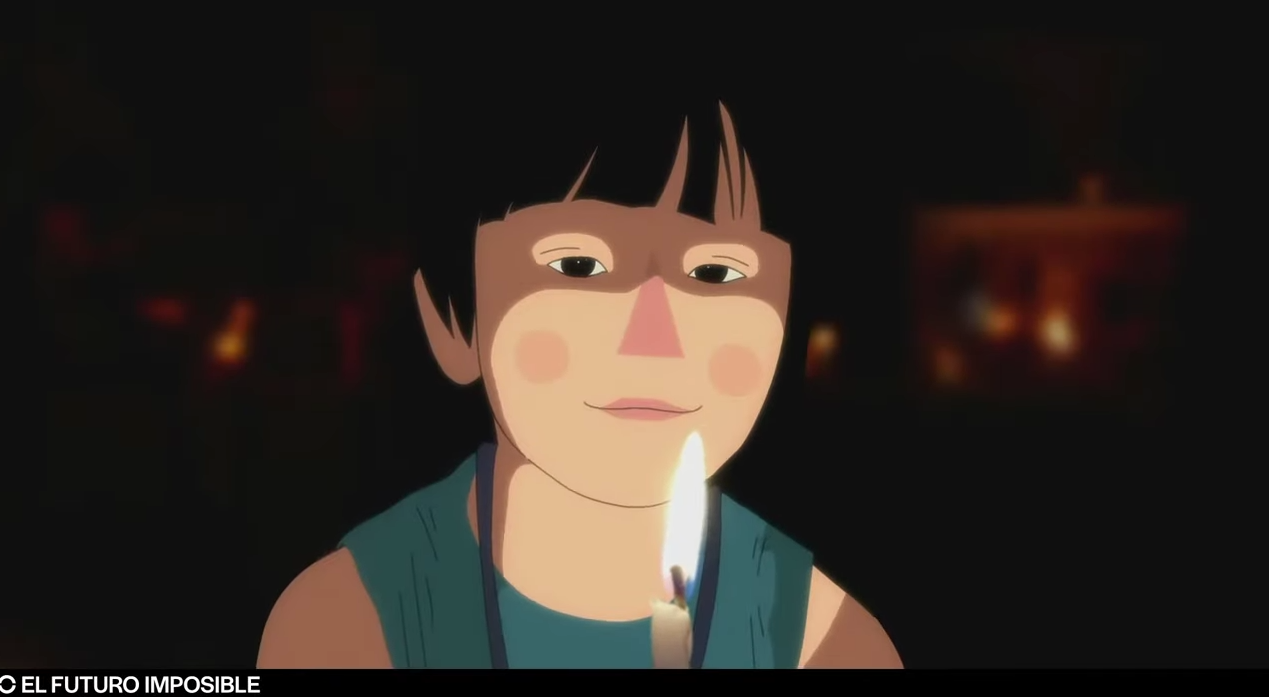
El Futuro Imposible, taken from stream of The World Around Summit 2021
The World Around Design Summit presented by the Guggenheim
One of my favorite things is hearing smart people take on the world, especially in a field I know very little about. The Guggenheim put together an international virtual festival of architecture and design and it made my heart soar to watch people actively engaged with where we are and where we’re going.
Lines from this sent me to my notebook and kept nagging at me throughout the weekend.
Alice Rawsthorn said, “By sharing constructive design issues on Design Emergency, we can persuade more people, decision-makers especially, to see design as we do: as a powerful tool to address social, political, economic, ecological challenges and to place it at the forefront of the post-pandemic reconstruction. Design isn’t a panacea for any of [our] challenges but it is one of our most powerful tools with which to tackle them if – and it’s a big if – it’s deployed intelligently, sensitively, and responsibly.”
That attitude that everything can be a tool to address the world and make things better for people with creative thought is something I try to carry with me and I’d never had it crystallized like so clearly.
I’ve thought about the Anthropocene a lot lately, it showed up in the Under The Radar pieces I wrote about a while ago, and Feral Atlas added fuel to the fire with “The great programs for the conquest of the Earth promised modern ease and happiness but in their inattention gave us a heap of terrifying, if unevenly spread disasters.”
How do we see things at the level of impact they are without crumbling into despair? I don’t know an answer but I know we have to. I’m still unpacking these three sessions and luckily they’re on Youtube indefinitely, another side benefit of all of us being stuck in our homes:
Back again! January’s always a pretty slow month but I found a lot to like. A mix of things that hit my radar as I read other people’s year end lists, advance singles of Spring records I’m salivating over, and a smattering of new records.
Blue Ridge from the Atlantic Theater Company website
Blue Ridge by Abby Rosebrock, directed by Taibi Magar, presented by Play Per View
Play Per View made their name earlier in the pandemic with some of the best Off-Broadway plays of the last few years, often reuniting their original casts. They scored another winner with Rosebrock’s Blue Ridge, assembling the stellar actors of the Obie-winning Atlantic Theater’s 2018 production for a Zoom reading.
Blue Ridge singed my damn eyebrows off. Marin Ireland’s Abby is a heartbreakingly relatable character – a portrait of someone getting in her way, so good at some things it lets her not acknowledge her toxicity radiating into the people around her. Whip-change moves underpinned by simultaneously a steely reserve and tragic desperation.
Under Magar’s direction, the rest of the cast crackles, with Kyle Beltran’s Wade, a fellow resident of the sober living house to which Abby was court-appointed, and Kristolyn Lloyd’s Cherie, Abby’s close friend and further along in her path to sobriety. Those two characters’ take the program’s lessons seriously, and their struggle is easier to relate to without the main character’s causticity. But Rosebrock is too canny a writer to let the audience rest in the easy moralistic dichotomy; everyone here is a person, and we’re all broken with varying degrees of self-awareness.
This pitch-black comedy set in the tip of Appalachia grapples with the difficulty of getting help and the often Sisyphean task of getting better, of treating your fellow humans with the love it’s hard to even see ourselves as deserving.
Questlove 50th Promo Picture from Youtube
Questlove’s 50th Birthday Stream
I was delighted to take a breath on January 20th for the Biden and Harris inauguration, and both Garth Brooks’ a capella “Amazing Grace” and Amanda Gorman’s stirring poem moved me. But when work ended and the night rolled around, the celebration I wanted to partake in from my couch – the closest representation of America I want, I have to choose, to believe in – was a celebratory birthday takeover of a scheduled Ahmir “Questlove” Thompson broadcast on The Roots’ YouTube channel.
Questlove’s been the heart and engine of some of my favorite music of all time. Without question, he was among the driving forces of most of my favorite music of college and immediately after. I’m in the middle of my third re-read of Creative Quest, trying to kickstart my brain out of a winter slump. His DJing is also rightly legendary – anyone watching him rock a massive crowd at Brooklyn Bowl knows we’re in the presence of someone hitting an apex of that form.
In the five or so hours of #Questo50 Anne and I were lucky to see a tribute to Questlove’s wide-ranging network of friends and influences on both sides. And each DJ – without trying too hard, they frequently overlapped a song or two – took up a distinct space. They treated that evening as a great party, even if we were all in our own houses. The latter also presented a heavier version of the usual Wednesday night problem: no waiting for champagne and whiskey that have already been paid for.
DJ Rashida’s infectious set played a greatest hits of Questlove’s work – classic The Roots, Erykah Badu, D’Angelo, Common – and his compatriots Q-Tip and Dilla. She served a burst of the best parts of memory, dancing to those songs in clubs and basements, probably not surprising since she’s within a month of my age.
DJ Sasara from Tokyo spoke to his international presence and the flow of ideas. She worked local floor-fillers like DJ Kawasaki into smooth ‘70s soul and hard-driving Colombian and Brazillian tunes. Stones Throw general Peanut Butter Wolf worked with the record nerd side. Having picked a crate of 45s he thought Questlove would enjoy, he chose them at random, delighting in the sensual, sometimes incongruity of the way they sparked against each other.
DJ Tara was that modern East Coast party, smoothly and seamlessly beat-matched and the perfect mix of stuff I already knew and loved and great surprises that all made me want to move. And the headliner, as only seems right, was Philly giant DJ Jazzy Jeff.
Like a real club night or warehouse party, I wanted to check in and still have a full night’s sleep for work. I couldn’t turn away – I was happily hooked on this until 1:00 am.
Immanuel Wilkins Quartet, from left Kris Davis, Daryl Johns, Immanuel Wilkins, Kewku Sumbry; taken from stream and edited
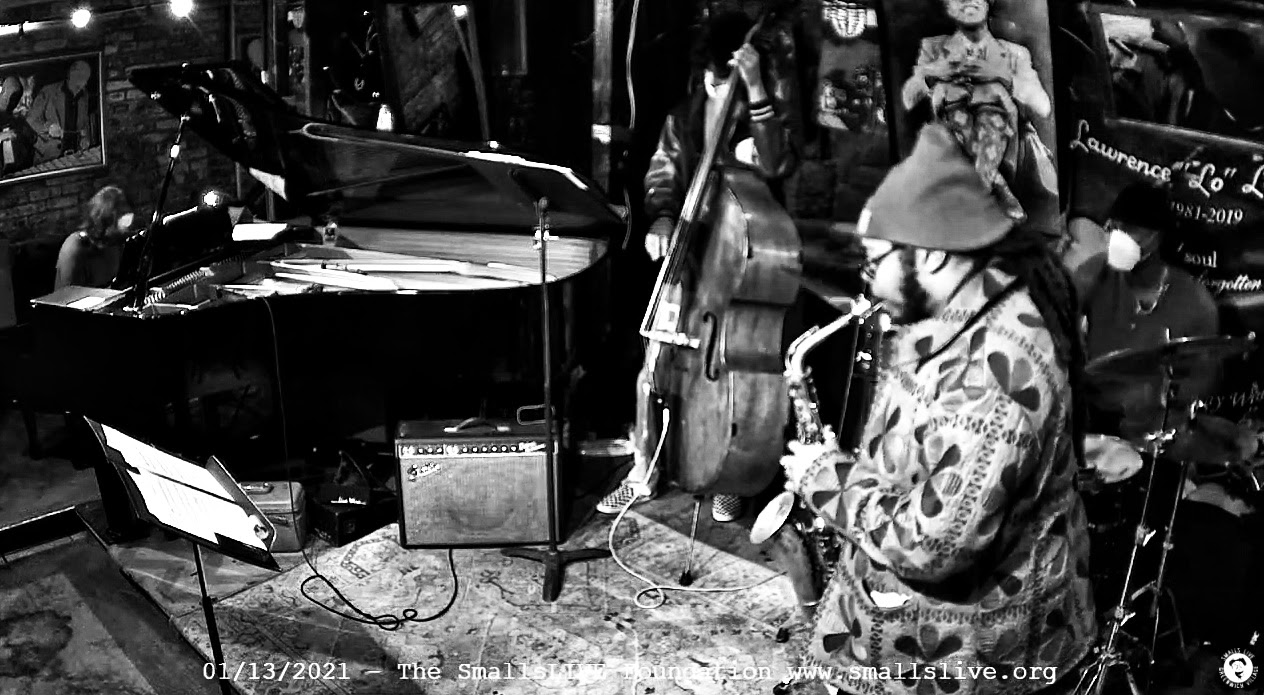
Immanuel Wilkins Quartet at Smalls
I mentioned APAP in last week’s writeup. Generally, in one of these years when I’d be in New York for mid-January, soaking up the remnants of arts presenters’ bounties, I’d be catching between 6 and 20 sets over a few days of Winter Jazz Fest. WJF’s excellent pivot of panels and performances is going on through March, but I caught a few streams that gave me some of that feeling.
The set that gave me the heftiest dose of that energy came from a stalwart of the classic NYC clubs and at the vanguard of this new digital era, Smalls. Immanuel Wilkins (also a standout on Joel Ross’ astonishing record last year) and one of our finest alto players, lead a striking quartet with Kris Davis (who closed out my previous New York trip with an explosion) on piano, Daryl Johns on bass, and Kweku Sumbry on drums.
The group wove together songs into unbroken suites, building landscapes and shifting them. Simmering, glistening ballads jostled with ecstatic classic fire music. Long, screeching cries curled like smoke into gorgeous melodies. Textures played out and expanded, then splintered and came together.
This set was everything I want from a band coming out of the jazz tradition. It made me miss New York, it made me miss walking down to Dick’s Den on a good night, and it made me miss being in the room; at the same time, it reminded me how lucky I am to have this option.
From left: Vijay Iyer, Arooj Aftab, Shazad Ismaily; taken from stream and edited
Love in Exile at Jazz Gallery
Jazz Gallery continues to present a wealth of fascinating programming in its streaming iteration and I was enthralled by their trio this week of pianist Vijay Iyer, multi-instrumentalist Shazad Ismaily (both of whom I’ve seen many times) and vocalist Arooj Aftab whose name pricked my consciousness when she played a Big Ears but I’d never seen.
This was an astonishing, glowing hour of music. Mostly working in these slow, unfolding oceanic tempos, the trio displayed an uncanny telepathy. On one piece, Iyer’s exploded flurries of his classic diamond hard-and-glistening attack into spaces left by Aftab’s silky melodies and Ismaily’s circular, hypnotic bass. Another used that tempo to expand into a rich, cinematic, baroque ballad, riding accumulations into a majestic cascade.
Other pieces had Ismaily bringing in a droning keyboard tone to underpin a dual longing between Aftab and Iyer. Beautiful and beguiling.
Espíritu; shot taken from stream and edited
Espíritu at Under the Radar
Caught up on the rest of the previous week’s Under the Radar and my favorite piece, Espíritu, came from the Chilean company Teatro Anónimo and the pen of Trinidad González.
It focuses on – mostly young – people grappling with the deep sickness of ennui and hopelessness. As one character says early on, “We are just a group of useless people with a great plan to stop the destruction of the world.”
That plan staggers and stumbles, people are wracked by cruelty and driven into impoverished fantasies that pass that cruelty on through jagged vignettes. Lines like “People yell at me and that makes them happy…Sometimes they think they’re making love but it’s something different from love. Do they dream?” and “If I were your father I’d burn that notebook and send you off to fight a war,” haunted me for days after seeing this.
If I were managing a company, I’d program a double bill of this with Matt Slaybaugh’s The Absurdity of Writing Poetry but there are probably dozens of plays about fighting despair with art, even, especially, when it feels hopeless, this would productively spark against. It made me miss UTR, made me miss NYC, and made me miss the theaters where I first loved work like this in the Wexner Center and at Available Light.









 Screen of Distance