Categories
"Hey, Fred!" dance theatre

Things I’ve Been Digging – 11/16/2020

Russan Troll Farm – From Upper Left, Haskell King, Ian Lassiter, Greg Keller, Danielle Slavick. Provided by TheatreWorks Hartford on their site.

Theater: Russian Troll Farm by Sarah Gancher, directed by Jared Mezzocchi and Elizabeth Williamson, presented by Theatreworks Hartford and TheatreSquared in association with The Civilians.

I still miss being in a theater, crammed around my fellow audience members, breathing as one, with an uncommon fire. But watching theatre artists – new jacks and veterans alike – mold today’s tools and limitations into beautiful things that feel like theater even split over different rooms. 

I saw one of my favorite examples of this 2020 alchemy this weekend. Long-standing champions of the new The Civilians teamed up with Fayetteville, Arkansas’ TheatreSquared, and Connecticut’s Theatreworks Hartford for a dazzling, incendiary romp through Sarah Gancher’s Russian Troll Farm.

Subtitled “A Workplace Comedy,” the play zooms in on a St Petersburg office to follow a team of trolls sowing discontent and confusion among Americans through Twitter. Former journalist Masha (Danielle Slavick) joins the established dynamic of laser-focused Egor (Haskell King), stunted throwback Steve (Ian Lassiter), and erstwhile artist Nikolai (Greg Keller), in the shadow of the manager: Soviet throwback Ljuba (Mia Katigbak). 

Gancher understands this low-level almost-tech job’s dynamics: the infighting, the jokes, the sourness, and sweetness. A vibrant scene of intense, flirtatious volleying between Slavick and Keller captures the adrenaline of being good at something, even something that feels both futile (from the inside) and evil (for those of us looking in), and Russian Troll Farm is littered with scenes this good. 

Gancher and her cast understand how similar the American and Russian psyches are but filter the characters through their environment’s specifics. Lassiter – recently very good in Gold’s uneven King Lear – has a ball playing the lusty, coarse Steve, bouncing off Slavick’s Masha and King’s brilliant, understated Egor. They create a world that feels like those little rooms for those of us who’ve done call center work or similar and makes us question how much of what we did for those hours and those years was just as morally questionable.

Directors Jared Mezzocchi and Elizabeth Williamson found ways to impose their stellar cast on one another with trickery that doesn’t lose its amateurish afterbirth completely but uses the seams we can see to its advantage. When Katigbak, in a heartbreaking soliloquy, says, “Are you even here? You’re the relic of a dying empire, the ghost of a glorious future that never came,” it snaps into sharp focus that we’ve been seeing ghosts all this time.

Russian Troll Farm was a triumph I’ll be thinking about for a very long time.

Bill Chats: Screenshot taken from livestream

Talk: Bill Chats – The Future is Present: A Casting The Vote Project. Bill T. Jones in conversation with Charlotte Brathwaite, Janani Balasubramanian, Justin Hicks, and Sunder Ganglani.

Bill T. Jones, through his New York Live Arts in association with Bard University, hosted a delightful, recharging conversation with four of the people behind The Future Is Present, a group running workshops at the intersection of performance and collective action.

It’s invigorating watching these ideas of what an artist means or even can mean bounce between people of color who came up in wildly different scenes, at different levels of outward acclaim and success. Jones said, “When I started in the art world, they said, ‘You wanna make art, make art. You want to do politics, do politics.’ And I thought the we was political…Trying to get to a ‘we’, many artists head for the door when that happens. An artist is trying to close the gap between this internal space here and the rest of the universe, and an artist finds a language, a form that lets them do that.”

That resonated deeply with me, who grew up steeped in the kind of late modernism Jones helped define before me, but I was enraptured by the way the younger people he’s talking to centered other people in the lens of their own languages. For instance, Justin Hicks said, “Even transcribing what [young people] want changed the ‘we’. I know lots of artists who don’t trouble themselves with the questions I do,” and “The concept of potential is much more important to us than certainty.”

After Jones posted the question “What are your dreams” to the panel, Sunder Ganglani said, “It’s not easy to imagine one’s self into a world in which you want to live. We have hopes, though,” and Janani Balasubramanian riposted, “You asked that question about certainty – I don’t think this project hinges on certainty, it’s actually present with discomfort, difficulty, and experimentation which is being cleared away in our society, through science, through catastrophe, through violence. In that space of clearing is a process of collective experimentation: sometimes difficult, sometimes joyful, sometimes both. I want to get to a place where people can verb it. Can ‘future’.”

Watching this clear-eyed group articulate a future worth fighting for and creating, while acknowledging the ambiguity it comes with, gave me more hope than anything I’ve seen, read, or heard, in quite a while. As Balasubramanian said, “Future making is about speculation but also about closing that gap between what’s speculative and what’s material – if we’re demanding something of the future, we’re demanding it of the present…Young people don’t need our encouragement for world-building.”
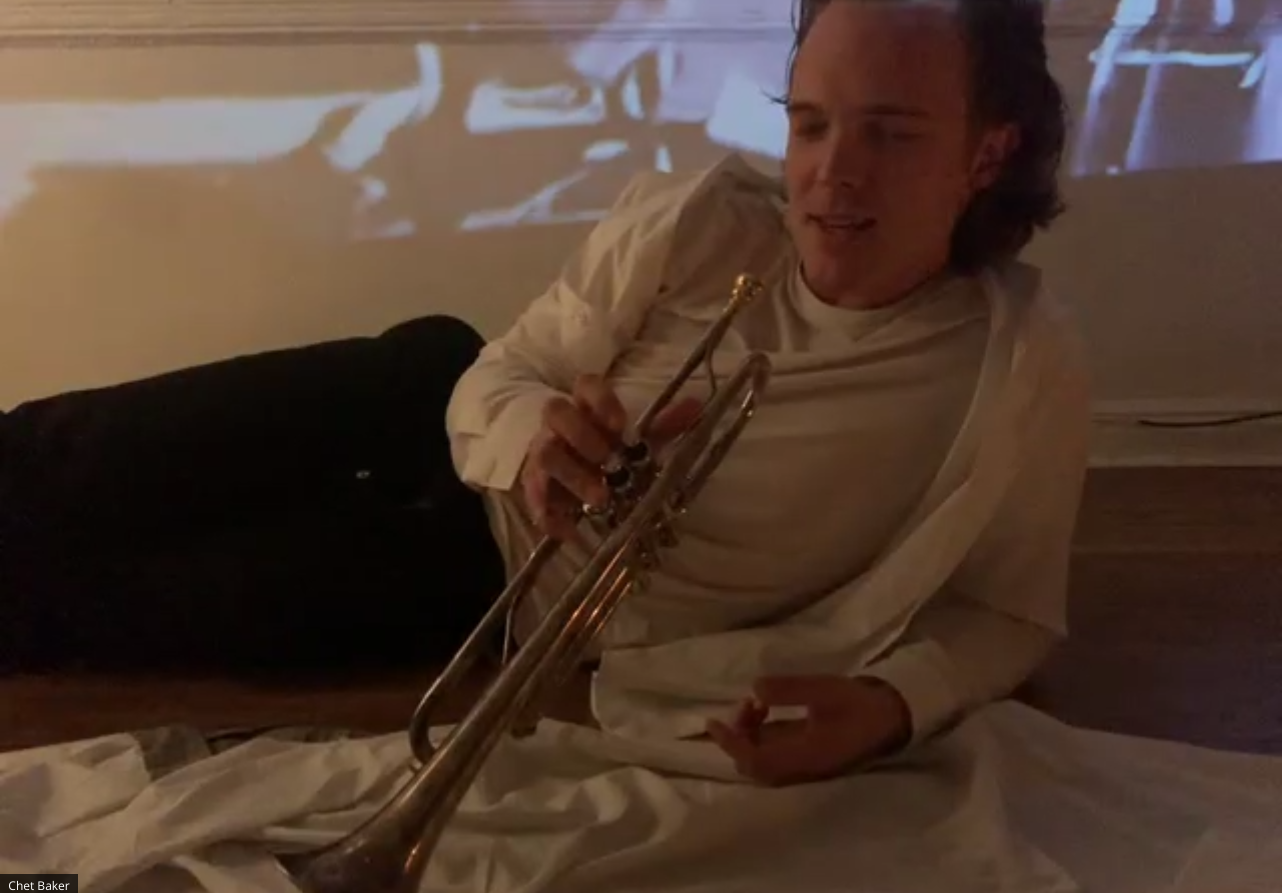
Theater: The Self-Combustion of a 30-Something-Year-Old Chet or, Icarus Tries to Catch the Sun by Keenan Tyler Oliphant, presented by New Ohio Theatre

Oliphant uses the raw material we all know about beautiful and damned Chet Baker and gives it new, molten life with Nicholas McGovern as the seductive wreck in a tiny apartment, old film clips playing on the wall like memories written on skin.

McGovern brings this his utter, unshakable commitment in the life Baker committed himself to, his ability to see magic where it confronted him – a gorgeous reverie about Charlie Parker “rising above us on corrupted wings,” snatches of songs – and his role as a self-identified truth-teller. His Baker is deep in the throes of “poetic self-destruction,” there to “remind [the audience] what it’s like to be awake.”

Somehow, in the crucible of this Zoom so intimate it’s like we’re eavesdropping these words distill into a hard crystal as the liquid boils off and they snap with the hard, sweet rhythm they need – with invaluable assistance from Jacob Robinson’s sound design. The text grows so large and thin we can see through it to the desire behind the words we’ve all heard too many times; the desire that’s all that matters here.

In lesser hands, this raving, this disappearing-ink last testament, could have been laughable, a plywood cartoon. But here it felt like that perfect tune on the jukebox as you order that one last drink you know you shouldn’t have.
Categories
"Hey, Fred!" books dance live music

Things I’ve Been Digging – 10/05/2020

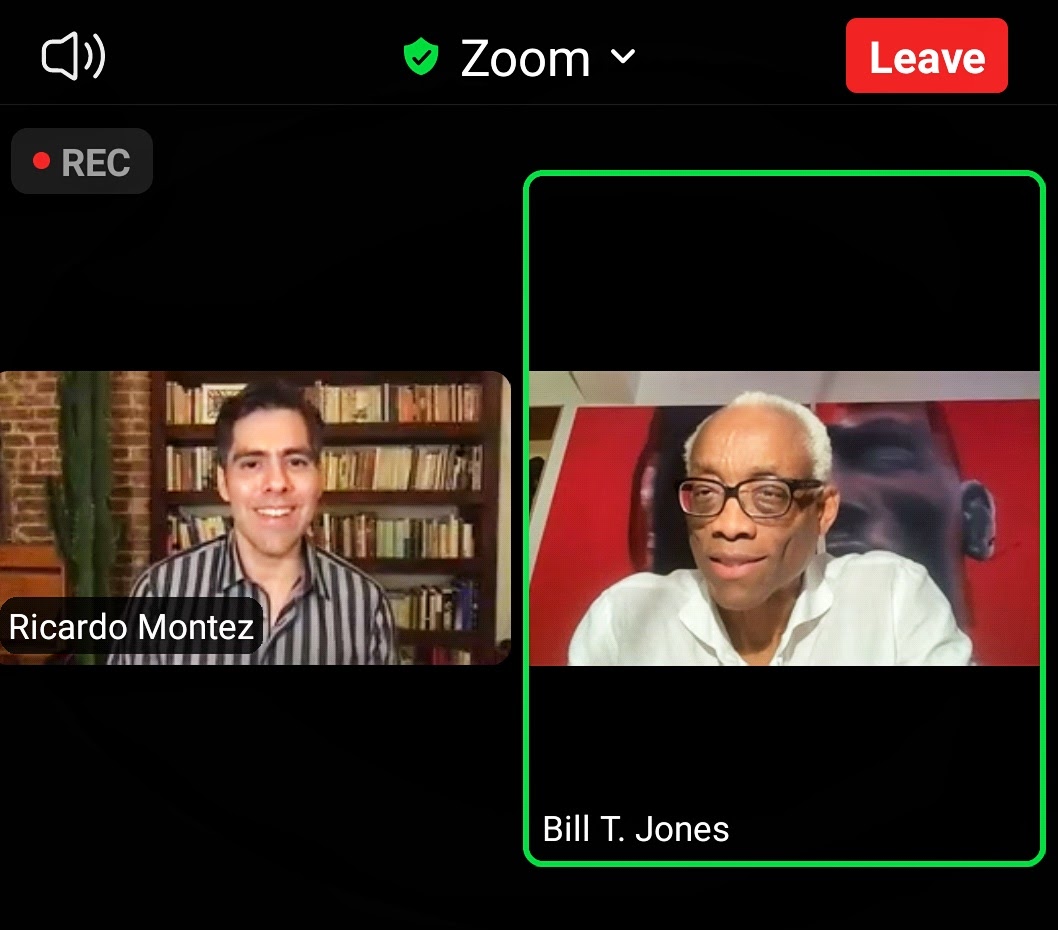
Talk: Virtual Bodies: Bill Chats – Ricardo Montez, Bill T. Jones in Conversation with Ricardo Montez, moderated by Joshua Lubin-Levy

I’ve been trying to stir in some more talks and workshops into the weekly diet of internet consumption, the same way I try to keep a rotation of weightier books and comfort food books. I struck gold this week with a conversation between the choreographer/organizer Bill T. Jones and professor/writer Ricardo Montez, sparked by Montez’s new book Keith Haring’s Line: Race and the Performance of Desire.

Jones’ early work is inextricably tied to the vibrant early ‘80s New York downtown milieu that captivated my peer group 15-20 years later and still feels fresh, striking, and full of life. Particular attention often focuses on Jones’ collaboration with his friend, the painter Keith Haring – the famous photo of Haring painting Jones’ nude body adorns the cover of Montez’s study.

Their conversation ranged from the intersection of race with abstraction, Jones reminiscing about the small number of black artists playing at The Kitchen in that era (“George Lewis, Douglas Ewart, maybe Bebe [Miller]”), and the need for irreverence and engaging with your own time.

Jones balancing his role as an elder statesman and a survivor, a witness, always inspires. Reflecting on his transition into his current roles and what keeps him motivated, he mused, “Do you still believe in beauty, Bill?” and sang a snatch of the standard, “Have I Stayed Too Long At The Fair,” his famous collaborator/companion/muse Arnie Zane’s favorite song.

There were so many lines here that struck me like a molten nail into grey flesh. Of the iconic cover image, he said, “Do I have the guts to do anything like that anymore? Can I be generous like that?” Jones described his goal as “How can I find the fervor of my Mother’s prayers in formalism?” And the thing I’m thinking about nailing like a thesis above my writing desk, his provocation to Montez, “Artists should always be in the face of academia saying, ‘You think you can capture this butterfly?’

John Hiatt and Lilly Hiatt, taken from the livestream and edited

Music: John and Lilly Hiatt, presented by Topeka

John Hiatt and his daughter Lilly have crafted catalogues of songs that dig as deep into the joy of connections and the reason we live as anyone else I can think of. Joy and pain aren’t discrete objects and neither are community and self for either of them. Hiatt’s career, at least since his ‘80s comeback Bring The Family is littered with gems, songs that make people want to sing (I promise, if your town has a bar with music back, someone is covering “Memphis in the Meantime” right this second). 

And especially with her last two records, Lilly is keeping him on his toes. As John said in this stream, “She just writes these amazing songs that make me try to keep up.” Their easy camaraderie, affection, and respect made this livestream deeply comfortable and exciting at the same time; that layer of familial affection didn’t create tension, but it also didn’t smooth out this classic guitar-pull style show.

Songs aren’t mirrors and they aren’t autobiography but it’s hard for a fan to not read a little of that even for those of us who are text essentialists. In that spirit, the father and daughter – who have been open about their struggles – singing together on two of the finest songs ever written about recovery moved me deeply. Lilly’s “Walking Proof,” the title track of her beautiful new album, had John’s authoritative and sweet growl rise to join hers on the chorus’s plea for acceptance and connection: “I could tell you that it’s easy but that wouldn’t be the truth; If you ever need to call me, well, you know there’s walking proof.” 

Later in the set, John’s anthem to those same materials of life, “Through Your Hands” shot into the stratosphere with a light injection of Lilly’s wry harmony as they danced through “And you ask, ‘What am I not doing?’ She said, ‘Your voice cannot command. In time you will move mountains. It will come through your hands.’”

They each had eight songs in the main set, with a two-song encore. John closed with the closest he’s written to a standard, “Have a Little Faith in Me,” that still jerks tears free when I’m not expecting it. With all the connotations of thirty years in our hearts and being covered by so many people, that sets a standard for the other encore.

Lilly met that energy with “Imposter,” a slow-burn highlight from her breakthrough Trinity Lane about her famous father. I loved “Imposter” before it finished the very first time I played it and I’m still beguiled by its ferocious empathy and its delicate power, its rock-solid sense of perspective even through its whip-crack shifting. It accomplishes an impressionistic, all-angles-of-a-perspective feat that makes me think of “Famous Blue Raincoat;” it’s one of the great songs of the 21st century so far.

Music: Jose James with Taali at Le Poisson Rouge

I’m keeping my fingers crossed for every venue I love to make it through to the end of this and watching with interest as they create alternative models to live. Without being privy to the finances of these places, I’m most heartened by the subscription efforts, treating a venue a little like public radio until we can pack in and buy beer. 

The big one here is Smalls which shows up in this column regularly but with October 1st, another of my favorite venues, Le Poisson Rouge in lower Manhattan, launched LPR.tv with an exciting slate that goes a long way to capture their diverse, open-ears booking. Saturday, I caught jazz singer Jose James (who also had Harlem Stage release the archived recording of his dazzling tribute to Billie Holliday to Youtube this week) with an opening set by Taali.

Taali’s spacious and incisive synth and vocal sculptures captivated me. She roamed from her finely wrought originals – “I’ll Meet You” haunted me with its sliding descent through the hook “I will take you home,” – to well-chosen covers. The latter included a lovely Regina Spektor piece, a mesmerizing version of Leonard Cohen’s “Hey, That’s No Way to Say Goodbye” that sounded like melting ice slipping off scaffolding onto concrete and slipping away into fractal patterns and steam on its way to return to water, and a gorgeous multi-tracked vocal on a Jewish hymn she introduced as “The song my parents walked down the aisle to.”

James brought a crack band to that stage I love so much to celebrate a 10th anniversary reissue of his breakout sophomore record Blackmagic. “Code” featured crisp keys from Big Yuki and a burst of acidic guitar by Marcus Machado before he broke down the repeated line “Don’t forget what my name is,” with a jazz singer’s improvisational excitement, a slam poet’s sense of digging up everything a word means through repetition and a DJ’s Burroughs cut-up sense of rhythmic possibility. The rest of the record got the same careful treatment, slow-burn ballads and dancefloor smashes and intriguing riddles.