
Hotel Good Luck by Alejandro Ricaño, presented by Cherry and New Ohio Theater
I’ve liked New Ohio’s work for a long time – they’re always on the short list of companies I check for whenever I’m in New York – and they have taken their ethos of brand new work that simultaneously vibrates with the pulse of the avant-garde and packs a deep emotional punch and found a path to present that vital work in our distanced environment and sacrificing very little in translation.
The newest, striking example of this crucial work came in partnership with the Cherry Artists Collective. Hotel Good Luck, from acclaimed Mexican playwright Alejandro Ricaño, hit hard in a stream from an empty theater in Ithaca, with an empathetic translation by Jacqueline Bixler and directed by Samuel Buggeln.
Hotel Good Luck uses the vibration of that empty theater to braid the metaphors of parallel universes and the solitary DJ for maximum loneliness. Bobby (Seth Soulstein) hunches over his turntables, spraying patter into the void and spinning records like a French version of “My Generation” when he discovers a gateway into other universes.
The irrevocability of death is baked into the Minotaur’s maze Bobby runs, backed by haunting cello lines and the confounding guidance of his psychologist and quantum physicist Larry (Desmond Bratton, also composer of the original music he plays).
The work also teases the frustration of figuring out where in the world – which world – any of us belongs. As Bratton declaims, right as answers start to appear in front of our hero but without solidity, “You be a disc jockey without listeners and I’ll be a therapist without patients! There is no original universe, Bobby. There is a universe you belong to but I don’t know how you get back there.”
The two performances and Buggeln’s beguiling direction, creating enough space to drift through but always knowing when to focus, made this dazzling play sing.

Hymn by Lolita Chakrabarti, presented by Almeida Theater
My first – alas, so far only – trip to London made me fall in love with so much I expected to (The Tate Modern, The V&A, Southbank) and things that weren’t even on my radar before. Almeida is top of that latter list, a contemporary theater doing everything right, from the cafe to sightlines to starting on time to their selection of work.
Playwright Lolita Chakrabarti hit my radar through one of my favorite institutions, St Ann’s Warehouse in Brooklyn. In 2013, St Ann’s presented the American premiere of Red Velvet, based on the true story of Ira Eldridge, the first black American to play Othello on the West End, starring Chakrabarti’s husband Adrian Lester, fresh off a smoking-hot London run.
Rolling the dice on an actor I was a fan of and a presenter who’d never let me down, I was enraptured. Later, I saw and reviewed a very good production at Ohio State’s theater department, proving the play wasn’t reliant on just that symbiotic relationship between star and writer.
Almeida’s transitioned to virtual shows that pack almost the same punch as being in their theater and I was overjoyed to wake up in time to catch the new Chakrabarti play, Hymn, streamed at 10 am my time (3 pm in London), starring Adrian Lester as Gilbert, the only known son of a local dry cleaner and upstanding member of the community, and Danny Sapani as the half-brother he didn’t know he had until a notice of their father’s funeral brings their orbits into collision.
In a taut 90 minutes, Hymn delves into what family and friendship mean, and the tracks left by the enormous shadow of a charismatic and loved father. Those impressions hit the two men in different ways but confirm presence and absence can both be suffocating and everything we live through has to be navigated.
The piece is bookended – after a whiplash prologue of Benny (Sapani) at the end of his rope, roaring at a bartender – by two eulogies, each delivered by one brother. The struggle to sum up a life in a few well-chosen words reverberates through the acid-burned snapshots that string the rest of the play together.
Music strings together this sudden, late-life friendship, staring from Sapani’s righteous takes on an evocative “Lean On Me,” and a furious read of the ominous Temptations classic “Papa Was a Rolling Stone,” through ‘80s classics like Full Force’s “Alice, I Want You Just For Me,” “Rapper’s Delight,” and a big UK hit I had to look up, “Street Tuff” by Rebel MC and Double Trouble, even into an ironic twisting of “Gettin’ Jiggy With It.”
The script brilliantly lets the physicality of these two men imply whole lives we only see glimpses of and highlights how little we – especially men – know each other, how hard we have to dig. McIntyre (who also directed The Writer which I saw at Almeida) uses the sparse set to evoke space and time, melting the scenes together organically with almost imperceptible transitions until suddenly the transition is a crash.
Grappling with self-awareness sparks heartbreaking moments at the end of the play. A haunted Lester saying “It’s the silence that breaks your heart,” looking at a suit in plastic. Sapani, summoning all his strength, sums up his brother with “The pieces of your life you think are missing are not necessarily the right ones…Gil tried so hard to play his notes in the right order but there is no right order, is there?”
We all have to reckon with that lack of a right order to find any semblance of peace. Hymn knows the joy in trying to live, if we let ourselves, but never forgets how much work it requires.
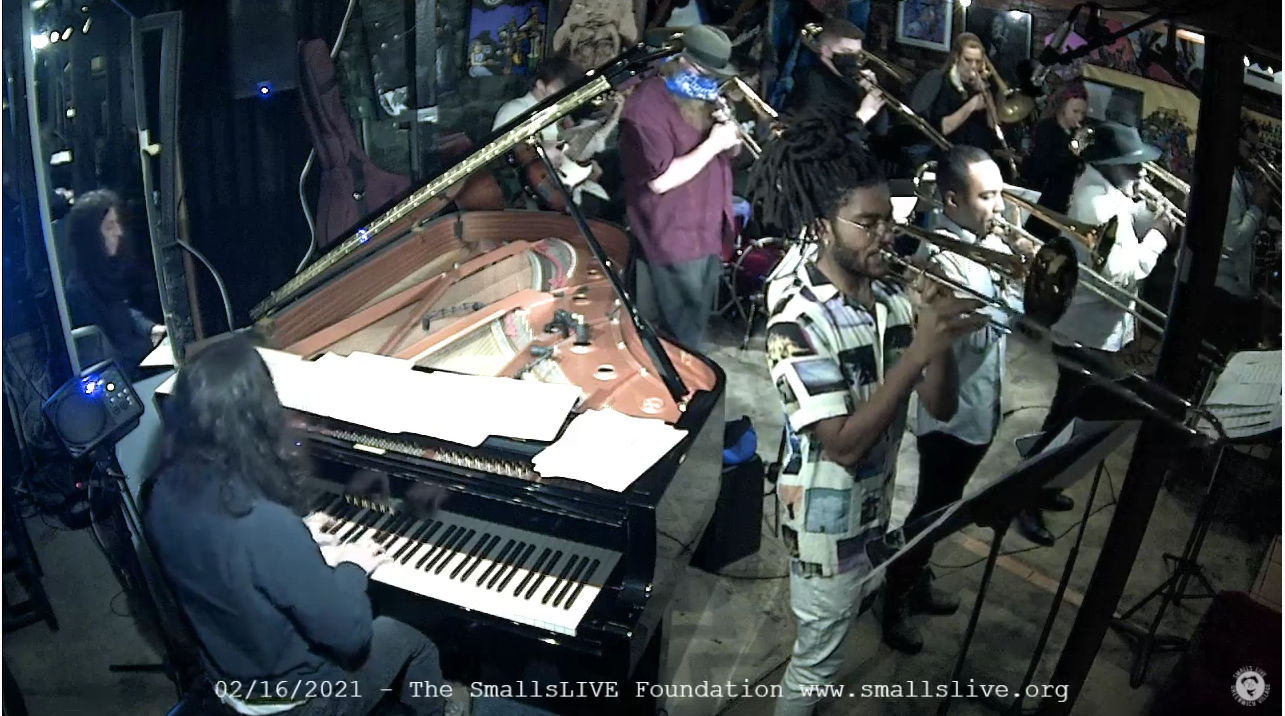
Frank Lacy’s Trombonivers at Smalls
One of the great things about Smalls in its public incarnation was – through their late-night jam sessions – they provided more public showing-your-ass stage time for young players than anywhere else in the current state of moneyed Manhattan, while still having the core house band be professional enough that if things went south it didn’t go on so long it drove the post-midnight crowd back up to 10th Street.
Great trombone player and bandleader Frank Lacy also has a reputation as a great teacher and encourager of young talent. For a vibrant Smalls set that brought tears to my eyes and made me dance around the room, he convened 8 fellow trombone players across the spectrum of experience – Corey Wilcox, Rashaan Salaam, Corey Wallace, Colman Hughes, Alevtina Wilcox, James Rodgers, Jacob Melsha, Maxine Troglauer – along with a sizzling rhythm section of Felix Moseholm on bass, Evan Sherman on drums, and Jon Elbaz on piano.
Appropriate for Fat Tuesday, that instrumentation soared through strutting New Orleans material with teeth like Ellis Marsalis’s “Nostalgic Expressions.” They also played with dynamics, harmonies like slow molasses seeping into a holy river then evaporating into colored smoke on a ballad original of Lacy’s. That ballad, with an insinuating, punchy bassline from Moseholm melted into one of the great ballads, Monk’s “Crepuscule for Nellie, with the horns capturing all that kaleidoscopic color, bouncing back and forth between dramatic punctuation and a silken waltz.
Probably my favorite – or at least most surprising – tune from the set was a funky dance take on Wayne Shorter’s “Palladium,” a highlight from the first Weather Report record I bought as a kid. Explosions of dive-bomb harmony with a thick, sultry bottom and a particularly smoking drum solo from Sherman which hinted at the Latin elements of the original without falling into cliches.
 Screen of Distance