
Theater: Russian Troll Farm by Sarah Gancher, directed by Jared Mezzocchi and Elizabeth Williamson, presented by Theatreworks Hartford and TheatreSquared in association with The Civilians.
I still miss being in a theater, crammed around my fellow audience members, breathing as one, with an uncommon fire. But watching theatre artists – new jacks and veterans alike – mold today’s tools and limitations into beautiful things that feel like theater even split over different rooms.
I saw one of my favorite examples of this 2020 alchemy this weekend. Long-standing champions of the new The Civilians teamed up with Fayetteville, Arkansas’ TheatreSquared, and Connecticut’s Theatreworks Hartford for a dazzling, incendiary romp through Sarah Gancher’s Russian Troll Farm.
Subtitled “A Workplace Comedy,” the play zooms in on a St Petersburg office to follow a team of trolls sowing discontent and confusion among Americans through Twitter. Former journalist Masha (Danielle Slavick) joins the established dynamic of laser-focused Egor (Haskell King), stunted throwback Steve (Ian Lassiter), and erstwhile artist Nikolai (Greg Keller), in the shadow of the manager: Soviet throwback Ljuba (Mia Katigbak).
Gancher understands this low-level almost-tech job’s dynamics: the infighting, the jokes, the sourness, and sweetness. A vibrant scene of intense, flirtatious volleying between Slavick and Keller captures the adrenaline of being good at something, even something that feels both futile (from the inside) and evil (for those of us looking in), and Russian Troll Farm is littered with scenes this good.
Gancher and her cast understand how similar the American and Russian psyches are but filter the characters through their environment’s specifics. Lassiter – recently very good in Gold’s uneven King Lear – has a ball playing the lusty, coarse Steve, bouncing off Slavick’s Masha and King’s brilliant, understated Egor. They create a world that feels like those little rooms for those of us who’ve done call center work or similar and makes us question how much of what we did for those hours and those years was just as morally questionable.
Directors Jared Mezzocchi and Elizabeth Williamson found ways to impose their stellar cast on one another with trickery that doesn’t lose its amateurish afterbirth completely but uses the seams we can see to its advantage. When Katigbak, in a heartbreaking soliloquy, says, “Are you even here? You’re the relic of a dying empire, the ghost of a glorious future that never came,” it snaps into sharp focus that we’ve been seeing ghosts all this time.
Russian Troll Farm was a triumph I’ll be thinking about for a very long time.

Talk: Bill Chats – The Future is Present: A Casting The Vote Project. Bill T. Jones in conversation with Charlotte Brathwaite, Janani Balasubramanian, Justin Hicks, and Sunder Ganglani.
Bill T. Jones, through his New York Live Arts in association with Bard University, hosted a delightful, recharging conversation with four of the people behind The Future Is Present, a group running workshops at the intersection of performance and collective action.
It’s invigorating watching these ideas of what an artist means or even can mean bounce between people of color who came up in wildly different scenes, at different levels of outward acclaim and success. Jones said, “When I started in the art world, they said, ‘You wanna make art, make art. You want to do politics, do politics.’ And I thought the we was political…Trying to get to a ‘we’, many artists head for the door when that happens. An artist is trying to close the gap between this internal space here and the rest of the universe, and an artist finds a language, a form that lets them do that.”
That resonated deeply with me, who grew up steeped in the kind of late modernism Jones helped define before me, but I was enraptured by the way the younger people he’s talking to centered other people in the lens of their own languages. For instance, Justin Hicks said, “Even transcribing what [young people] want changed the ‘we’. I know lots of artists who don’t trouble themselves with the questions I do,” and “The concept of potential is much more important to us than certainty.”
After Jones posted the question “What are your dreams” to the panel, Sunder Ganglani said, “It’s not easy to imagine one’s self into a world in which you want to live. We have hopes, though,” and Janani Balasubramanian riposted, “You asked that question about certainty – I don’t think this project hinges on certainty, it’s actually present with discomfort, difficulty, and experimentation which is being cleared away in our society, through science, through catastrophe, through violence. In that space of clearing is a process of collective experimentation: sometimes difficult, sometimes joyful, sometimes both. I want to get to a place where people can verb it. Can ‘future’.”
Watching this clear-eyed group articulate a future worth fighting for and creating, while acknowledging the ambiguity it comes with, gave me more hope than anything I’ve seen, read, or heard, in quite a while. As Balasubramanian said, “Future making is about speculation but also about closing that gap between what’s speculative and what’s material – if we’re demanding something of the future, we’re demanding it of the present…Young people don’t need our encouragement for world-building.”
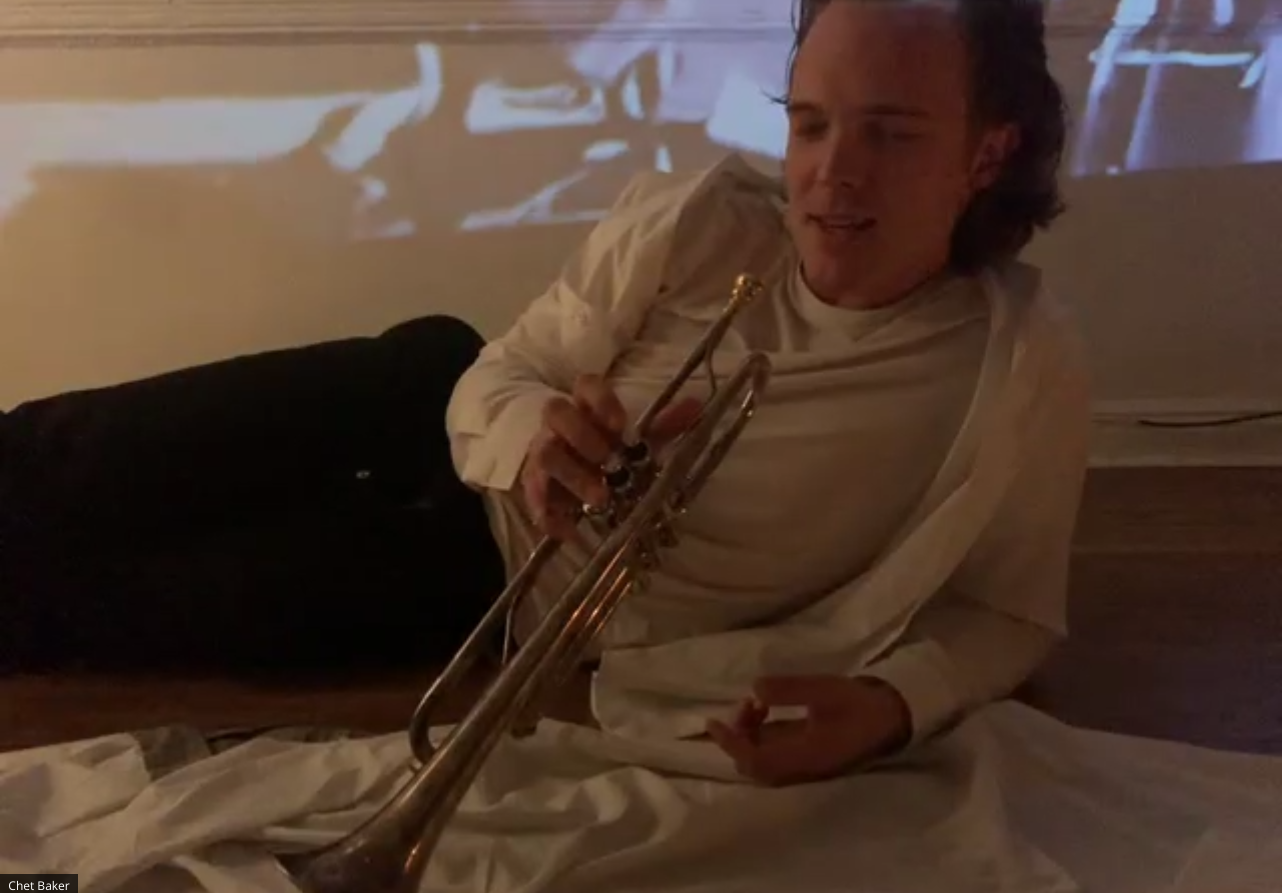
Theater: The Self-Combustion of a 30-Something-Year-Old Chet or, Icarus Tries to Catch the Sun by Keenan Tyler Oliphant, presented by New Ohio Theatre
Oliphant uses the raw material we all know about beautiful and damned Chet Baker and gives it new, molten life with Nicholas McGovern as the seductive wreck in a tiny apartment, old film clips playing on the wall like memories written on skin.
McGovern brings this his utter, unshakable commitment in the life Baker committed himself to, his ability to see magic where it confronted him – a gorgeous reverie about Charlie Parker “rising above us on corrupted wings,” snatches of songs – and his role as a self-identified truth-teller. His Baker is deep in the throes of “poetic self-destruction,” there to “remind [the audience] what it’s like to be awake.”
Somehow, in the crucible of this Zoom so intimate it’s like we’re eavesdropping these words distill into a hard crystal as the liquid boils off and they snap with the hard, sweet rhythm they need – with invaluable assistance from Jacob Robinson’s sound design. The text grows so large and thin we can see through it to the desire behind the words we’ve all heard too many times; the desire that’s all that matters here.
In lesser hands, this raving, this disappearing-ink last testament, could have been laughable, a plywood cartoon. But here it felt like that perfect tune on the jukebox as you order that one last drink you know you shouldn’t have.
 Screen of Distance