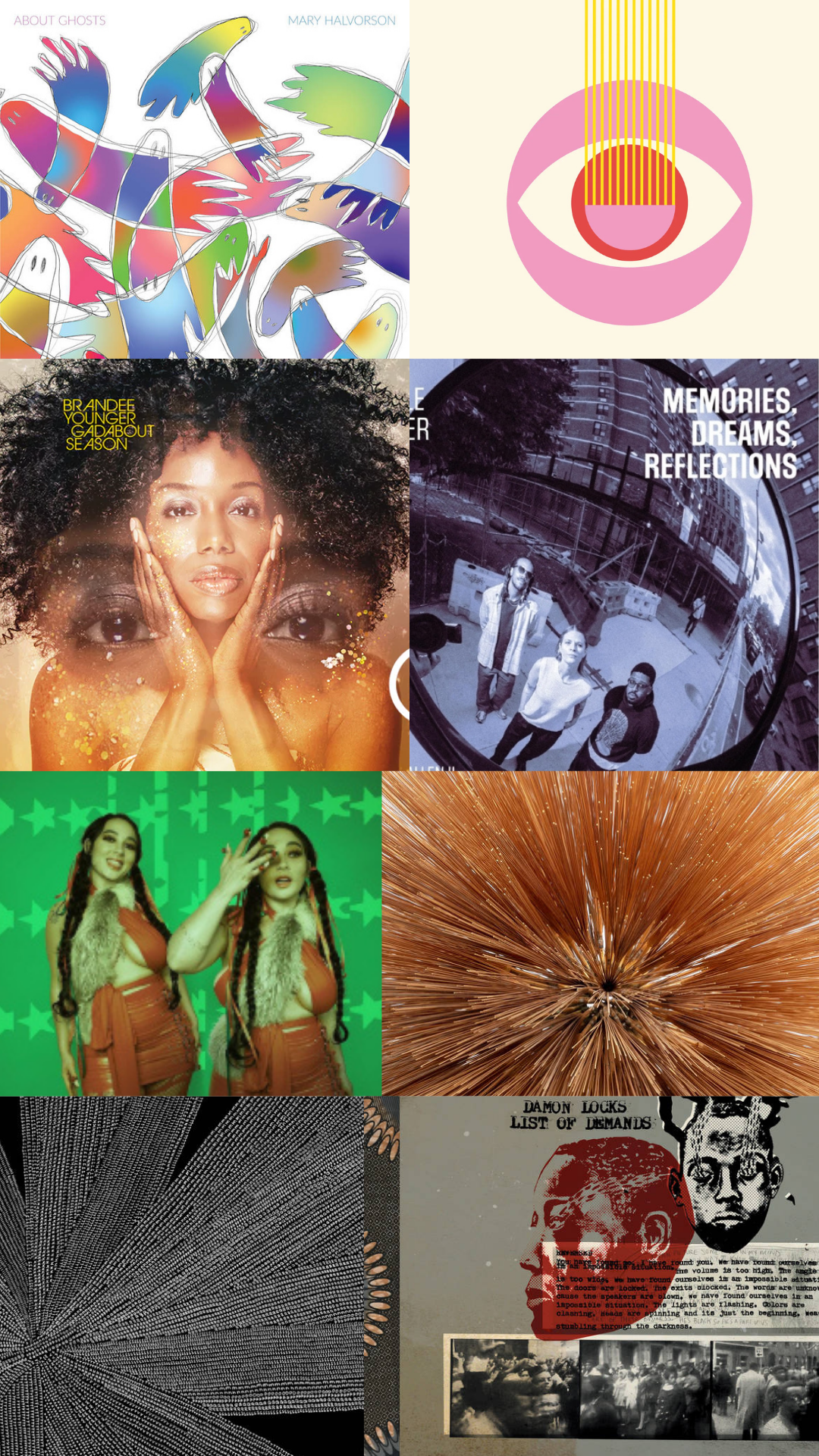
I started splitting playlists a few years ago, both to keep them from getting too unwieldy and to keep longer 15-20 minute tracks from discouraging people who were in it for more bite-sized material, without going full this-is-one-genre-and-this-is-another, which wasn’t much fun for me.
So much great material this year. The Spaces designation starts as mostly jazz, classical, and electronic, but I think of it as anything more sculptural, environmental, or exploratory. Obviously, there’s a lot of overlap – Antibalas, Damon Locks, William Tyler/Kieran Hebden’s Lyle Lovett cover, Moor Mother’s orchestral reworking of an earlier song, for example – would have definitely worked in the other list, but this was a by-feel process. These songs all felt right with the other songs on this playlist.
As usual, just used Tidal; my preferred transferring mechanism is Soundiiz, but there are several varieties. I hope there’s something you love here, and I hope you tell me what I missed:
https://tidal.com/playlist/0fcdcd21-2a4d-4bc0-b572-941e33f14238
- Antibalas, “Oasis” – Kicking off with some of my favorite grooves of the year. Antibalas’s lean, bubbling instrumental offering Hourglass immediately jumped to some of my favorite of their work, as much as I’d loved the lead vocals previously.
- James Brandon Lewis, “D.C. Got Pocket” – For his second record with Anti, James Brandon Lewis leaned into a muscular, sinewy trio with Chad Taylor on drums (who shows up on this list a few other times) and Josh Werner on bass (along with guest spots from Guilherme Monteiro on guitar and Stephane San Juan on percussion). This taut, funky track references the go-go sounds of Lewis’s hometown without being too obvious, and puts one of my favorite hooks of the year in the bell of his horn.
- Peter Gordon and Love of Life Orchestra, “Macho Music Danceteria” – Another raging fanfare and unstoppable groove, from a different scene. This archival record, LOLO80, is a potent reminder of the revelatory nature of Gordon’s work. Rhys Chatham called Gordon the first artist to pair rock-and-roll gestures with classical technique, and it still bangs. This tune specifically mentioned the gay underground of early ’80s New York and the intersection of glamor and grime at its famous Danceteria.
- Damon Locks, “Click” – Damon Locks’ first record under his own name in a minute is the kind of thoughtful, grimy collage music I don’t hear enough of anymore, done as well as I’ve ever heard it. This moody track is a highlight in a record full of highlights. “I stay tuned in, but the radio only plays a voice in the distance.”
- Makaya McCraven featuring Theon Cross and Ben LaMar Gay, “Strikes Again” – Continuing the Chicago flavor as we visit drummer-composer-producer McCraven’s return to International Anthem and his beat-tape-inspired roots on a series of stellar EPs. This tune, from Techno Logic, features waves of brass from Gay’s cornet and Cross’s tuba in an infectious late-night groove.
- William Basinski and Richard Chartier, “Aurora Terminalis (excerpt 1)” – I felt a commonality in the way sounds decay, vaporize into shifting atmospheres, in this gorgeous second collaboration between Basinski and Chartier with the McCraven above, along with a common affection for community, even in mourning.
- Rob Mazurek, “Papaya Fruit” – Mazurek’s solo synth excursions on Nestor’s Nest intrigued and beguiled me throughout the year.
- Sir Simon Rattle and the London Symphony Orchestra, “Four Walt Whitman Songs, No. 1: ‘Beat! Beat! Drums!'” – Of the many ways I am a simple man: about all you have to do is put Kurt Weill’s name on your record, and I’m giving it a concerted listen. But the collision of talent here, conductor Rattle with the LSO and baritone Ross Ramgobin taking lead vocals, made these definitive versions for me.
- John Zorn and the Mary Halvorson Quartet, “Bagatelle #82” – There’s something that reminds me of Weill in Zorn’s classical/chamber writing I find intoxicating, and this set of his Bagatelles performed by the Mary Halvorson Quartet was a match made in heaven.
- Julia Hülsmann Quartet, “Nevergreen” – German pianist Hülsmann leads a spellbinding quartet, with music that shares a similar spirituality and tightly woven quality, reminding me of Zorn and exemplifying the current era of ECM artists.
- Marshall Allen, “Are You Ready” – Marshall Allen – while still shepherding the Sun Ra Arkestra – celebrated his 101st birthday with a gorgeous solo record, still killing it on alto with a marvelous band including baritone player Knoel Scott, trumpeter Michael Ray, and a killing string section.
- Nels Cline, “House of Steam” – Cline’s Consentrik Quartet with tenor player Ingrid Laubrock sharing the frontline and the flexible rhythm section of Chris Lightcap and Tom Rainey, was the set I was sorriest to miss at Big Ears this year and if I’d had enough time to live with the debut record by this astonishing band beforehand, I might have made sure I was in line earlier. Magical.
- Preservation Brass, “Climax Rag” – A gorgeous, swinging tribute to longtime percussionist Kerry “Fat Man” Hunter. For Fat Man is a perfect example of what makes Preservation Hall Jazz Band and its offshoots so crucial in the American music landscape, and this version of James Scott’s 1914 groundbreaking rag feels as alive as the first warm spring day.
- Ethan Iverson, “Dance of the Infidels” – Speaking of crucial reminders that the canon can still feel live and immediate, Smalls both as a club and a label reiterate that again and again, not least on this remarkable document of Ethan Iverson leading a righteous trio with Albert “Tootie” Heath on drums and Ben Street on bass. This romp through a Bud Powell classic is a personal favorite but every track is a highlight.
- Rodney Whitaker, “Sunday Special” – Mosaic, the fourth record of bassist Rodney Whitaker exploring the compositions of Gregg Hill, delighted me front-to-back. The gorgeous horn line on this one, played by Terell Stafford and Tim Warfield, drew me in initially, and the pristine melody kept me coming back.
- Renee Rosnes, “Estorias de Florista” – Rosnes digs deep into Brazilian music on Crossing Paths, as on this gorgeous version of Milton Nascimento’s classic, with her driving Fender surrounded by a crushing and delicate band including Chris Potter, Chico Pinheiro, and John Patitucci.
- Billy Mohler featuring Jeff Parker, Damion Reid, and Devin Daniels, “No Age” – Bassist Billy Mohler was unknown to me, but the presence of Jeff Parker and Damion Reid got me to check out his terrific The Eternal. This excellent tune, rich with mood and tension, is a great vehicle for this quartet.
- Vijay Iyer and Wadada Leo Smith, “Floating River Requiem (for Patrice Lumumba)” – The second meeting of these towering artists, Defiant Life, is another astonishing look at the intersection of their compositional and improvisational styles and a series of gorgeous landscapes. This mournful piece, dedicated to the first prime minister of the Democratic Republic of the Congo, is one of a series of masterpieces they weave together throughout the record.
- Nicole McCabe, “Inner Critic” – A newer voice to me, the California-based saxophonist and composer McCabe blew me away with her compositions and bandleading throughout A Song to Sing.
- Adam O’Farrill, “Nocturno, 1932” – O’Farrill’s writing and playing just get stronger and clearer in a way that reminds me of Samuel Delaney, in his essential book about writing, making a plea “For clarity, not simplicity.” He shows up throughout this list, often with some of the players he assembled on his masterful For These Streets, like Mary Halvorson, Patricia Brennan, and Tomas Fujiwara, and I’m still finding gems on this gorgeous record, like this soulful noir stroll.
- Sumac and Moor Mother, “Scene 5: Breathing Fire” – Expansive doom-metal band find a perfect partner/rallying cry with rapper/poet Moor Mother on The Film, full of righteous, slow-groove tracks like this one.
- The Sure Fire Soul Ensemble, “The Grifter” – Giving a little break on the expansive visions of death and dread we’d dug into on the previous several tracks, but also carrying some of the thematic material, with a smoky cloud of instrumental soul from The Sure Fire Soul Ensemble.
- DJ Python featuring Jawnino and Organ Tapes, “Dai Buki” – Queens-based DJ Python works in a similar mood-piece vein on this track, but also maintains a taut momentum throughout. Built for the chillout room or a transition between a couple of bangers.
- JKriv and Pahua, “Paula’s Dance (Extended Mix)” – My biggest musical obsession this year as a whole was digging deeper into the Razor-N-Tape label (including funk and soul mentor Andrew Patton and I making a pilgrimage to the store in Brooklyn on my birthday trip) and this collaboration between co-founder JKriv and Argentinian producer Pahua is a prime example of what kept me coming back, a track I never get tired of.
- Ringdown featuring New Body Electric, “Emotional Absentee” – Ringdown, the collaboration between Caroline Shaw and Danni Lee, could have fit on either list, working as a luminous pop song, but I still hear the classical rigor, the intricate clockwork throb of Shaw’s better-known work, and I always heard this remarkable song in this context.
- David Murray Quartet, “Bird’s The Word” – Tenor legend David Murray’s (here also on bass clarinet) newer Quartet continues to astound and delight me. They live in and move through this composition; the subtle melodic comping of Luke Stewart’s bass, Marta Sanchez’s piano, and Russell Carter’s rock-solid but surprising drumming gives a gravity and lightness to the proceedings.
- Raymond Pilon, “Long Story Short” – Parisian guitarist Pilon and a crack quintet gave us a gorgeous record, Open Roads, and this song, with its intertwining guitar and vibes (Alexis Valet) lines, hit my heart immediately.
- Eric Alexander, “Angel Eyes” – Saxophonist Eric Alexander and his Quartet on Chicago to New York find every curve and shadow in this, one of my favorite standards.
- Gerald Clayton, “Cinnamon Sugar” – Pianist Clayton assembled an all-star group for Ones & Twos – vibraphonist Joel Ross, flutist Elena Pinderhughes, trumpeter Marquis Hill, and drummer Kendrick Scott, with post-production work by Kassa Overall – and they all shine on some of his best, most distinctive compositions.
- Ingrid Laubrock withFay Victor and Mariel Roberts, “Koan 58” – A favorite tenor player, Laubrock, assembled a series of trios for adaptations of Erica Hunt’s poetry, Purposing the Air, and the connections between Victor’s voice, Roberts’ cello, and Laubrock’s reeds struck me perfectly.
- Angel Bat Dawid and Naima Nefertari, “Procession of the Equinox” – Any time there’s new work from polymath Angel Bat Dawid, it’s cause for celebration in my corner. Here she works with London-based musician and curator Nefertari on a spiritual, searching set of work.
- Exceptet, “Tree Lines: IX. Baobab” – This excerpt from Katherine Balch’s ode to old-growth trees, exquisitely executed by NYC-based chamber ensemble Exceptet felt like it shared some DNA with the previous two tracks, exulting and finding spirituality in nature but without the sentimentality that often carries with it.
- Esthesis Quartet featuring Bill Frisell, “Capricorn” – Esthesis came together with Bill Frisell to pay tribute to cornetist Ron Miles – the quartet’s mentor and Frisell’s longtime collaborator – with mostly new, original compositions. An act full of love, rigor, and powerful, joyful defiance.
- William Tyler, “A Dream, A Flood” – Nashville guitarist Tyler made his strongest and most fully realized record yet. I’m still panning the rivers of this record and finding gold, like this haunting tear between the fabric of worlds.
- Kara-lis Coverdale, “Equal Exchange” – Coverdale’s warm, beguiling solo piano and synth pieces vibrate the same parts of my soul as the Tyler and even the dancier track that follows this.
- Nomi Ruiz and Eli Escobar, “Full Fantasy” – Two people who epitomize NYC dancefloor royalty come together and live up to every expectation in this perfect club track.
- Mark Ernestus’ Ndagga Rhythm Force, “Khadim” – Hard Wax founder Ernestus digs into mbalax with this simultaneously stripped-down and lush record, as good for hitting the floor with your people as going inside yourself.
- Brad Mehldau, “Better Be Quiet Now” – I found my appreciation for Brad Mehldau – huge for me as a teenager, drifted away for a couple of decades – renewed in recent years, starting with his stunning memoir and stoked by reunions with Joshua Redman and a stunning duo set with Christian McBride, both last year. So I was primed for Ride Into the Sun, a richly orchestrated journey through (mostly) the Elliott Smith catalogue that captures the romance with an unpitying eye.
- Chris Cheek/Bill Frisell/Tony Scherr/Rudy Royston, “O Sacrum Convivium!” – This brilliant quartet led by saxophonist Cheek, Keepers of the Eastern Door, covers an astonishing range of rep with a deep, lived-in empathy, like this Messiaen piece.
- Camila Meza featuring Gretchen Parlato and Becca Stevens, “Uncovered Ground” – Chilean guitarist/composer/singer Meza teamed up with two of my favorite jazz vocalists for this breathtaking original and standout from her record Portal.
- The Budos Band, “Escape from Ptenoda City” – Turning the temperature back up with this kicking, groove-saturated avalanche of overlapping riffs from Budos’s terrific VII.
- Quantic and Sly5thAve, “Twang” – Quantic made my favorite entry in the DJ-Kicks series in many years and, naturally, many of my highlight tracks are his own work. This collaboration sent me deep into the catalog of Austin saxophonist/composer/producer Sly5thAve.
- Soul Clap, “Unifying Force” – This Boston duo released another astonishing record that reminds me of what I love about house, including its sense of possibility, especially this pulse-pounding earworm.
- Teri Lyne Carrington and Christie Dashiell, “Triptych: Resolve/Resist/Reimagine” – A different flavor of possibility and groove comes in this highlight of drummer-composer Carrington and singer-composer Dashiell’s revivification of Max Roach and Abbey Lincoln’s landmark We Insist!
- Brandee Younger, “Breaking Point” – Brandee Younger’s compositions and playing get stronger and stronger, as evidenced by this sparkling, racing, cascading highlight of Gadabout Season with a tight trio of Rahsaan Carter on bass and Allen Mednard on drums.
- Ganavya, “Land” – I learned about Ganavya through her astonishing guest spot with Shabaka’s band at Big Ears last year, and so was primed for her magnificent Nilam, and it didn’t disappoint. A magical cry into the wonder.
- Nathan Salsburg, “Part I” – The two beautiful pieces of Salsburg’s Ipsa Corpora are a new apotheosis of his long-form solo acoustic guitar playing and a powerful portrait, a reminder of the necessity of bearing witness.
- Nicole Glover, “Resilience” – Saxophonist Nicole Glover’s creamy-and-spiked tone gets a brilliant showcase on Memories, Dreams, Reflections with the supple rhythm section of Tyrone Allen and Kayvon Gordon.
- Amina Claudine Myers, “Hymn for John Lee Hooker” – This miniature from Myers’ home recorded solo piano and organ record Solace of the Mind is a potent reminder of art and people’s ability to ripple through time, building resonance.
- Brian Charette, “Ceora” – One of the finest current organ players in the NYC jazz scene returned with a beautiful showcase for saxophone legend George Coleman including this sumptuous read on a Lee Morgan classic.
- DJ Airwalk, “Flower Metal” – The floating chords this atmospheric dancefloor crusher starts with felt like they shared a language with the previous tracks and the two that follow.
- Cerrone and Christine and the Queens, “Supernature MMXXV (Purple Disco Machine Remix)” – Cerrone’s revival in the last few years has given me endless joy and this collab with Christine and the Queens (who I discovered when they worked with Dam-Funk) and Purple Disco Machine on remixing duties is a classic given a subtle, sweet refurbish that honors it in every way.
- DJ Haram, “Loneliness Epidemic” – DJ Haram’s Beside Myself is a furious, love-rich encomium to finding ways to live in the world and not succumb to despair. This and several other songs on her new one have given me so much solace in this year.
- Nate Mercereau, Josh Johnson, and Carlos Niño, “Hawk Dreams” – The rhythm section of Mercereau and Niño (who first blew me away with Surya Botofasina but went to the stratosphere with Andre 3000) pairing with one of modern music’s most fearless genre-crossing saxophonists Johnson seemed like a match made in heaven, and what’s hopefully the first of many records by this trio did not disappoint.
- Alexa Tarantino, “Inside Looking Out” – A saxophonist who has not only a grasp but an incessant curiosity for the entire history of the horn that comes out in her playing a way that reminds me of James Carter more than anyone else, Tarantino’s writing and bandleading – like the thrilling way her solo blends seamlessly into Steven Feifke’s piano on this lead-off track to her excellent The Roar and the Whisper – catch up to her dynamic technique and point the way to even greater things.
- Natural Information Society and Bitchin’ Bajas, “Nothing Does Not Show” – Two exploratory groups at the vanguard of the current Chicago scene, Josh Abrams’ Natural Information Society and CAVE offshoot Bitchin Bajas, came together for an astonishing record of warm, spiritual minimalism on Totality.
- Behn Gillece, “Beyond the Veil” – Vibraphonist Behn Gillece assembled a remarkable ensemble, including Rudy Royston on drums and Willie Morris on reeds, for a set of his excellent compositions, like this slow-flowing piece that feels like watching clouds of fiberglass.
- Saul Williams and Carlos Niño, “We are calling out in this moment” – Saul Williams has loomed large in my consciousness, my understanding of poetry and music, since a year-ish period when I found Slamdance, Slam (which I saw at the Drexel in the whole week it was in theaters), and his track on Crucialpoetics Vol. 1. This collaboration with Carlos Niño and other guests (on this track including Maia the Artiste and Kamasi Washington) is the closest thing I’ve heard to Williams’ exhilarating set at Big Ears a couple of years ago yet committed to wax, and I can’t wait to see this group live at this year’s festival.
- Maya Beiser, “Salt Air, Salt Earth” – Cellist Maya Beiser made a breathtaking record themed around salt. Every piece is excellent, but this Clarice Jensen composition lit up every cell in my body.
- Linda May Han Oh, Ambrose Akinmusire, Tyshawn Sorey, “Folk Song” – Linda May Han Oh’s arco bass that kicks off this singing, sweeping standout from her Strange Heavens felt like it had some commonality with the Beiser, and the restrained, deep-drilling tonal palette Akinmusire’s trumpet and Sorey’s drums find every nuance reminds what an astonishing unit this is.
- Chicago Underground Duo, “Hyperglyph” – This collaboration between cornetist Rob Mazurek and drummer Chad Taylor was one of my gateway drugs into exploratory instrumental music – I saw them at a Firexit downtown on the same bill with German techno duo Mouse on Mars – and they’re still astonishing me.
- Oren Ambarchi, Johan Berthling, and Andreas Werliin, “Chahar” – There’s a very cool angular free-funk quality I wasn’t expecting from this trio led by avant-doom-noise guitarist Oren Ambarchi with bassist Johan Berthling and drummer Andreas Werliin (who I knew from Mats Gustafsson’s Fire! Orchestra).
- Dave Douglas, “Future Community Furniture” – Another of my very early gateways into the avant-garde (I feel like I bought Douglas’s tribute to Mary Lou Williams and Charms of the Night Sky in the same year I first heard Zorn’s Masada) still searching and still putting out everything at the highest quality as on this intriguing band with the brass section filled out by Alexandra Ridout and David Adewumi (making stunning use of those harmonies and dissonances) and a rhythm section of Kate Pass, Rudy Royston, and Patricia Brennan.
- Fieldwork, “Fantome” – A reunion of Tyshawn Sorey, Steve Lehman, and Vijay Iyer, that shows they haven’t missed a step, that shared language still has ineffable qualities that come out more strongly in this configuration than when the three of them work with one another in other contexts.
- Matthew Shipp, “Cosmic Junk Jazz DNA” – Every Shipp record is an event, even as he’s one of the most prolifically recorded pianists in any genre. While I’ve been a big fan since the David S. Ware quartet he was in, he’s developed a solo-piano language like few people of his generation. This vocabulary begs to be pored over like Cecil Taylor’s as it evolves subtly and explosively. The Cosmic Piano is his most potent statement in the genre yet.
- Kris Davis Trio, “Lost in Geneva” – Still reeling from last year’s remarkable debut album, this ferocious rhythm section of Robert Hurst and Johnathan Blake pairs beautifully with probably my single favorite pianist of my age cohort, Davis, and this between-albums single keeps me extremely excited for more music from these three.
- Dayna Stephens, “Brake’s Sake” – Saxophonist Stephens moved to bass for a surprising and delightful run through Monk tunes, featuring his long-running collaborators Ethan Iverson, Stephen Riley, and Eric McPherson.
- The Necks, “Warm Running Sunlight” – The Australian trio who redefined the piano trio continue to dig deep into their shared language, as on this flowing pastoral (and the rest of their beautiful record Disquiet).
- Otherlands Trio, “Imago” – This trio, led by bassist Stephan Crump, aligns him with two other musicians who never abandon their shared melodic groove sensibilities, even at their most avant-garde: tenor player Darius Jones and drummer Eric McPherson, and the results are a rain of gorgeous multi-colored sparks.
- Tomas Fujiwara, “Recollection of a Dance” – Fujiwara, long one of my favorite drummers, assembled a percussion quartet – including Patricia Brennan, who’s very probably this year’s playlist MVP, alongside Tim Keiper and Kaoru Watanabe – for a gorgeous, searching set of songs on Dream Up, including this one.
- Chris Thile, “Partita No. 2 in D Minor, BWV 1004: IV. Giga” – I like Thile’s first record of Bach but not quite as much as his excursions into the classical canon on other people’s records – like Edgar Meyer or Bela Fleck – or on his Live From Here radio show, where it felt like the pressure wasn’t as strong. This return to that repertoire burned away all those reservations; it feels like he’s relaxing into the material and singing it through the mandolin, without sacrificing any rigor or concentration.
- Sam Amidon, “Tavern” – Salt River is the most fun I’ve had with a Sam Amidon record in years, and this bouncing duet with saxophonist/producer Sam Gendel epitomizes why.
- Estratos and Michael Mayo, “VESPER” – Brooklyn jazz/R&B band Estratos beguiled me with their eponymous album, especially this song, with Mayo’s deadpan vocal riding a hypnotic, bouncing groove.
- Pat Thomas, “For McCoy Tyner” – London’s [Ahmed] astonished me this year at Big Ears – though it’s still a set I’m torn about, ask me in person – and that sent me down the rabbit hole of its component players, especially pianist Pat Thomas (not the Highlife singer, a mistake it turns out I’d been making for years). The subtlety and closeness of this Tyner tribute hints at the blast furnace intensity of [Ahmed] and feels a million miles away at the same time.
- Patricia Brennan, “Aquarius” – Vibraphonist Brennan amazes me more with every single record and Of the Near and Far is a masterwork. The slow build on this, the melodic cells from her band including Miles Okazaki, Sylvie Courvoisier, and John Hollenbeck, and the surging power it rises to… just stunning.
- Kieran Hebden and William Tyler, “If I Had a Boat” – Tyler’s solo record also made my list. Still, this collaboration with Kieran Hebden (Four Tet) who was massively influential to me in my 20s felt very much its own thing. This extended, pastoral take on one of my favorite Lyle Lovett songs was the rare “This feels like it was made for me” piece of art that exceeded those expectations.
- Lonnie Holley, “The Burden (I Turned Nothing Into Something)” – Another artist whose wide ranging taste in collaboration finds a way to honor what’s unique about each of the artists he works with while still feeling entirely his, Holly teamed with percussionist/synth player Jacknife Lee and multi-instrumentalist Angel Bat Dawid (mentioned earlier on this list) on this gorgeous track from his remarkable Tonky. I’m still not sure if the “prayers” part of the playlist starts with this or the track before, but we’re definitely in it by now.
- Moor Mother with Wooden Elephant and the Beethoven Orchestra Bonn, “LA92” – Moor Mother’s orchestral reworking of her Analog Fludis of Sonic Black Holes record was a brilliant chance to revisit one of the first records of hers I fell for, and a remarkable statement in its own right.
- Gabriel Kahane, “Heirloom: I. Guitars in the Attic” – Kahane’s astonishing piano concerto, played by his father Jeffrey Kahane (also signed to Nonesuch in the ’80s) and The Knights, is my favorite of his classical works on record yet, leaning into the form and conjuring a lot of inchoate thoughts I’d been working through about memory and inheritance.
- Mary Halvorson, “About Ghosts” – Mary Halvorson’s Amyrillis band – I’m on record as calling it her most powerful and flexible unit, perfect for translating her writing – made their best record yet, About Ghosts, including adding to certain songs (like this one) two additional tenor saxophones, Immanuel Wilkins and Brian Settles, upping the harmonies and fire in the front.
- Charles Lloyd, “Ancient Rain” – At 87 years old, Charles Lloyd continues to play with a clarity and fire refined over an entire life in music and as a person. His bluesy Figure in Blue would be the envy of anyone, with astonishing interplay between Lloyd, Jason Moran, and guitarist Marvin Sewell. As good as the rest of the record is, I couldn’t get this unaccompanied tarogato coda out of my head and that’s where we leave this year’s wrap up – an 87 year old legend, playing one of the most beautiful melodies of the year, on an instrument that’s not even his main axe, bare in a single beam of light.




 Screen of Distance