Categories
"Hey, Fred!" live music theatre

Things I’ve Been Digging – 02/22/2021

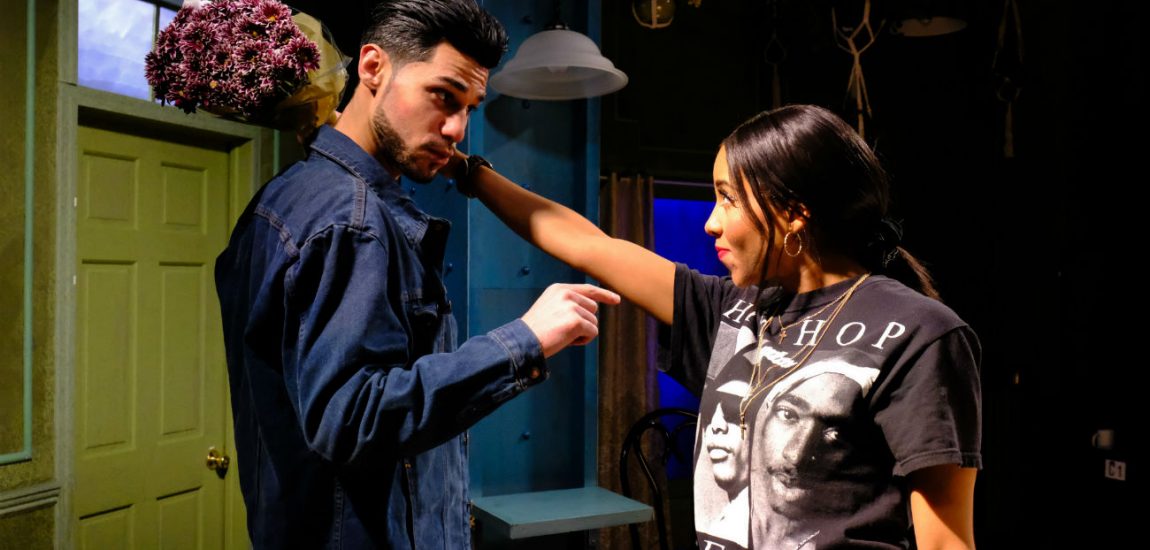
Seth Soulstein from Hotel Good Luck, image taken from official website of the production

Hotel Good Luck by Alejandro Ricaño, presented by Cherry and New Ohio Theater

I’ve liked New Ohio’s work for a long time – they’re always on the short list of companies I check for whenever I’m in New York – and they have taken their ethos of brand new work that simultaneously vibrates with the pulse of the avant-garde and packs a deep emotional punch and found a path to present that vital work in our distanced environment and sacrificing very little in translation.

The newest, striking example of this crucial work came in partnership with the Cherry Artists Collective. Hotel Good Luck, from acclaimed Mexican playwright Alejandro Ricaño, hit hard in a stream from an empty theater in Ithaca, with an empathetic translation by Jacqueline Bixler and directed by Samuel Buggeln.

Hotel Good Luck uses the vibration of that empty theater to braid the metaphors of parallel universes and the solitary DJ for maximum loneliness. Bobby (Seth Soulstein) hunches over his turntables, spraying patter into the void and spinning records like a French version of “My Generation” when he discovers a gateway into other universes.

The irrevocability of death is baked into the Minotaur’s maze Bobby runs, backed by haunting cello lines and the confounding guidance of his psychologist and quantum physicist Larry (Desmond Bratton, also composer of the original music he plays). 

The work also teases the frustration of figuring out where in the world – which world – any of us belongs. As Bratton declaims, right as answers start to appear in front of our hero but without solidity, “You be a disc jockey without listeners and I’ll be a therapist without patients! There is no original universe, Bobby. There is a universe you belong to but I don’t know how you get back there.” 

The two performances and Buggeln’s beguiling direction, creating enough space to drift through but always knowing when to focus, made this dazzling play sing.

From left: Adrian Lester, Danny Sapani, from Hymn. Image taken from official website of the production

Hymn by Lolita Chakrabarti, presented by Almeida Theater

My first – alas, so far only – trip to London made me fall in love with so much I expected to (The Tate Modern, The V&A, Southbank) and things that weren’t even on my radar before. Almeida is top of that latter list, a contemporary theater doing everything right, from the cafe to sightlines to starting on time to their selection of work.

Playwright Lolita Chakrabarti hit my radar through one of my favorite institutions, St Ann’s Warehouse in Brooklyn. In 2013, St Ann’s presented the American premiere of Red Velvet, based on the true story of Ira Eldridge, the first black American to play Othello on the West End, starring Chakrabarti’s husband Adrian Lester, fresh off a smoking-hot London run.

Rolling the dice on an actor I was a fan of and a presenter who’d never let me down, I was enraptured. Later, I saw and reviewed a very good production at Ohio State’s theater department, proving the play wasn’t reliant on just that symbiotic relationship between star and writer.

Almeida’s transitioned to virtual shows that pack almost the same punch as being in their theater and I was overjoyed to wake up in time to catch the new Chakrabarti play, Hymn, streamed at 10 am my time (3 pm in London), starring Adrian Lester as Gilbert, the only known son of a local dry cleaner and upstanding member of the community, and Danny Sapani as the half-brother he didn’t know he had until a notice of their father’s funeral brings their orbits into collision.

In a taut 90 minutes, Hymn delves into what family and friendship mean, and the tracks left by the enormous shadow of a charismatic and loved father. Those impressions hit the two men in different ways but confirm presence and absence can both be suffocating and everything we live through has to be navigated.

The piece is bookended – after a whiplash prologue of Benny (Sapani) at the end of his rope, roaring at a bartender – by two eulogies, each delivered by one brother. The struggle to sum up a life in a few well-chosen words reverberates through the acid-burned snapshots that string the rest of the play together.

Music strings together this sudden, late-life friendship, staring from Sapani’s righteous takes on an evocative “Lean On Me,” and a furious read of the ominous Temptations classic “Papa Was a Rolling Stone,” through ‘80s classics like Full Force’s “Alice, I Want You Just For Me,” “Rapper’s Delight,” and a big UK hit I had to look up, “Street Tuff” by Rebel MC and Double Trouble, even into an ironic twisting of “Gettin’ Jiggy With It.”

The script brilliantly lets the physicality of these two men imply whole lives we only see glimpses of and highlights how little we – especially men – know each other, how hard we have to dig. McIntyre (who also directed The Writer which I saw at Almeida) uses the sparse set to evoke space and time, melting the scenes together organically with almost imperceptible transitions until suddenly the transition is a crash.

Grappling with self-awareness sparks heartbreaking moments at the end of the play. A haunted Lester saying “It’s the silence that breaks your heart,” looking at a suit in plastic. Sapani, summoning all his strength, sums up his brother with “The pieces of your life you think are missing are not necessarily the right ones…Gil tried so hard to play his notes in the right order but there is no right order, is there?”

We all have to reckon with that lack of a right order to find any semblance of peace. Hymn knows the joy in trying to live, if we let ourselves, but never forgets how much work it requires.
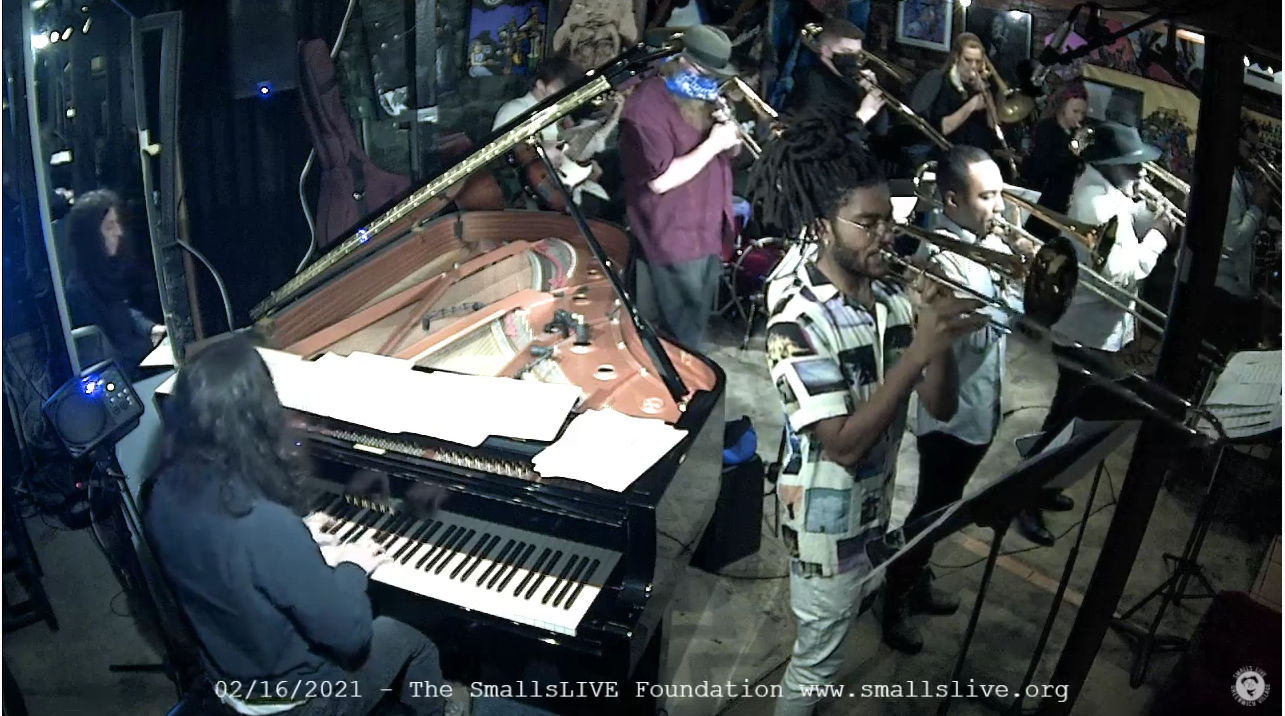
Frank Lacy’s Trombonivers at Smalls, image taken from stream and edited

Frank Lacy’s Trombonivers at Smalls

One of the great things about Smalls in its public incarnation was – through their late-night jam sessions – they provided more public showing-your-ass stage time for young players than anywhere else in the current state of moneyed Manhattan, while still having the core house band be professional enough that if things went south it didn’t go on so long it drove the post-midnight crowd back up to 10th Street.

Great trombone player and bandleader Frank Lacy also has a reputation as a great teacher and encourager of young talent. For a vibrant Smalls set that brought tears to my eyes and made me dance around the room, he convened 8 fellow trombone players across the spectrum of experience – Corey Wilcox, Rashaan Salaam, Corey Wallace, Colman Hughes, Alevtina Wilcox, James Rodgers, Jacob Melsha, Maxine Troglauer – along with a sizzling rhythm section of Felix Moseholm on bass, Evan Sherman on drums, and Jon Elbaz on piano.

Appropriate for Fat Tuesday, that instrumentation soared through strutting New Orleans material with teeth like Ellis Marsalis’s “Nostalgic Expressions.” They also played with dynamics, harmonies like slow molasses seeping into a holy river then evaporating into colored smoke on a ballad original of Lacy’s. That ballad, with an insinuating, punchy bassline from Moseholm melted into one of the great ballads, Monk’s “Crepuscule for Nellie, with the horns capturing all that kaleidoscopic color, bouncing back and forth between dramatic punctuation and a silken waltz.

Probably my favorite – or at least most surprising – tune from the set was a funky dance take on Wayne Shorter’s “Palladium,” a highlight from the first Weather Report record I bought as a kid. Explosions of dive-bomb harmony with a thick, sultry bottom and a particularly smoking drum solo from Sherman which hinted at the Latin elements of the original without falling into cliches.

Categories
Best Of theatre

Best of 2020 – Theatre/Opera/Dance

“Are you even here? You’re a relic of a dying empire. The ghost of a glorious future that never came.” 

-Sarah Gancher, Russian Troll Farm

Salt given me at Under The Radar’s Salt

Live:

I was lucky to see about 15 shows – almost all outstanding – before doors started slamming shut. These 8 grabbed me hard and wouldn’t let go. Their memories are still burned into my brain this many months later. Photos are taken from press either given directly to me or on the company/creator’s official website.

  • Salt by Selina Thompson, directed by Dawn Walton (01/11/2020 – Public Theatre, Under the Radar, NYC) – Sometimes – and this might be my favorite part of seeing theatre and especially my favorite part of Under the Radar, I see work by a playwright who’s new to me and the voice alone burns a layer of skin off me and makes me feel both more and differently. Selina Thompson’s personal-historical-poetic dive into the Transatlantic Slave Trade, Salt, masterfully acted by Rochelle Rose, did that to me this year. I walked out babbling and as hungry for more of her work as any writing of the last decade.
  • Body Comes Apart by Molly Lieber and Eleanor Smith (01/12/2020 – New York Live Arts, NYC) – This vivisection of expectations, trauma, and freedom balanced an unsparing dedication to truth with a supernova love for the world. Body Comes Apart was a physical hour of dance, and acting was a whirlwind from which I couldn’t look away. It avoided platitudes and simplification but burned with a clarity that made its unanswered questions cut even deeper. I could have seen this three times and still tried to grasp it. 
  • Medea by Simon Stone after Euripides, directed by Simon Stone (01/12/2020 – BAM, NYC) – I’m a sucker for the Greeks and I’d never seen Bobby Cannavale on stage. Something felt very fitting about seeing Stone’s ferocious, knives-out take on Euripides here in the same theatre I saw my favorite Hedda Gabler. The adaptations to the play were interesting, aided by vibrant video. My brain pinballed between the remarkable acting – Cannavale, Rose Byrne, Dylan Baker – and the wrenching image of ash falling on that pristine white stage, both stuck with me well after the next day’s flight home.
The Motherfucker With the Hat, photo by Nick Lingnofski
  • Or by Liz Duffy Adams, directed by Rowan Winterwood (01/17/2020 – Actors Theatre) – Actors Theatre’s relationship with MadLab for smaller-scale indoor plays continued to bear fruit this year, even as they had to cancel what looked like an exciting outdoor season. Or was a delightful drawing room sex romp around the fascinating historical character Aphra Behn (played brilliantly by Michelle Weiser) with crackling support from Andy Woodmansee and McLane Nagy as the other legs of the triangle. Winterwood’s sizzling direction made this a hot, funny winter diversion when I needed it most.
  • The Motherfucker With the Hat by Stephen Adly Guirgis, directed by Chari Arespacochaga (01/23/2020 – Short North Stage) – Short North Stage doesn’t always get enough credit for their dark, low-to-the-ground plays in the Green Room. Their Motherfucker With the Hat was another triumph in that lane. Arespacochaga directed it with the right mix of Greek tragedy and cage match, a stellar cast orbited around a volcanic Raphael Ellenberg.
  • The Bridge Called My Ass by Miguel Gutierrez (01/25/2020 – presented by the Wexner Center) – Gutierrez’s bilingual piece mixed puns, everyday action, and flights of fancy into something I’d never seen before. I didn’t always understand it but I was always enraptured.
The Shadow Whose Prey The Hunter Becomes, photo by Jeff Busby
  • A Doll’s House Part 2 by Lucas Hnath, directed by Michael Garrett Herring (01/30/2020 – Red Herring Theater) – There have been a few times I’ve seen a Columbus production I felt improved on New York, and this was the most recent example. Herring stripped away the ba-dum-bum sitcom rhythm that sank the Broadway version of this for me the night I saw it and made Hnath’s sequel to Ibsen glow like a bruise. All stellar performances, especially Sonda Staley’s for-the-ages take on Nora.
  • The Shadow Whose Prey The Hunter Becomes by Back to Back Theater (02/13/2020 – presented by the Wexner Center) – One of my favorite previews I’ve ever written. I was so glad I held off, skipping this at Under The Radar so I could go into it cold when it played my town. A more complicated bit of metatheatre than the first work of theirs I loved, Ganesh Vs The Third Reich, but brillant and arresting. A look at how much “acting” we all do in making our voices heard and how much marginalized people have to work past just to get their voices heard, to not be seen as a monolithic interest. If this was the last live performance I saw, I went out high.

Online:

We Need Your Listening, screenshot from stream and edited

Theatre feels like a circuit between the stage and the audience, even more than music, to me. But for me, this immediate, physical art reaped the greatest rewards as companies tried to find ways to make work that still felt like theater while wholly embracing the new media. I deeply hope many of us can find ways to continue to make things accessible after we can all gather in a room again. 

It would be a true shame for these opportunities for people with disabilities or other reasons not to be part of the physical exchange of energy, to finally get a wider range of options and then have them taken away.

Things that moved and inspired me with virtual theatre:

Zoom readings run by local stalwarts Krista Lively Stauffer and Tim Browning with their Virtual Theatre Project gave me the chance to catch Douglas Whaley’s phenomenal The Turkey Men (I missed its premiere run when I was in Italy last year), revisit the terrific Red Herring two-hander Thicker Than Water, and dip into remarkable work from our astounding pool of talent.

Established companies pivoted with aplomb and grace: 

Abbey Theatre’s The Sissy Chronicles, photo provided by Joe Bishara
  • Short North Stage revisited shows they’d loved and couldn’t find space for in their schedule previously like the moving early Andrew Lippa John & Jen and the delightfully raunchy Off-Broadway hit by Howard Crabtree and Mark Waldrop When Pigs Fly. They also used their connections to get new material for these revivals while also building new work like Quarantine With the Clauses. 
  • New CATCO Artistic Director Leda Hoffmann met the challenge of her first season in town coinciding with the pandemic and excelled with marvelous Idris Goodwin shorts, Plays For an Antiracist Tomorrow, bringing in legacy CATCO artists as well as fresh blood, then acclaimed Julienna Gonzalez adapted her Detroit Christmas Carol into a Columbus version under Hoffmann’s direction.
  • Joe Bishara came into his own with Dublin’s Abbey Theatre giving life to exciting pieces from artists like Mark Schwamberger and Nikki Davis.
  • Red Herring provided astounding social dramas and made steps toward a hybrid experience.

The plethora of archival work was an embarrassment of riches, from American Conservatory Theatre’s take on Lydia Diamond’s Toni Stone to the Goodman’s hilarious and heartbreaking Jocelyn Bioh’s School Girls or The African Mean Girls Play.

The Elaborate Entry of Chad Deity, screenshot taken from stream and edited

The New Group, Play-Per-View, and more presented riveting reunion readings, giving new life to great plays from past seasons. I especially loved Beth Henley’s The Jacksonian, Kristoffer Diaz’s The Elaborate Entry of Chad Deity, and Suzan-Lori Parks’ Death of the Last Black Man in the Whole Entire World.

I was in awe of groups that created new work from tools not intended for this purpose. Magic came from relatively straightforward narrative work like Mona Mansour’s The Beginning Days of True Jubilation, Theatre of War’s Antigone in Ferguson, and Sarah Gancher’s Russian Troll Farm. to more ephemeral work like We Need Your Listening by Velani Dibba, Ilana Khanin, Elizagrace Madrone, Stephen Charles Smith, Bill T Jones and Arnie Zane’s Come Together Revisited, and Theatre Mitu’s </remnant>.

Antigone in Ferguson, screenshot taken from stream and edited

Even in the dark times, there was still joy if you looked, and I am as grateful as ever people took on these burdens to bring it to us.

Categories
"Hey, Fred!" dance theatre

Things I’ve Been Digging – 11/16/2020

Russan Troll Farm – From Upper Left, Haskell King, Ian Lassiter, Greg Keller, Danielle Slavick. Provided by TheatreWorks Hartford on their site.

Theater: Russian Troll Farm by Sarah Gancher, directed by Jared Mezzocchi and Elizabeth Williamson, presented by Theatreworks Hartford and TheatreSquared in association with The Civilians.

I still miss being in a theater, crammed around my fellow audience members, breathing as one, with an uncommon fire. But watching theatre artists – new jacks and veterans alike – mold today’s tools and limitations into beautiful things that feel like theater even split over different rooms. 

I saw one of my favorite examples of this 2020 alchemy this weekend. Long-standing champions of the new The Civilians teamed up with Fayetteville, Arkansas’ TheatreSquared, and Connecticut’s Theatreworks Hartford for a dazzling, incendiary romp through Sarah Gancher’s Russian Troll Farm.

Subtitled “A Workplace Comedy,” the play zooms in on a St Petersburg office to follow a team of trolls sowing discontent and confusion among Americans through Twitter. Former journalist Masha (Danielle Slavick) joins the established dynamic of laser-focused Egor (Haskell King), stunted throwback Steve (Ian Lassiter), and erstwhile artist Nikolai (Greg Keller), in the shadow of the manager: Soviet throwback Ljuba (Mia Katigbak). 

Gancher understands this low-level almost-tech job’s dynamics: the infighting, the jokes, the sourness, and sweetness. A vibrant scene of intense, flirtatious volleying between Slavick and Keller captures the adrenaline of being good at something, even something that feels both futile (from the inside) and evil (for those of us looking in), and Russian Troll Farm is littered with scenes this good. 

Gancher and her cast understand how similar the American and Russian psyches are but filter the characters through their environment’s specifics. Lassiter – recently very good in Gold’s uneven King Lear – has a ball playing the lusty, coarse Steve, bouncing off Slavick’s Masha and King’s brilliant, understated Egor. They create a world that feels like those little rooms for those of us who’ve done call center work or similar and makes us question how much of what we did for those hours and those years was just as morally questionable.

Directors Jared Mezzocchi and Elizabeth Williamson found ways to impose their stellar cast on one another with trickery that doesn’t lose its amateurish afterbirth completely but uses the seams we can see to its advantage. When Katigbak, in a heartbreaking soliloquy, says, “Are you even here? You’re the relic of a dying empire, the ghost of a glorious future that never came,” it snaps into sharp focus that we’ve been seeing ghosts all this time.

Russian Troll Farm was a triumph I’ll be thinking about for a very long time.

Bill Chats: Screenshot taken from livestream

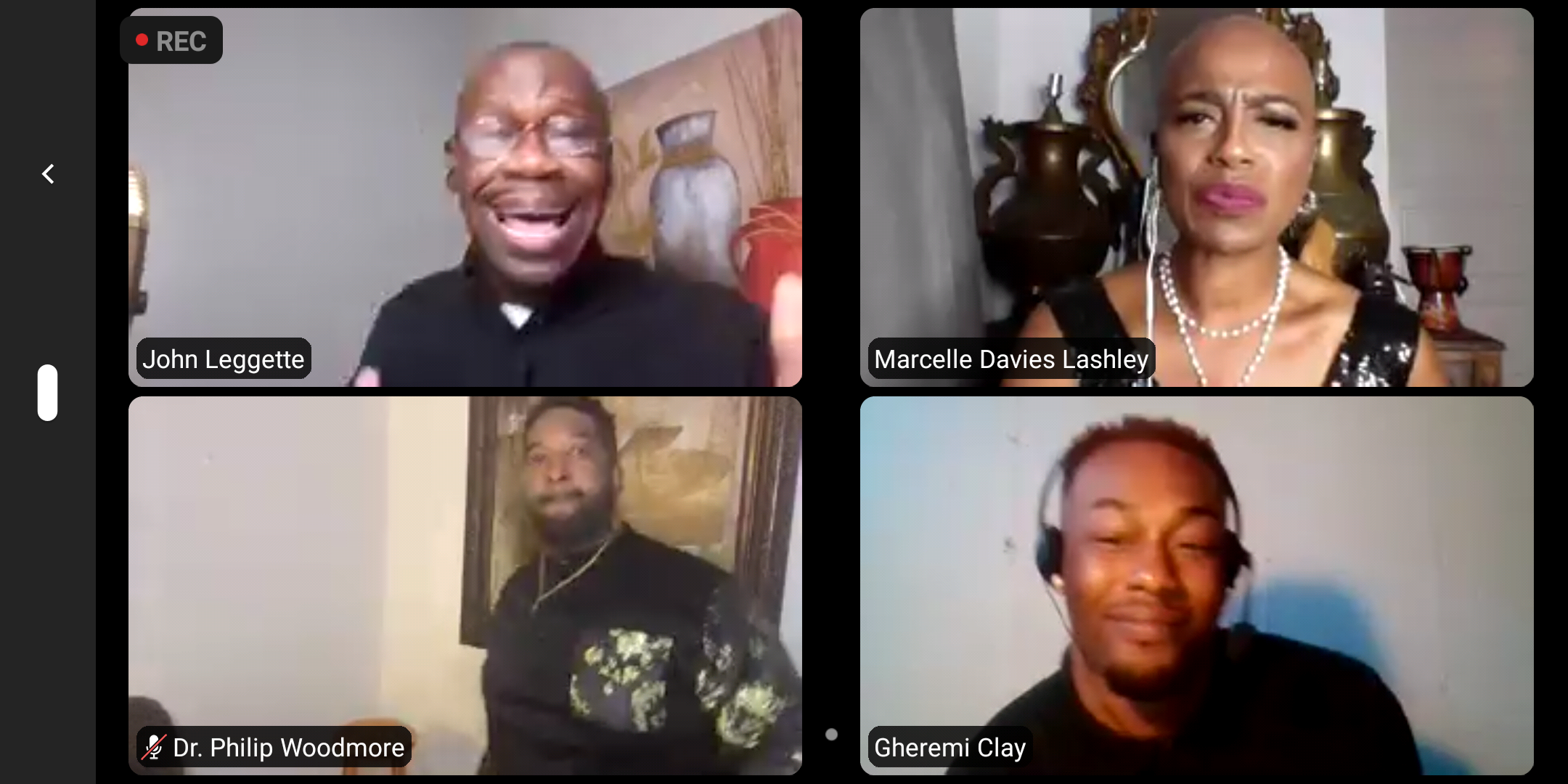
Talk: Bill Chats – The Future is Present: A Casting The Vote Project. Bill T. Jones in conversation with Charlotte Brathwaite, Janani Balasubramanian, Justin Hicks, and Sunder Ganglani.

Bill T. Jones, through his New York Live Arts in association with Bard University, hosted a delightful, recharging conversation with four of the people behind The Future Is Present, a group running workshops at the intersection of performance and collective action.

It’s invigorating watching these ideas of what an artist means or even can mean bounce between people of color who came up in wildly different scenes, at different levels of outward acclaim and success. Jones said, “When I started in the art world, they said, ‘You wanna make art, make art. You want to do politics, do politics.’ And I thought the we was political…Trying to get to a ‘we’, many artists head for the door when that happens. An artist is trying to close the gap between this internal space here and the rest of the universe, and an artist finds a language, a form that lets them do that.”

That resonated deeply with me, who grew up steeped in the kind of late modernism Jones helped define before me, but I was enraptured by the way the younger people he’s talking to centered other people in the lens of their own languages. For instance, Justin Hicks said, “Even transcribing what [young people] want changed the ‘we’. I know lots of artists who don’t trouble themselves with the questions I do,” and “The concept of potential is much more important to us than certainty.”

After Jones posted the question “What are your dreams” to the panel, Sunder Ganglani said, “It’s not easy to imagine one’s self into a world in which you want to live. We have hopes, though,” and Janani Balasubramanian riposted, “You asked that question about certainty – I don’t think this project hinges on certainty, it’s actually present with discomfort, difficulty, and experimentation which is being cleared away in our society, through science, through catastrophe, through violence. In that space of clearing is a process of collective experimentation: sometimes difficult, sometimes joyful, sometimes both. I want to get to a place where people can verb it. Can ‘future’.”

Watching this clear-eyed group articulate a future worth fighting for and creating, while acknowledging the ambiguity it comes with, gave me more hope than anything I’ve seen, read, or heard, in quite a while. As Balasubramanian said, “Future making is about speculation but also about closing that gap between what’s speculative and what’s material – if we’re demanding something of the future, we’re demanding it of the present…Young people don’t need our encouragement for world-building.”

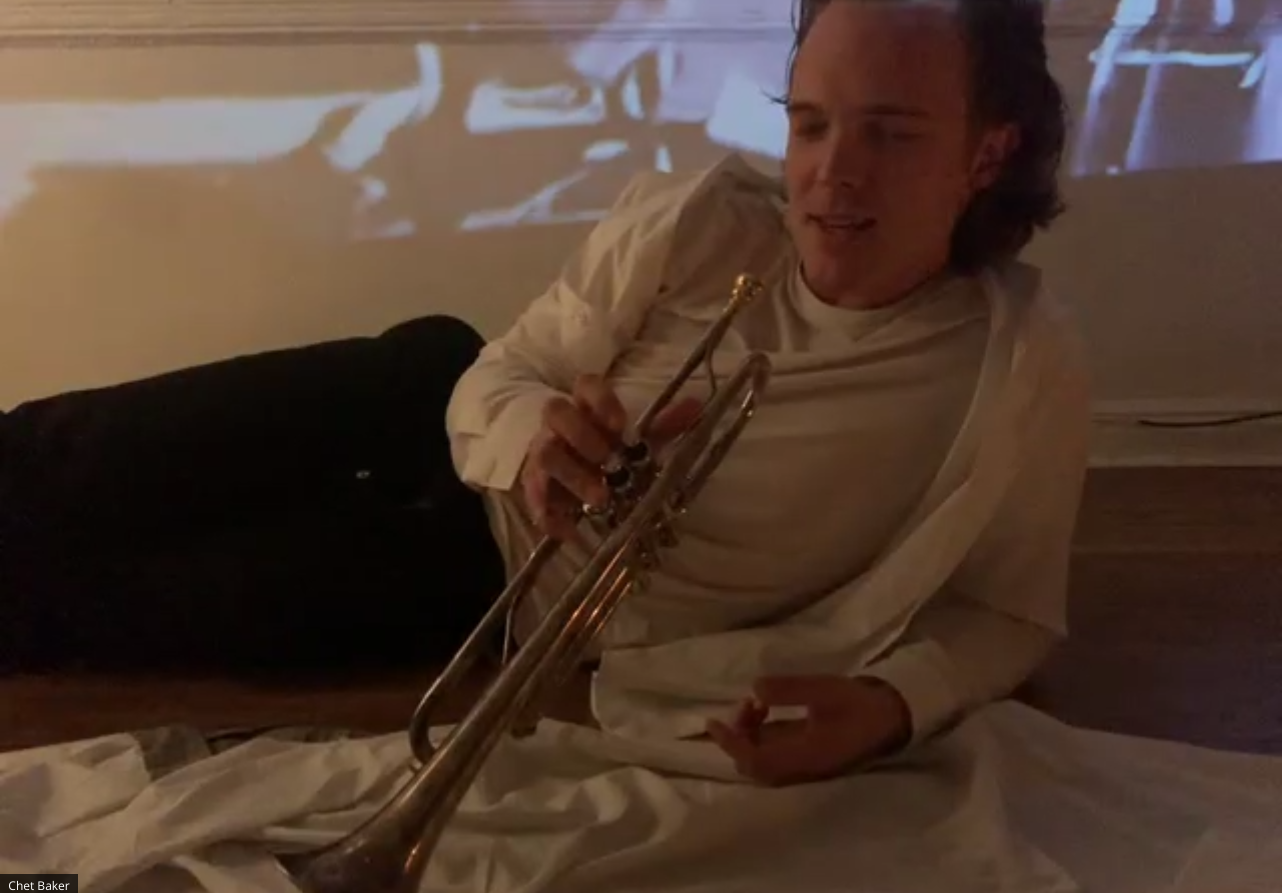
Theater: The Self-Combustion of a 30-Something-Year-Old Chet or, Icarus Tries to Catch the Sun by Keenan Tyler Oliphant, presented by New Ohio Theatre

Oliphant uses the raw material we all know about beautiful and damned Chet Baker and gives it new, molten life with Nicholas McGovern as the seductive wreck in a tiny apartment, old film clips playing on the wall like memories written on skin.

McGovern brings this his utter, unshakable commitment in the life Baker committed himself to, his ability to see magic where it confronted him – a gorgeous reverie about Charlie Parker “rising above us on corrupted wings,” snatches of songs – and his role as a self-identified truth-teller. His Baker is deep in the throes of “poetic self-destruction,” there to “remind [the audience] what it’s like to be awake.”

Somehow, in the crucible of this Zoom so intimate it’s like we’re eavesdropping these words distill into a hard crystal as the liquid boils off and they snap with the hard, sweet rhythm they need – with invaluable assistance from Jacob Robinson’s sound design. The text grows so large and thin we can see through it to the desire behind the words we’ve all heard too many times; the desire that’s all that matters here.

In lesser hands, this raving, this disappearing-ink last testament, could have been laughable, a plywood cartoon. But here it felt like that perfect tune on the jukebox as you order that one last drink you know you shouldn’t have.

Categories
live music theatre

Things I’ve Been Digging – August 3, 2020

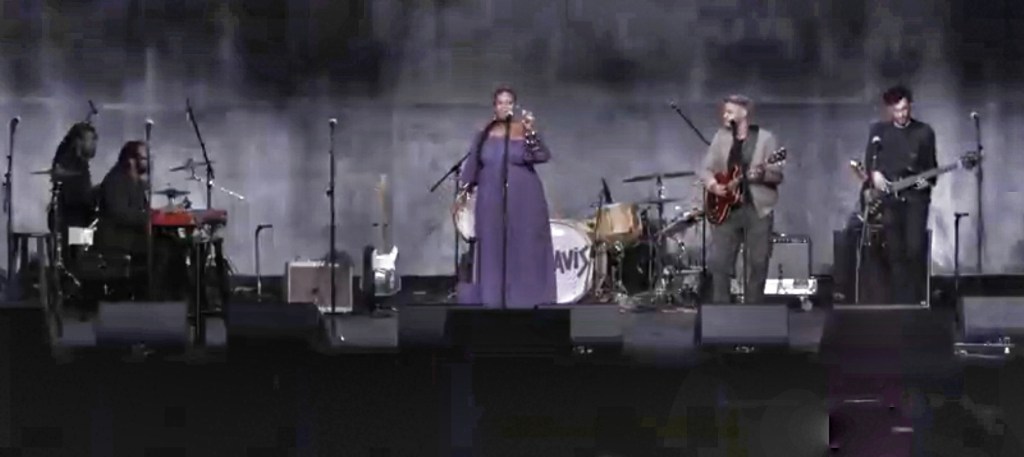
Deva Mahal and Son Little, Mavis 80, screenshot from broadcast

Music: Mavis 80, Mavis Staples’ 80th birthday celebration taped at the Ace Theater in LA and rebroadcast as a benefit for the Newport Folk Festival Foundation.

It’s hopelessly reductive to say any single voice is America but sometimes the temptation is irresistible. Since the 1960s, Mavis Staples has earned that voice if anyone has. Bringing gospel music into the contemporary world, enlivening rock and soul, and still making outstanding record after outstanding record, still hungry for the best new songs and the best players, she’s an inspiration on every level.

I got a lot of joy this weekend out of tuning into the Newport Folk Revival weekend streamed through WFUV (also giving me pandemic life with Binky Griptite’s Saturday slot), a perfect reminder of how great this institution has been for so many years and argument to archive everything.

I heard so much great stuff but the crown jewel was this rebroadcast of the third of Staples’ 80th birthday concerts, with a cross-section of great American voices approaching one of the finest canons in 20th century music with exactly the right amount of intensity, reverence, and play, and, course, even in such a stellar lineup – highlights for me included War and Treaty and Deva Mahal and Son Little – Mavis Staples wiped them all out of our minds within three notes.

We Need Your Listening screenshot

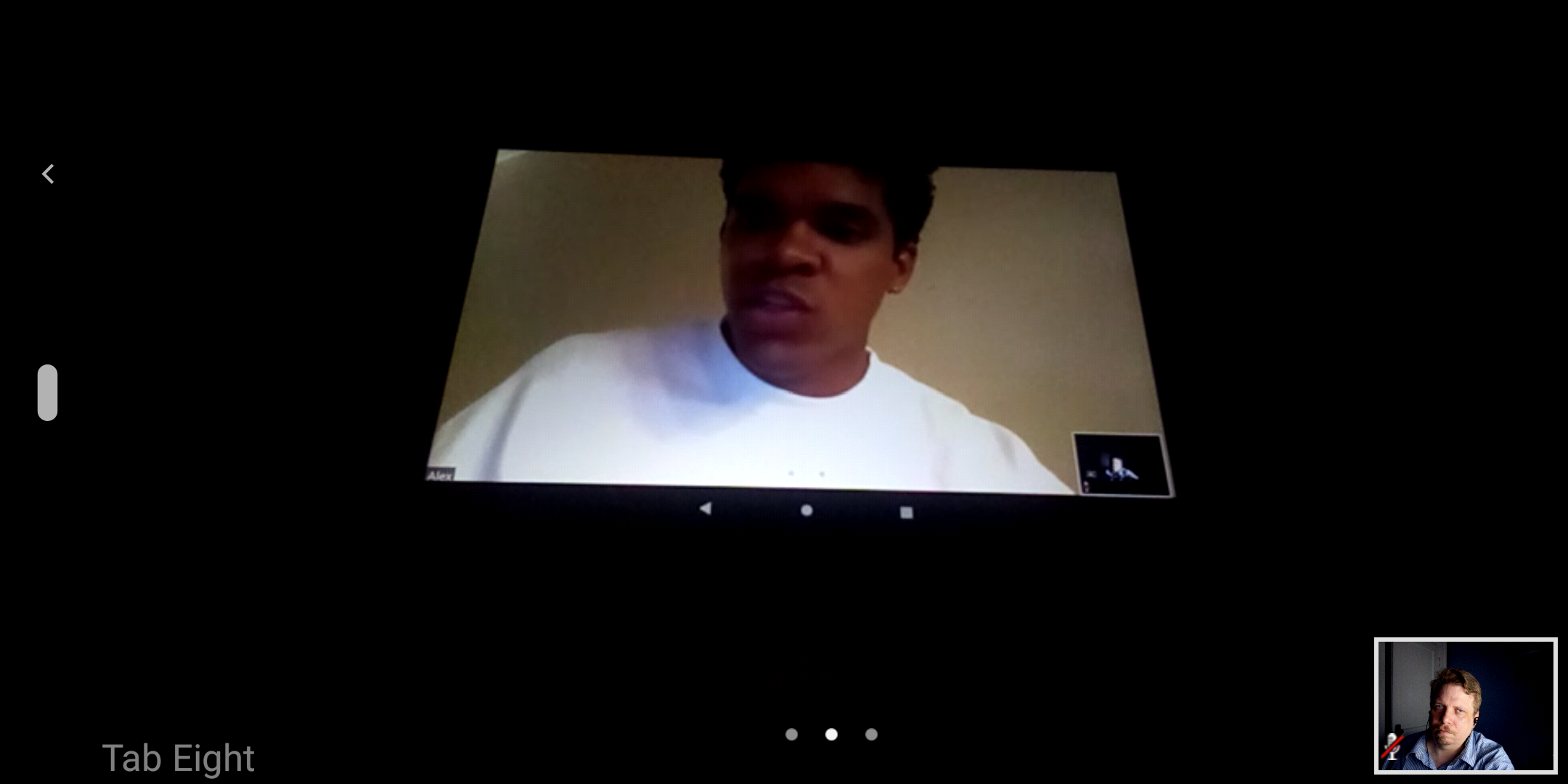
Theater: We Need Your Listening by Velani Dibba, Ilana Khanin, Elizagrace Madrone, Stephen Charles Smith, presented by New Ohio Theatre as part of the Ice Factory Festival.

Despite the sudden proliferation of Zoom readings and similar real-time grappling with the question of how to make theater in our new time of plague and worry, this tribute to human connection and study in “radical listening” came the closest to delivering on the age-gifted new double meaning of Aretha’s late-period classic “Who’s Zoomin’ Who.”

They ushered each viewer from the digital waiting room that irritates most of us into breakout sessions – after time scanning the slightly shabby West Village space where the New Ohio recently moved (that made me extremely nostalgic). Unseen hands led us through a solo journey (represented in space by a tablet or computer) from one other computer to the next, featuring a member of the ensemble: Hilary Asare, Alex Bartner, ChiWen Chang, Sam Gonzalez, Alice Gorelick, Julia Greer, Nile Assata Harris, Annie Hoeg, Sam Im, Bri Woods.

That fantastic ensemble, for a couple minutes, interacted with me, the viewer, to a greater or lesser degree (most impressively, one woman played an abbreviated “20 Questions” with me) while muted. There are layers of discomfort in not being able to say your piece and a heavy re-figuring toward listening, absorbing what the person is staying that was difficult to adjust to (even for those of us who have exercises and think we’re better at it, this puts the lie to that – addressed to my fellow men, mostly, probably).

These snippets of conversations – some responding to the same prompt: were two different people meant to talk about the three memories they’d take to a desert island or did someone get confused on the order – are provoking in themselves, for me the character who had a family friend say, “The least we can do is show up.” at her father’s funeral, a delectation-soliloquy about favorite sounds, and a fantasia about “Doing a knife dance to Nina Simone’s ‘Take Care of Business For Me’” all hit me hard.

But these vignettes accumulate weight, like a combine, from the objects in immediate proximity. And that underlined how we all accumulate meaning and resonance from one another. The hum of other conversations that periodically came through the edges made me so lonely for other humanity I almost cried.

There’s also an interesting, rough-hewn visual poetry in the movement. The not-perfect rise and walk when we’re picked up. The blur of lights and shaky faces, the theatre lit only by that blue light that will wreck all of our sleep.

I’ve had some wonderful one-person experiences – most prominently I remember a COIL Festival show called Hotel Goethe – and I’ve seen some brilliant theater since the lockdown. But this was the closest thing I’ve seen to feeling like I’m at the theater. And I can’t thank the company enough for it.

Beginning Days of True Jubliation Promo Photo from New Ohio Theatre site

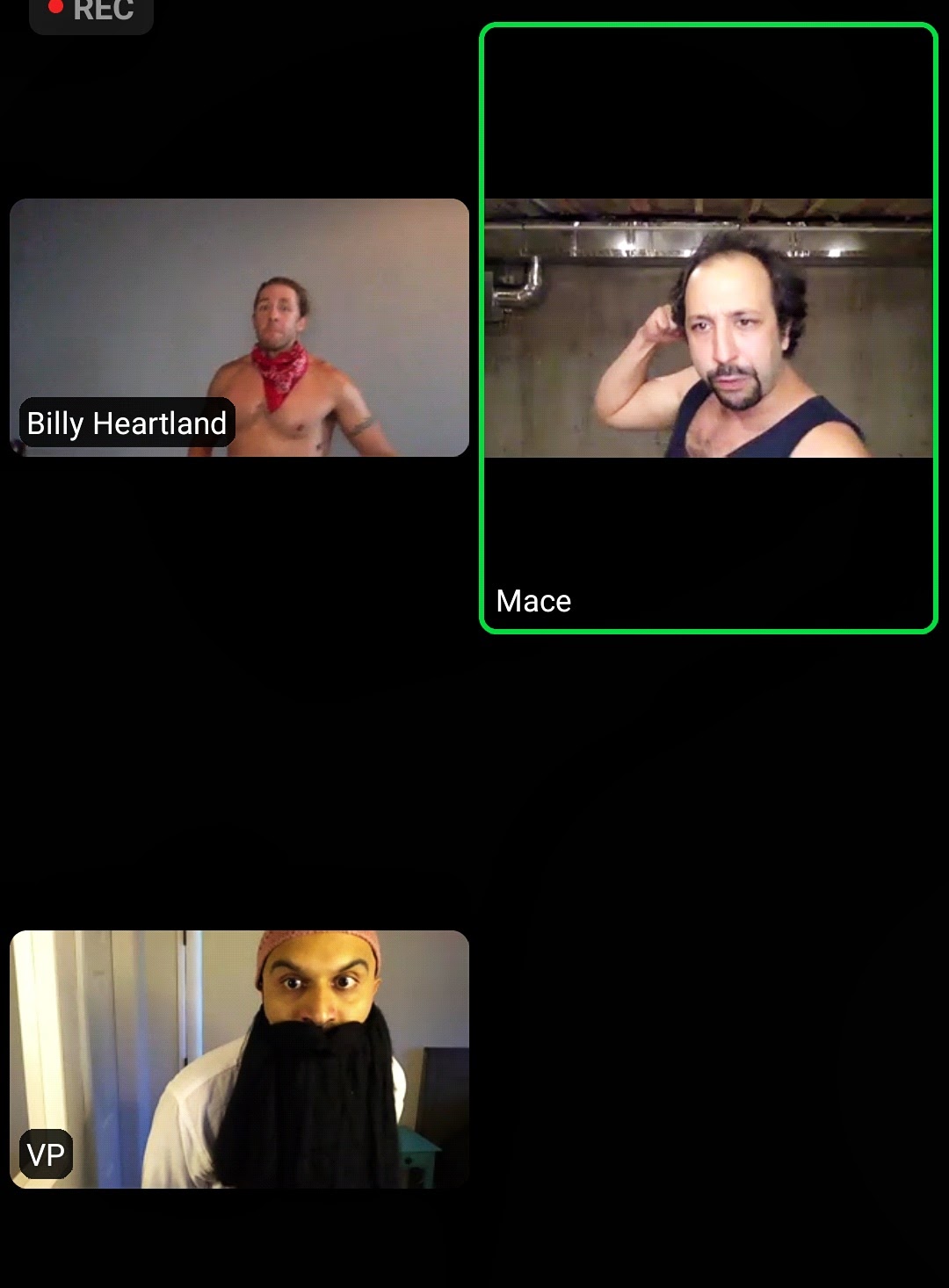
Theater: Beginning Days of True Jubilation by Mona Mansour, directed by Scott Illingworth and conceived with SOCIETY, presented by New Ohio Theatre as part of the Ice Factory Festival.

Mona Mansour further cements her status as one of our most exciting playwrights, engaging with these confusing, melting-ice-floe times, with an expansive look at start-up culture Beginning Days of True Jubilation.

With a huge cast and sharp satire, I couldn’t help but picture what this would have looked like on a stage – and I hope that chance comes sooner than later – but Mansour’s voice and the brilliant players leaned into the format of Zoom (also tied in with the tech company they give us a cross-section of) and found diamonds throughout.

Monsour and the company conjure the implacable but easy-to-forget truth that a company is made up of people, and she carves the start-up here with sympathy for the burst of creativity at the heart of this cannonball and the people who end up as its cannon-fodder.