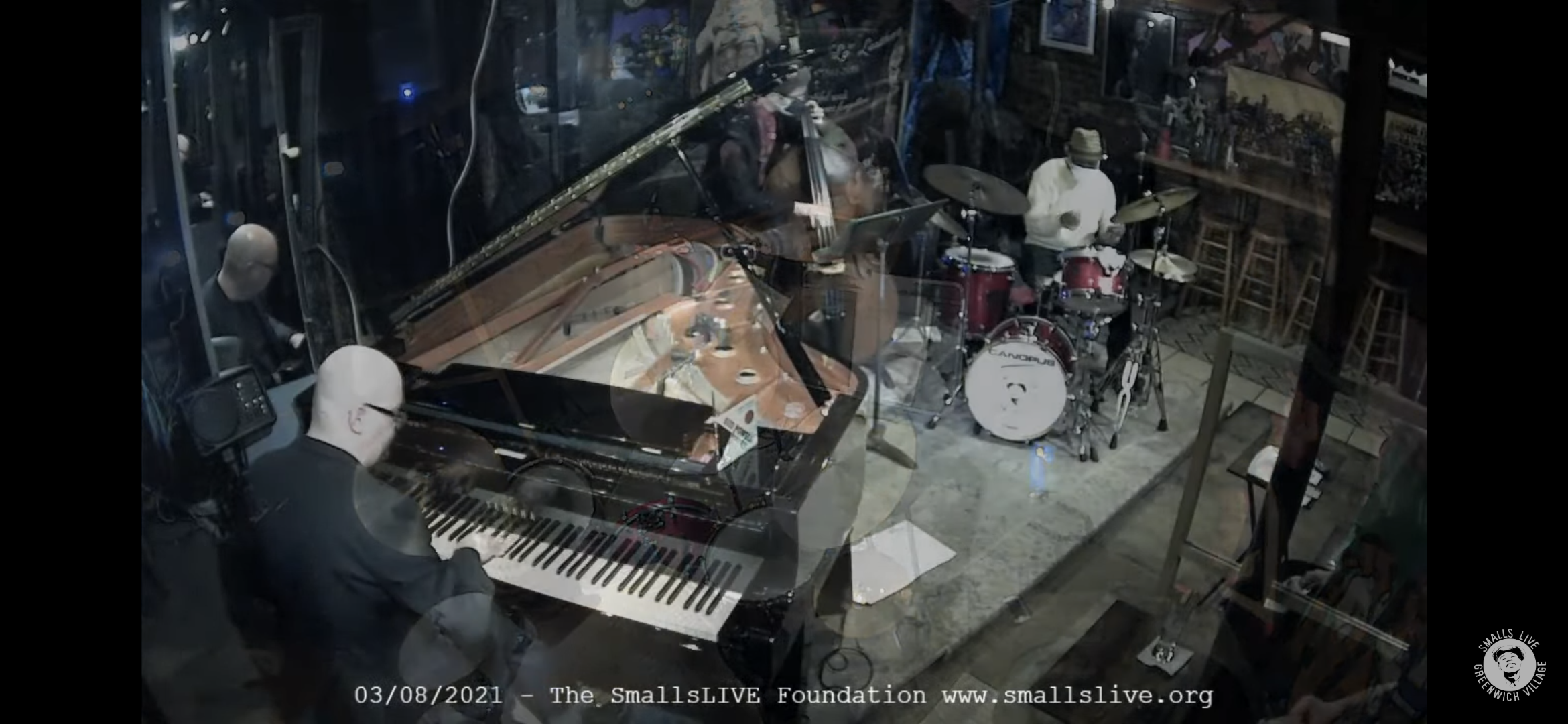
From left: Ethan Iverson, Thomas Morgan, Andrew Cyrille. Taken from stream and edited.
Ethan Iverson Trio at Smalls
I raved about Ethan Iverson’s vibrant new record Bud Powell in the 21st Century in last month’s playlist. In place of a record release, Iverson convened a top-tier rhythm section to play one of the temples of classic bop, Smalls, in a set of almost entirely Powell and Thelonious Monk compositions.
Andrew Cyrille on drums, 81, is an inspiration. I’ve been a fan for almost as long as I’ve cared about jazz – my gateway came from his work with Cecil Taylor, especially buying Unit Structures at 18 and hearing him power the rhythm of the massive, undulating machine – and he’s blown me away with reeds players like John Carter and Bill McHenry. Still, there’s a particular delight watching him lock in with a piano player. Thomas Morgan on bass brought vital color and dancing propulsion to recent Bill Frisell and Henry Threadgill records.
The two sets here are a clinic in how much life there is in these songs. It’s no exaggeration to say I probably own 30 versions of the opening tune here – Monk’s “Well You Needn’t” – and I’ve heard it at least 200 times over 20+ years of assiduous show-going. Those first notes brushed any preconception away, and I listened with grinning, childlike glee like the first time.
At once point, Iverson says, “It feels great to play,” and that joy suffuses everything in these sets: the interlocking handoffs on “Bouncing With Bud;” the long solo piano intro building to a luxurious simmer of “I’ll Keep Loving You;” the explosive, contained cacophony on “52nd Street Theme” with Iverson’s gleaming, sharpened attack rubbing up against Morgan’s thick, declarative notes and Cyrille’s hooky patterns.
Smalls has reopened to limited capacity audiences, and as great as the no-audience streams are, as lucky as I feel to have them, there’s a distinct difference in the vibration of these shows, even having ten people in the audience creates the feedback loop I’m missing and, as I see it close on the horizon, makes me miss being in the room with the music very much.
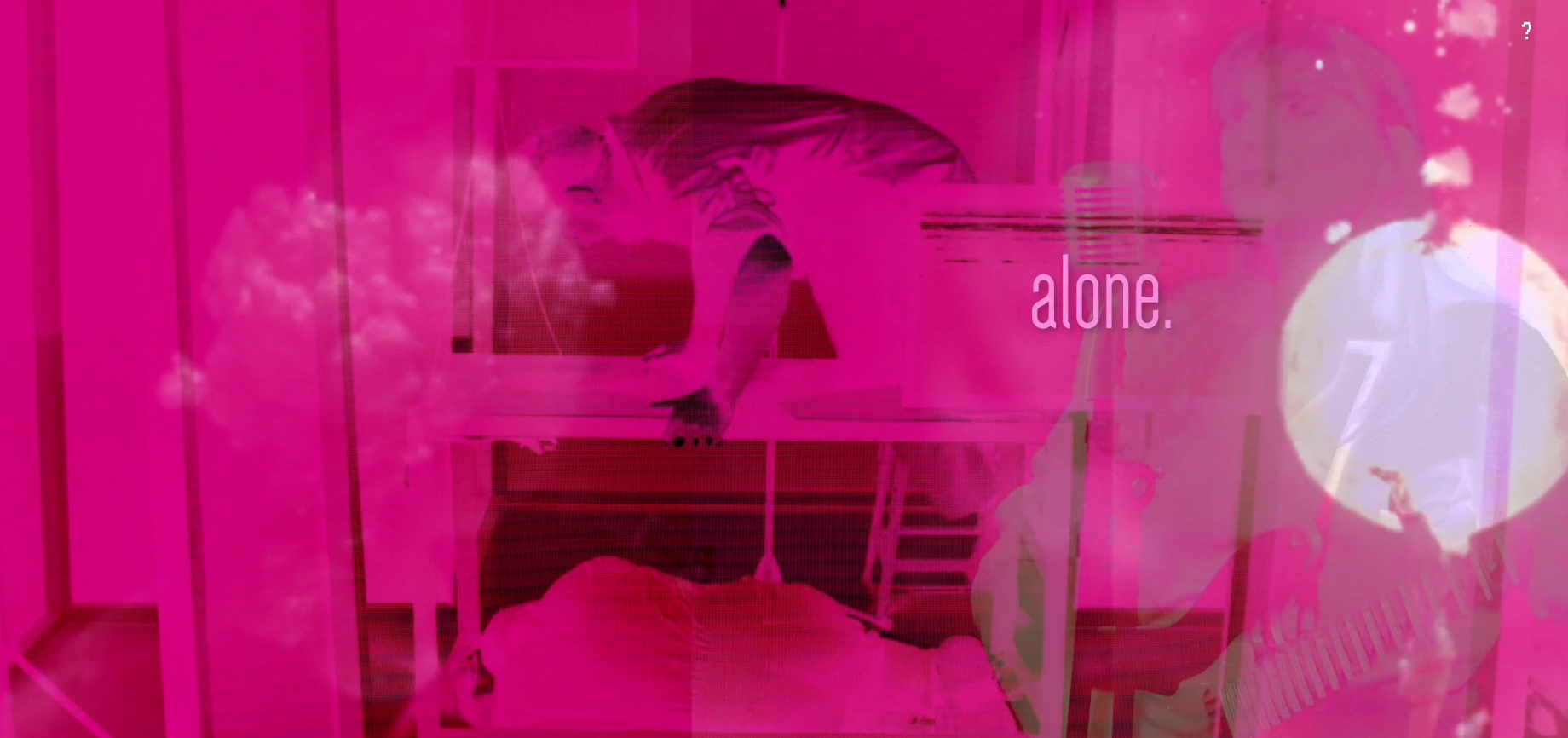
Seth Soulstein from Hotel Good Luck, image taken from official website of the production
Hotel Good Luck by Alejandro Ricaño, presented by Cherry and New Ohio Theater
I’ve liked New Ohio’s work for a long time – they’re always on the short list of companies I check for whenever I’m in New York – and they have taken their ethos of brand new work that simultaneously vibrates with the pulse of the avant-garde and packs a deep emotional punch and found a path to present that vital work in our distanced environment and sacrificing very little in translation.
The newest, striking example of this crucial work came in partnership with the Cherry Artists Collective. Hotel Good Luck, from acclaimed Mexican playwright Alejandro Ricaño, hit hard in a stream from an empty theater in Ithaca, with an empathetic translation by Jacqueline Bixler and directed by Samuel Buggeln.
Hotel Good Luck uses the vibration of that empty theater to braid the metaphors of parallel universes and the solitary DJ for maximum loneliness. Bobby (Seth Soulstein) hunches over his turntables, spraying patter into the void and spinning records like a French version of “My Generation” when he discovers a gateway into other universes.
The irrevocability of death is baked into the Minotaur’s maze Bobby runs, backed by haunting cello lines and the confounding guidance of his psychologist and quantum physicist Larry (Desmond Bratton, also composer of the original music he plays).
The work also teases the frustration of figuring out where in the world – which world – any of us belongs. As Bratton declaims, right as answers start to appear in front of our hero but without solidity, “You be a disc jockey without listeners and I’ll be a therapist without patients! There is no original universe, Bobby. There is a universe you belong to but I don’t know how you get back there.”
The two performances and Buggeln’s beguiling direction, creating enough space to drift through but always knowing when to focus, made this dazzling play sing.
From left: Adrian Lester, Danny Sapani, from Hymn. Image taken from official website of the production
Hymn by Lolita Chakrabarti, presented by Almeida Theater
My first – alas, so far only – trip to London made me fall in love with so much I expected to (The Tate Modern, The V&A, Southbank) and things that weren’t even on my radar before. Almeida is top of that latter list, a contemporary theater doing everything right, from the cafe to sightlines to starting on time to their selection of work.
Playwright Lolita Chakrabarti hit my radar through one of my favorite institutions, St Ann’s Warehouse in Brooklyn. In 2013, St Ann’s presented the American premiere of Red Velvet, based on the true story of Ira Eldridge, the first black American to play Othello on the West End, starring Chakrabarti’s husband Adrian Lester, fresh off a smoking-hot London run.
Rolling the dice on an actor I was a fan of and a presenter who’d never let me down, I was enraptured. Later, I saw and reviewed a very good production at Ohio State’s theater department, proving the play wasn’t reliant on just that symbiotic relationship between star and writer.
Almeida’s transitioned to virtual shows that pack almost the same punch as being in their theater and I was overjoyed to wake up in time to catch the new Chakrabarti play, Hymn, streamed at 10 am my time (3 pm in London), starring Adrian Lester as Gilbert, the only known son of a local dry cleaner and upstanding member of the community, and Danny Sapani as the half-brother he didn’t know he had until a notice of their father’s funeral brings their orbits into collision.
In a taut 90 minutes, Hymn delves into what family and friendship mean, and the tracks left by the enormous shadow of a charismatic and loved father. Those impressions hit the two men in different ways but confirm presence and absence can both be suffocating and everything we live through has to be navigated.
The piece is bookended – after a whiplash prologue of Benny (Sapani) at the end of his rope, roaring at a bartender – by two eulogies, each delivered by one brother. The struggle to sum up a life in a few well-chosen words reverberates through the acid-burned snapshots that string the rest of the play together.
Music strings together this sudden, late-life friendship, staring from Sapani’s righteous takes on an evocative “Lean On Me,” and a furious read of the ominous Temptations classic “Papa Was a Rolling Stone,” through ‘80s classics like Full Force’s “Alice, I Want You Just For Me,” “Rapper’s Delight,” and a big UK hit I had to look up, “Street Tuff” by Rebel MC and Double Trouble, even into an ironic twisting of “Gettin’ Jiggy With It.”
The script brilliantly lets the physicality of these two men imply whole lives we only see glimpses of and highlights how little we – especially men – know each other, how hard we have to dig. McIntyre (who also directed The Writer which I saw at Almeida) uses the sparse set to evoke space and time, melting the scenes together organically with almost imperceptible transitions until suddenly the transition is a crash.
Grappling with self-awareness sparks heartbreaking moments at the end of the play. A haunted Lester saying “It’s the silence that breaks your heart,” looking at a suit in plastic. Sapani, summoning all his strength, sums up his brother with “The pieces of your life you think are missing are not necessarily the right ones…Gil tried so hard to play his notes in the right order but there is no right order, is there?”
We all have to reckon with that lack of a right order to find any semblance of peace. Hymn knows the joy in trying to live, if we let ourselves, but never forgets how much work it requires.
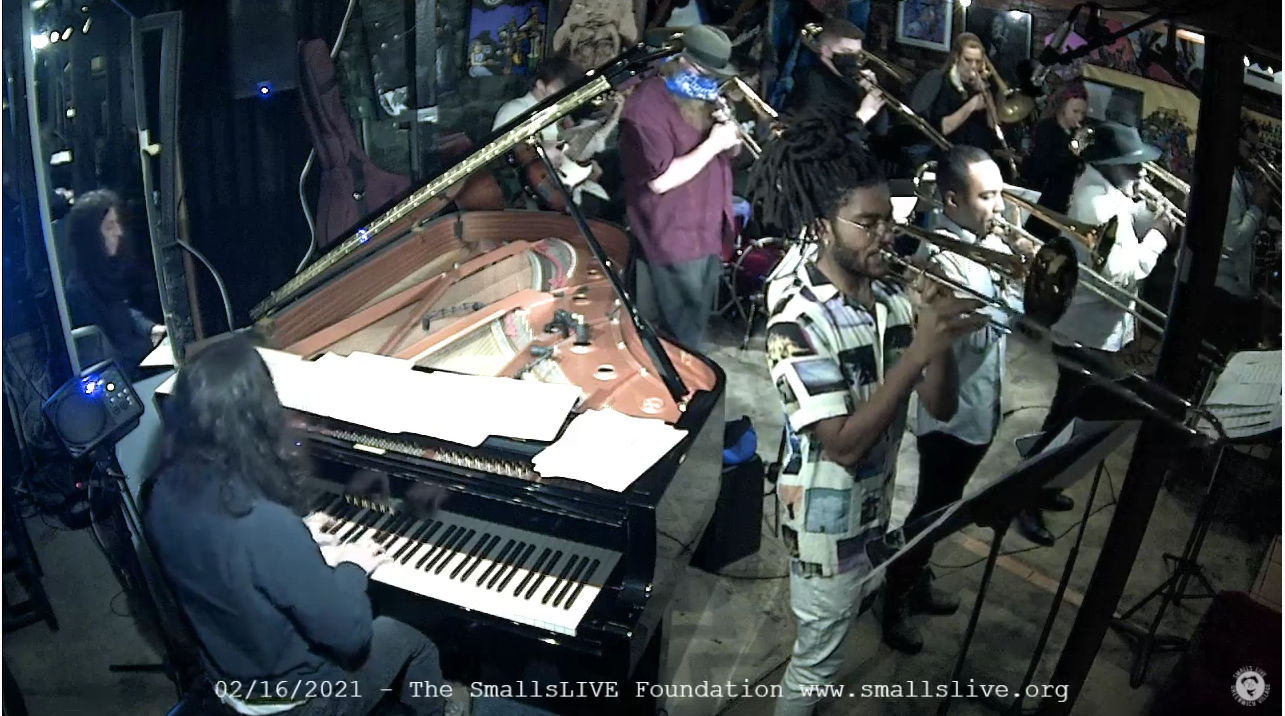
Frank Lacy’s Trombonivers at Smalls, image taken from stream and edited
Frank Lacy’s Trombonivers at Smalls
One of the great things about Smalls in its public incarnation was – through their late-night jam sessions – they provided more public showing-your-ass stage time for young players than anywhere else in the current state of moneyed Manhattan, while still having the core house band be professional enough that if things went south it didn’t go on so long it drove the post-midnight crowd back up to 10th Street.
Great trombone player and bandleader Frank Lacy also has a reputation as a great teacher and encourager of young talent. For a vibrant Smalls set that brought tears to my eyes and made me dance around the room, he convened 8 fellow trombone players across the spectrum of experience – Corey Wilcox, Rashaan Salaam, Corey Wallace, Colman Hughes, Alevtina Wilcox, James Rodgers, Jacob Melsha, Maxine Troglauer – along with a sizzling rhythm section of Felix Moseholm on bass, Evan Sherman on drums, and Jon Elbaz on piano.
Appropriate for Fat Tuesday, that instrumentation soared through strutting New Orleans material with teeth like Ellis Marsalis’s “Nostalgic Expressions.” They also played with dynamics, harmonies like slow molasses seeping into a holy river then evaporating into colored smoke on a ballad original of Lacy’s. That ballad, with an insinuating, punchy bassline from Moseholm melted into one of the great ballads, Monk’s “Crepuscule for Nellie, with the horns capturing all that kaleidoscopic color, bouncing back and forth between dramatic punctuation and a silken waltz.
Probably my favorite – or at least most surprising – tune from the set was a funky dance take on Wayne Shorter’s “Palladium,” a highlight from the first Weather Report record I bought as a kid. Explosions of dive-bomb harmony with a thick, sultry bottom and a particularly smoking drum solo from Sherman which hinted at the Latin elements of the original without falling into cliches.
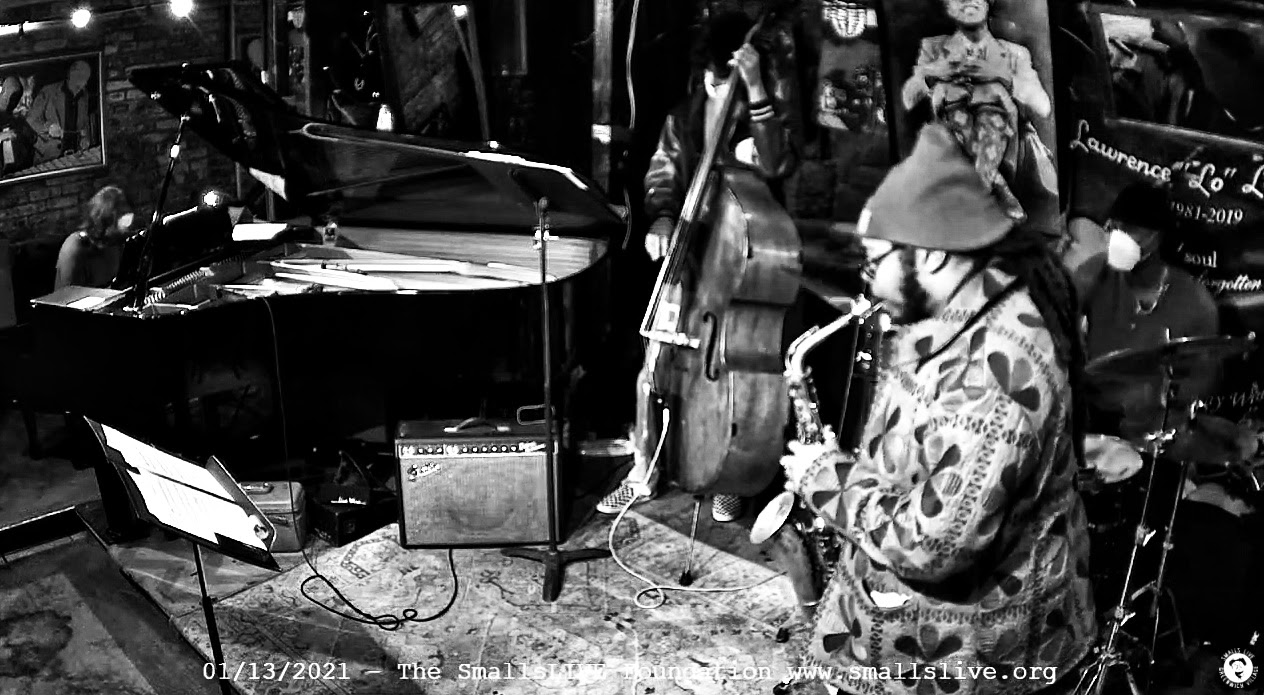
Immanuel Wilkins Quartet, from left Kris Davis, Daryl Johns, Immanuel Wilkins, Kewku Sumbry; taken from stream and edited
Immanuel Wilkins Quartet at Smalls
I mentioned APAP in last week’s writeup. Generally, in one of these years when I’d be in New York for mid-January, soaking up the remnants of arts presenters’ bounties, I’d be catching between 6 and 20 sets over a few days of Winter Jazz Fest. WJF’s excellent pivot of panels and performances is going on through March, but I caught a few streams that gave me some of that feeling.
The set that gave me the heftiest dose of that energy came from a stalwart of the classic NYC clubs and at the vanguard of this new digital era, Smalls. Immanuel Wilkins (also a standout on Joel Ross’ astonishing record last year) and one of our finest alto players, lead a striking quartet with Kris Davis (who closed out my previous New York trip with an explosion) on piano, Daryl Johns on bass, and Kweku Sumbry on drums.
The group wove together songs into unbroken suites, building landscapes and shifting them. Simmering, glistening ballads jostled with ecstatic classic fire music. Long, screeching cries curled like smoke into gorgeous melodies. Textures played out and expanded, then splintered and came together.
This set was everything I want from a band coming out of the jazz tradition. It made me miss New York, it made me miss walking down to Dick’s Den on a good night, and it made me miss being in the room; at the same time, it reminded me how lucky I am to have this option.
From left: Vijay Iyer, Arooj Aftab, Shazad Ismaily; taken from stream and edited
Love in Exile at Jazz Gallery
Jazz Gallery continues to present a wealth of fascinating programming in its streaming iteration and I was enthralled by their trio this week of pianist Vijay Iyer, multi-instrumentalist Shazad Ismaily (both of whom I’ve seen many times) and vocalist Arooj Aftab whose name pricked my consciousness when she played a Big Ears but I’d never seen.
This was an astonishing, glowing hour of music. Mostly working in these slow, unfolding oceanic tempos, the trio displayed an uncanny telepathy. On one piece, Iyer’s exploded flurries of his classic diamond hard-and-glistening attack into spaces left by Aftab’s silky melodies and Ismaily’s circular, hypnotic bass. Another used that tempo to expand into a rich, cinematic, baroque ballad, riding accumulations into a majestic cascade.
Other pieces had Ismaily bringing in a droning keyboard tone to underpin a dual longing between Aftab and Iyer. Beautiful and beguiling.
Espíritu; shot taken from stream and edited
Espíritu at Under the Radar
Caught up on the rest of the previous week’s Under the Radar and my favorite piece, Espíritu, came from the Chilean company Teatro Anónimo and the pen of Trinidad González.
It focuses on – mostly young – people grappling with the deep sickness of ennui and hopelessness. As one character says early on, “We are just a group of useless people with a great plan to stop the destruction of the world.”
That plan staggers and stumbles, people are wracked by cruelty and driven into impoverished fantasies that pass that cruelty on through jagged vignettes. Lines like “People yell at me and that makes them happy…Sometimes they think they’re making love but it’s something different from love. Do they dream?” and “If I were your father I’d burn that notebook and send you off to fight a war,” haunted me for days after seeing this.
If I were managing a company, I’d program a double bill of this with Matt Slaybaugh’s The Absurdity of Writing Poetry but there are probably dozens of plays about fighting despair with art, even, especially, when it feels hopeless, this would productively spark against. It made me miss UTR, made me miss NYC, and made me miss the theaters where I first loved work like this in the Wexner Center and at Available Light.
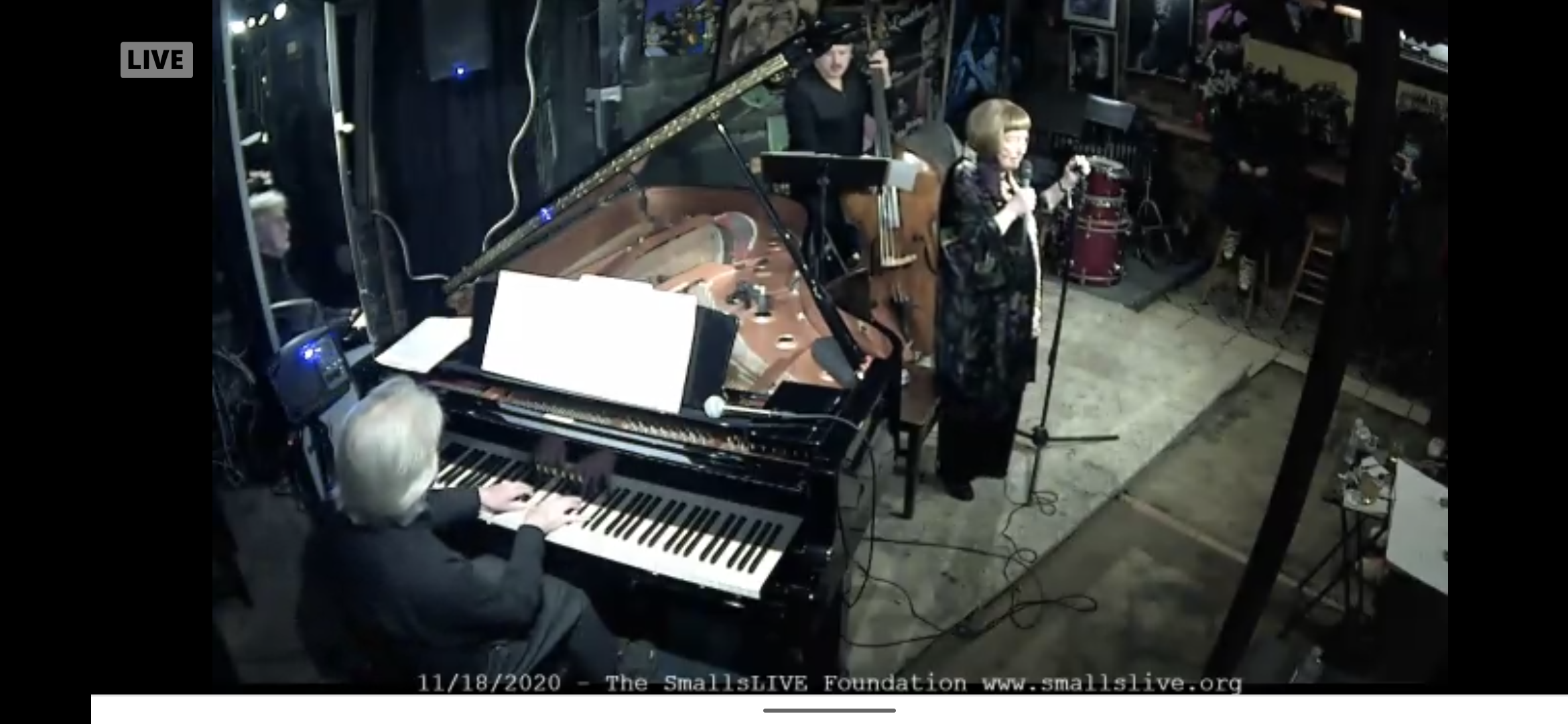
From left: Alan Broadbent, Sheila Jordan, Harvie S. Taken from stream and edited
Music: Sheila Jordan Trio at Smalls Live
I’ve waxed rhapsodic here about Smalls constant creativity and persistence to bring musicians together to play. In the last few weeks, they’ve carefully and strategically brought in small audiences and I almost wept hearing – from my kitchen, many miles away, missing New York in a week where Timehop reminds me I was at least three of the last six years – the great Sheila Jordan celebrate her 92nd birthday in this storied club.
A direct line to Charlie Parker, Lennie Tristano, and Charles Mingus – one of few left – Jordan took us to school with this survey of the great American songbook and this reminder of the glory of following one’s interests, wherever they land.
Backed by her longtime bassist Harvie S and New Zealand native Alan Broadbent, two of the most sympathetic vocal-accompanists alive, she reminded us how ineffable, fleeting, and indelible beauty can be in song. Definitive, forged in years of experience, versions of “Autumn in New York” and “I Concentrate on You” were highlights in this delightful rain of gems.
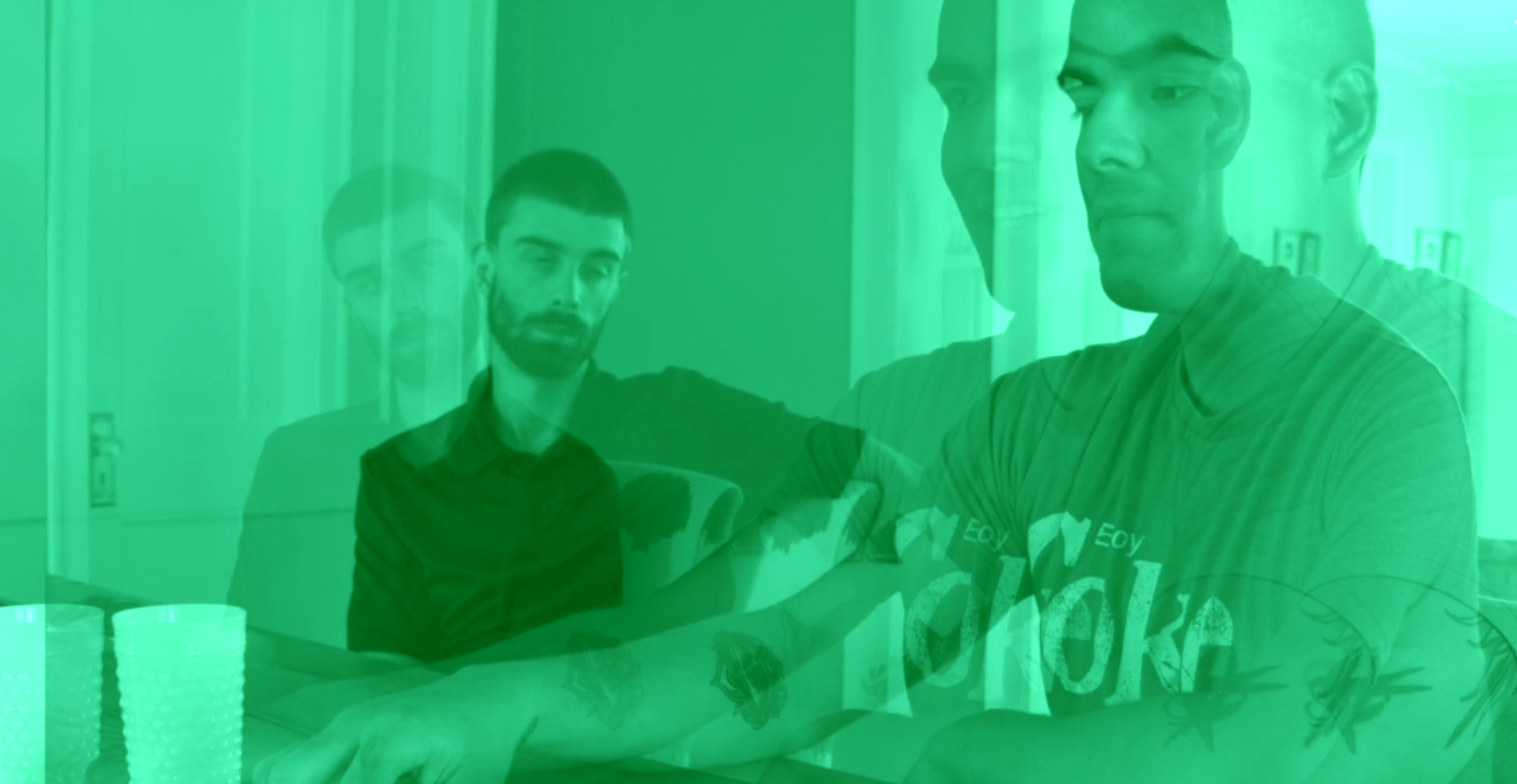
</remnant> presented by NYTW, screenshots taken from livestream and edited
Theater: </remnant> by Theatre Mitu, directed by Rubén Polendo.
What’s memory mean to us? How do we piece these fragments together? Where does religion fit? How do we survive war? How do we stay connected with ourselves and a collective humanity? Cacophonies of voices and images fracture and coalesce in Theatre Mitu’s </remnant>, presented with New York Theatre Workshop, burning fragments into my brain.
This riveting exploration of memory – including memory as a feeding trough for trauma and the evolution of PTSD over the last century-plus set a high bar for these new digital hybrids that still felt like theater, that I was in the dark with other people even if I couldn’t see them, and with the fiery immediacy of something happening now even with the degree of editing and post-production visible.
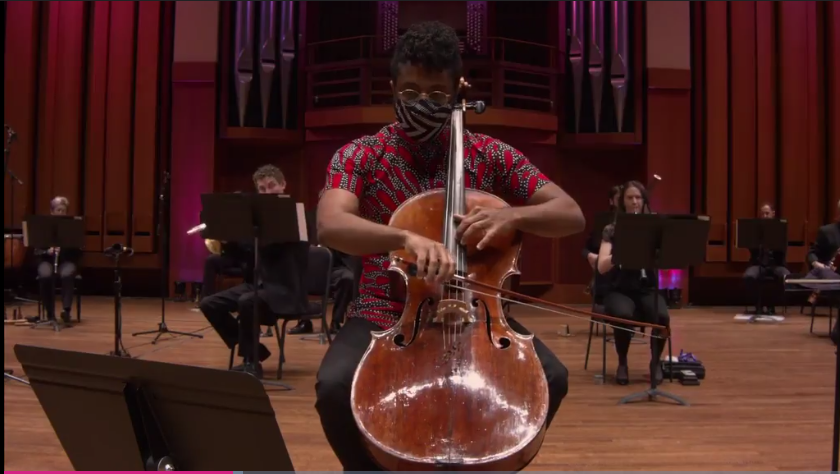
Seth Parker-Woods (foreground) with members of Seattle Symphony. Taken from livestream and edited
Music: For Roscoe Mitchell by Tyshawn Sorey, performed by Seth Parker-Woods and Seattle Symphony Orchestra.
Anyone with evening a passing glimpse of my taste over the years knows I’m an unabashed admirer of Tyshawn Sorey’s work as a drummer and composer. He continues a streak of astonishing large-format pieces with an astonishing cello concerto, For Roscoe Mitchell, performed by the Seattle Symphony.
The dazzling piece conjured Mitchell’s luminescent compositions without using any of his moves directly. Played beautifully by the orchestra and soloist Parker-Woods under the baton of David Robertson, I don’t even have words for how grateful I am for this remarkable series from Seattle Symphony in these trying times.




 Screen of Distance