Categories
Best Of visual art

Best of 2025: Visual Art

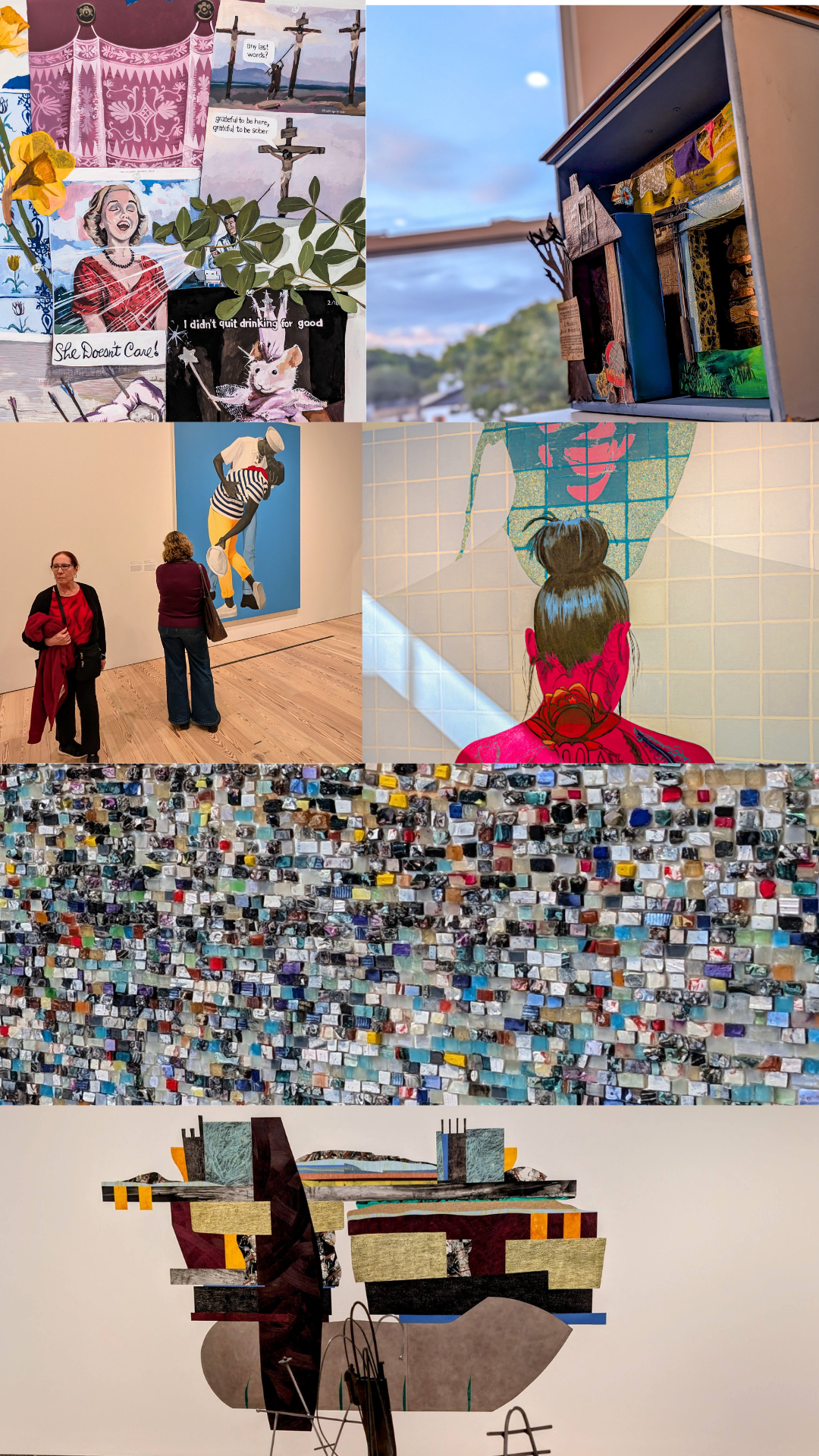
Incredibly strong slate of Visual Art exhibits this year, 70 shows across six cities. Less New York presence because I only made one trip this year and because it was celebrating my birthday less time to traipse through galleries, but what we saw there was choice. Getting to show my Mom an hour of Christian Marclay’s The Clock – not on this list because it was on it when I first saw the piece, but maybe my favorite single artwork of the last 20 years – was worth so much.

Everything on this list is in Columbus, unless otherwise stated. All photographs are by me; all art is owned by the respective artists. The list is in chronological order.

20 Favorite Visual Art Shows of 2025
  • Harminder Judge, Bootstrap Paradox (MOCA, Cleveland) – Fascinating spiritual abstraction dealing with death through changing colors. I was unaware of the London-based artist before walking into MOCA and walked away breathless.
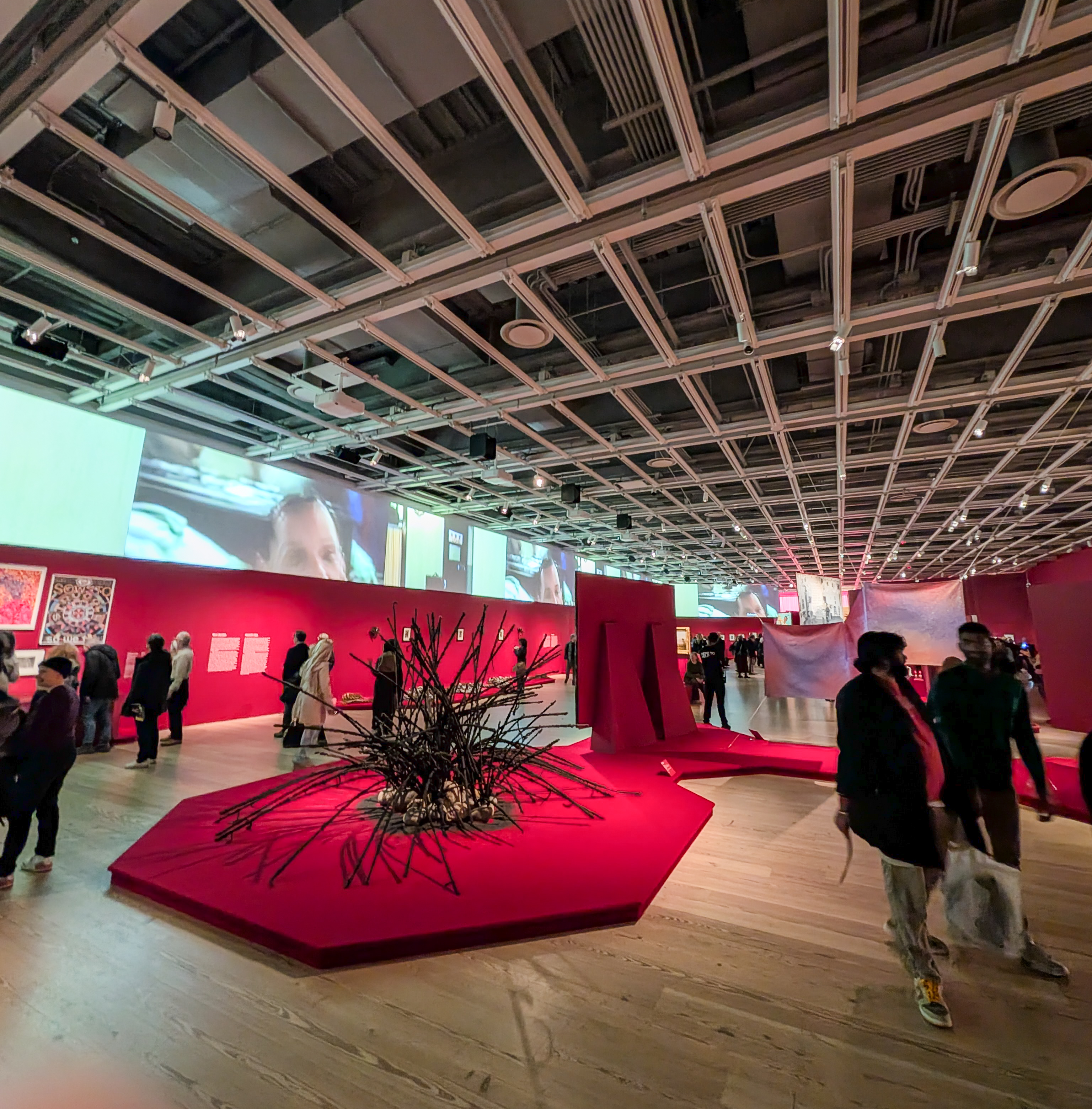
  • Various Artists, Pangrok Sulap (Red Gallery, Knoxville) – Big Ears Festival has stepped its visual art game up significantly over the last few years and this year I was especially struck by the work of this indigenous collective out of Malaysian Borneo (Dusun and Murut clans) where Pangrok means “punk rock.” Large scale, protest art that vibrated with the music bounding through the streets.
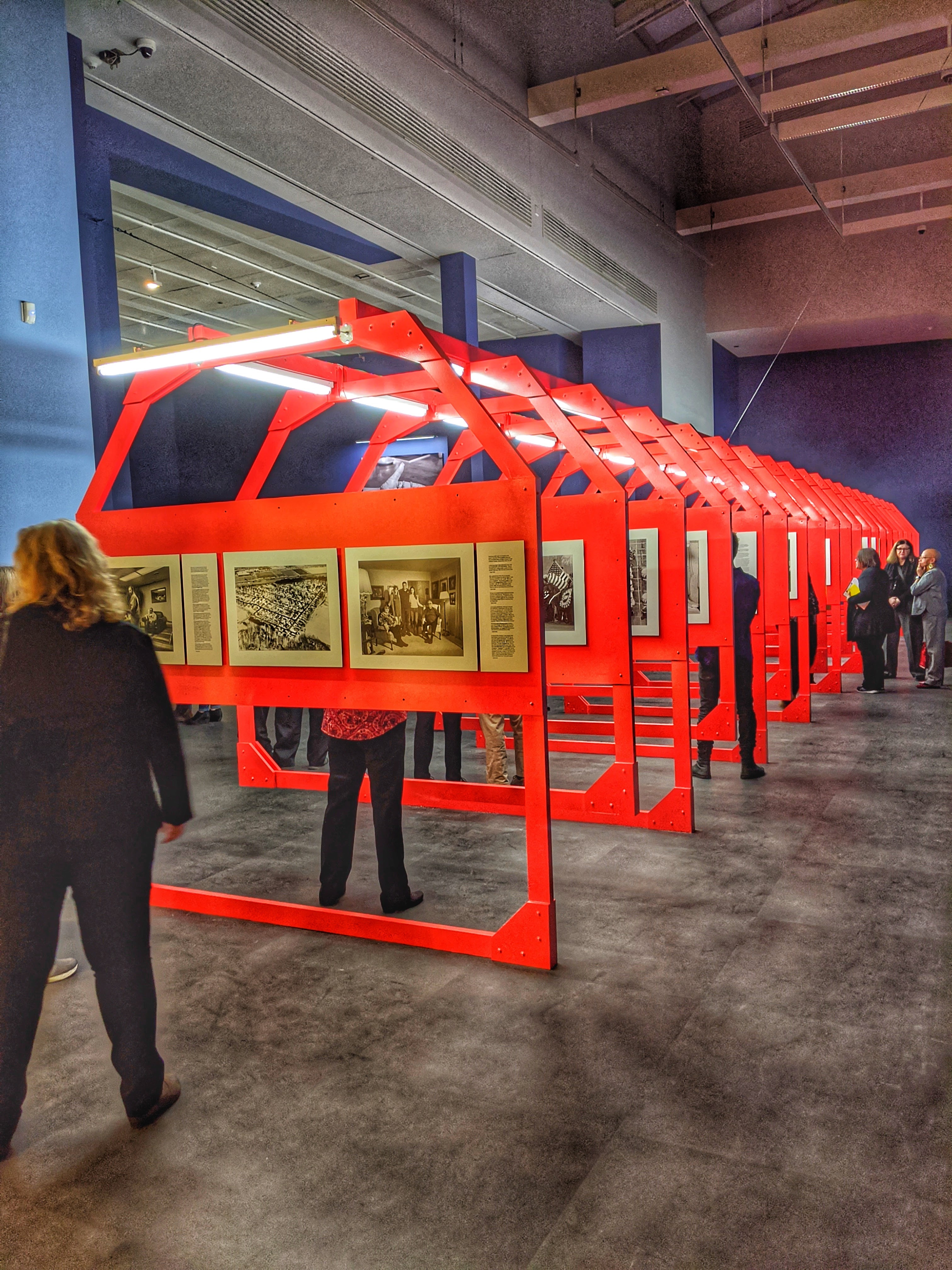
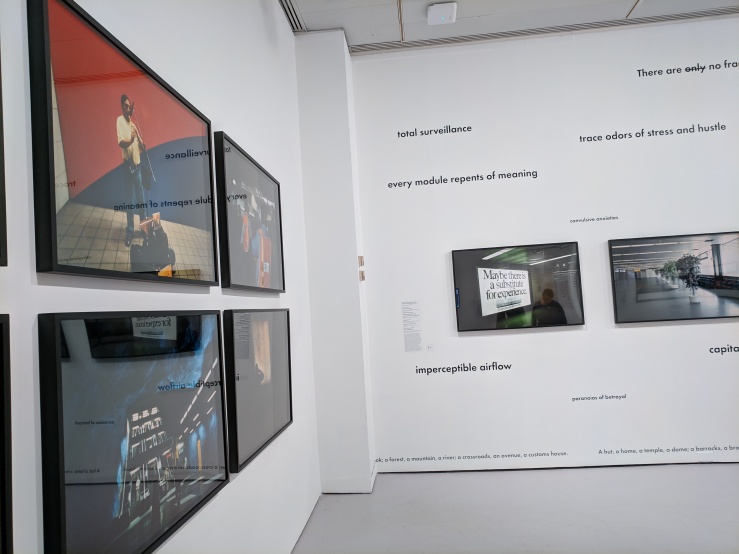
  • Taryn Simon, Taryn Simon (Gagosian, NYC) – Another fascinating collection of protest/commentary art including a riff on the kleroterion, an Athens election mechanism, and unsettling, beautiful photographs commenting on the current political moment without smashing us over the head.
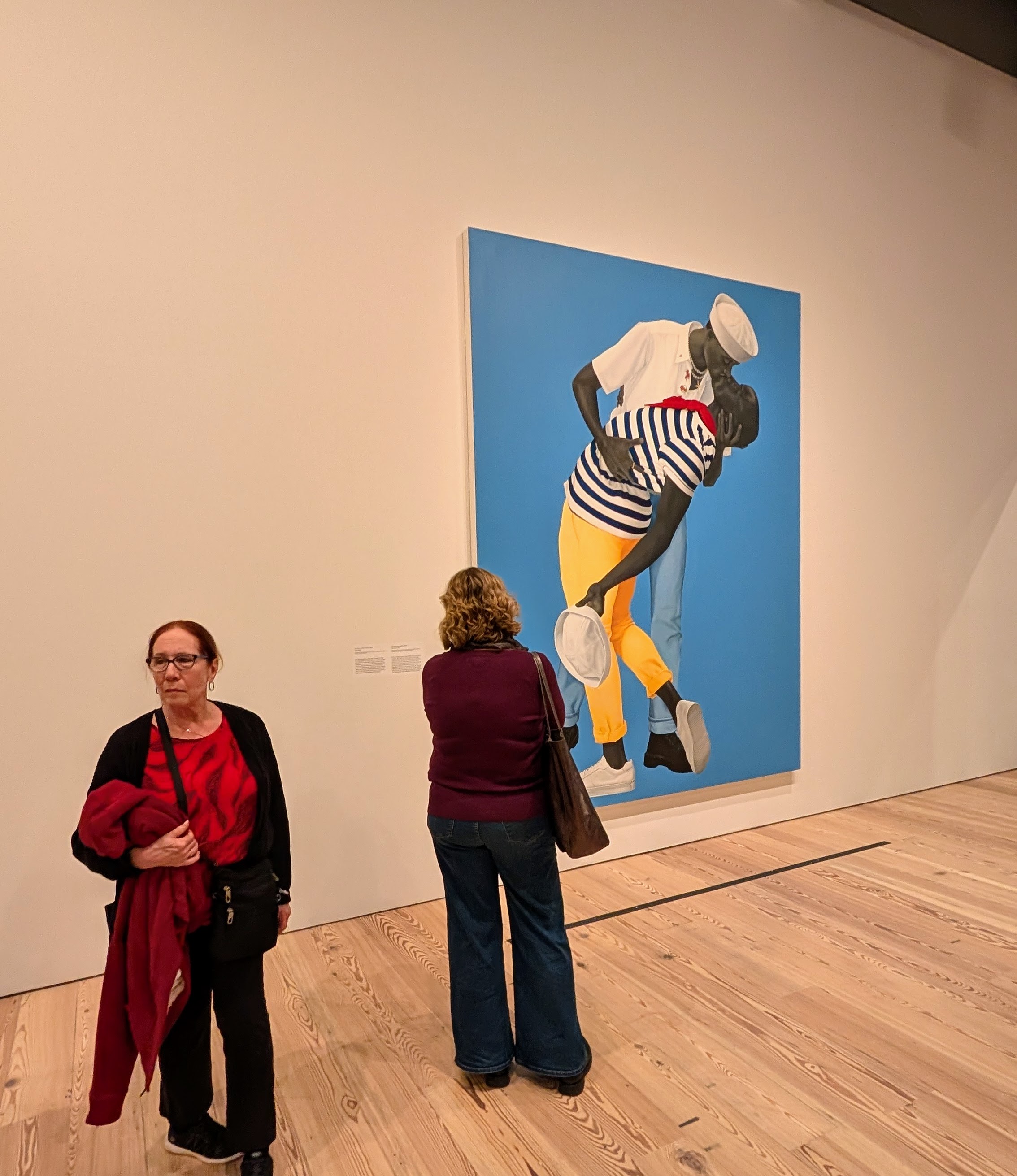
Amy Sherald, Whitney Museum (my Mom in the foreground)
  • Amy Sherald, American Sublime (Whitney Museum, NYC) – I knew Sherald’s portraits, but the Whitney’s exquisite, sharp presentation reiterated the cumulative power of seeing the massive scale of these pieces, often putting marginalized communities at a mythic/American mural scale, bringing them into a perspective that was a necessary corrective, and the number of canvases talking with one another. Also a show that benefitted greatly from the free hours – even though I have a membership to the Whitney, I loved seeing these with a wider range of people.
  • Jack Whitten, The Messenger (MoMA, NYC) – I’ve been a rabid fan of Jack Whitten since the Wexner Center show a few years ago and this fuller retrospective deepened his hold on me and my appreciation for his work, as well as letting me turn my Mom and my friends Daria and Marie onto his work.
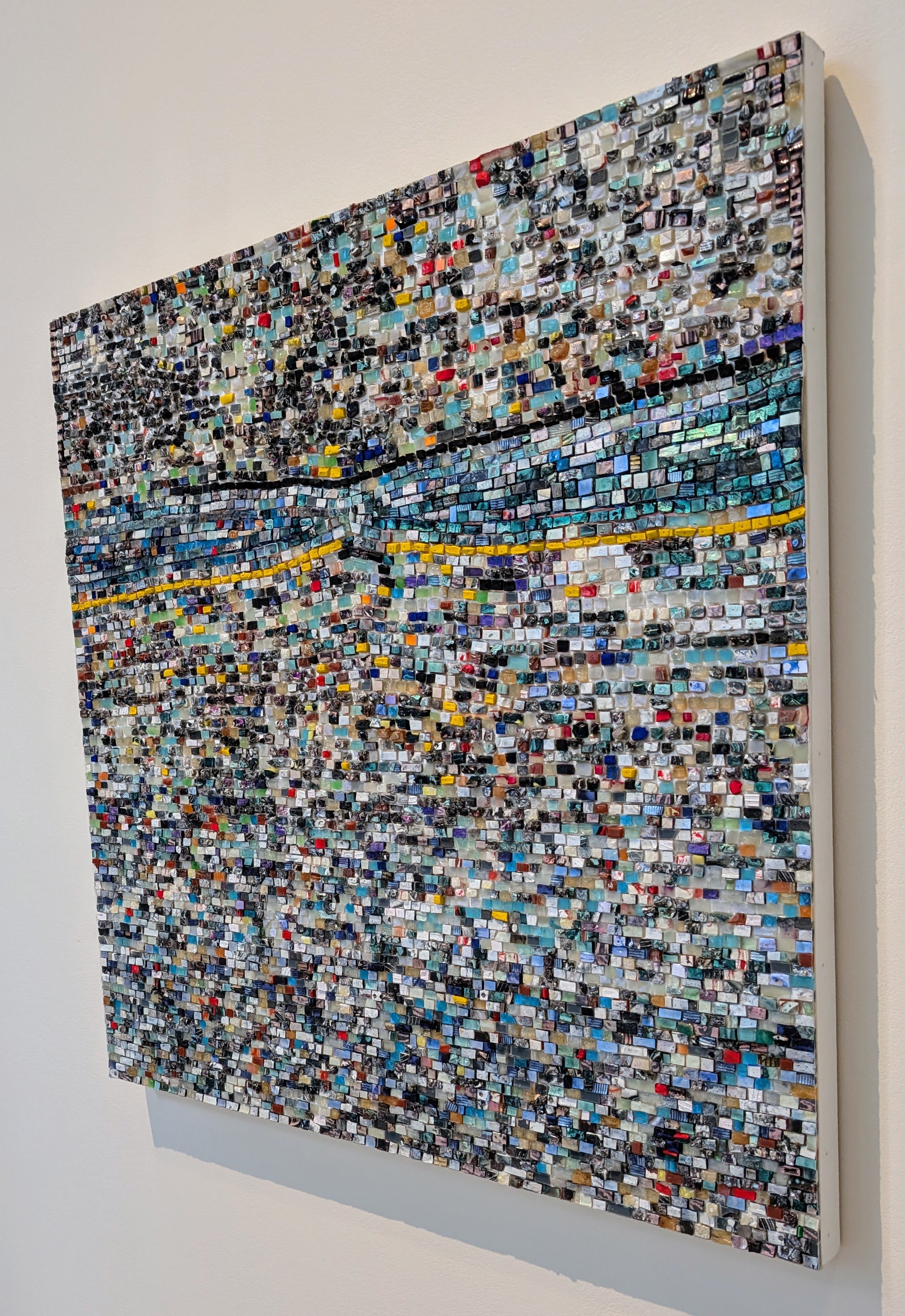
Jack Whitten at MoMA
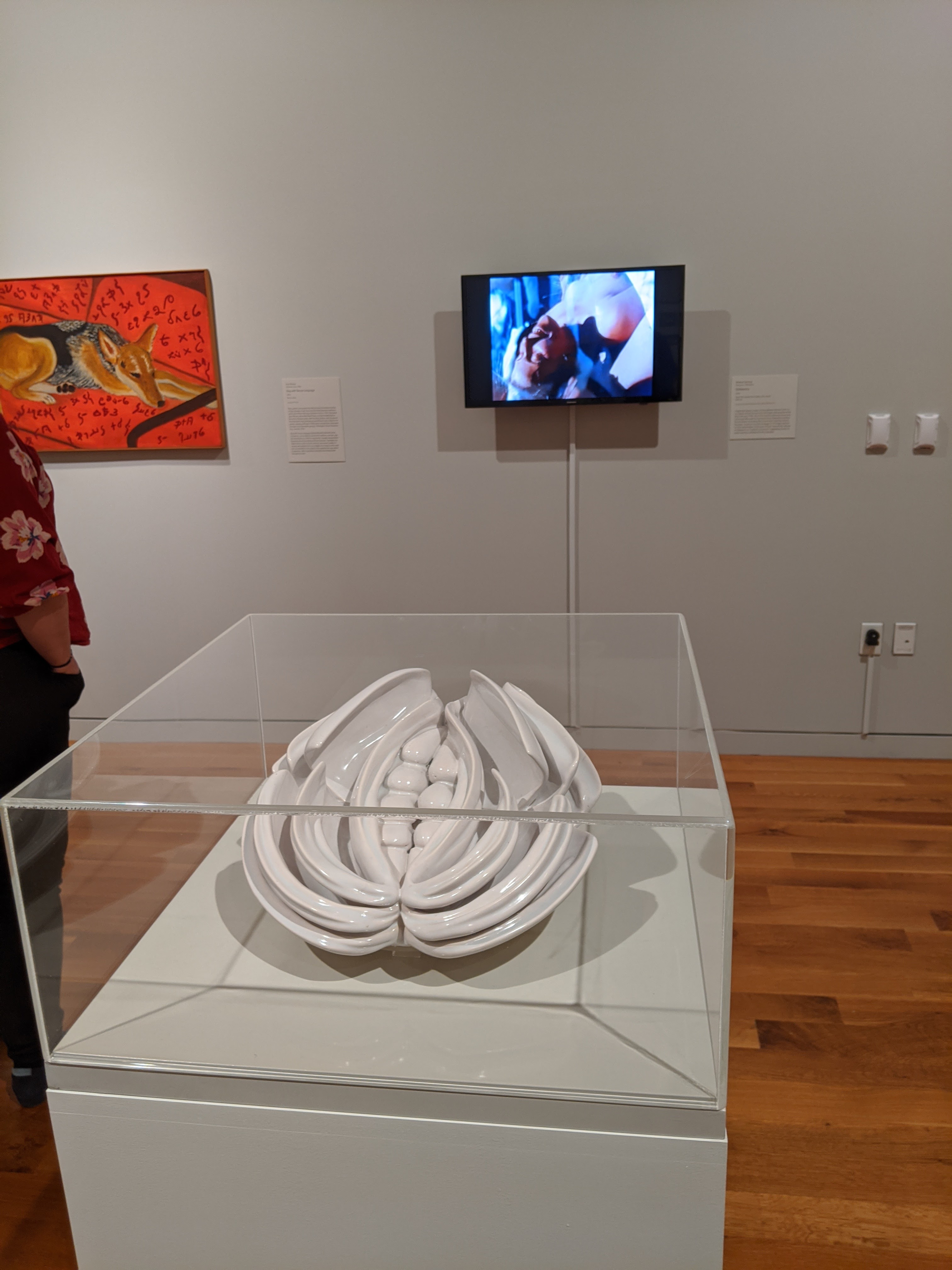
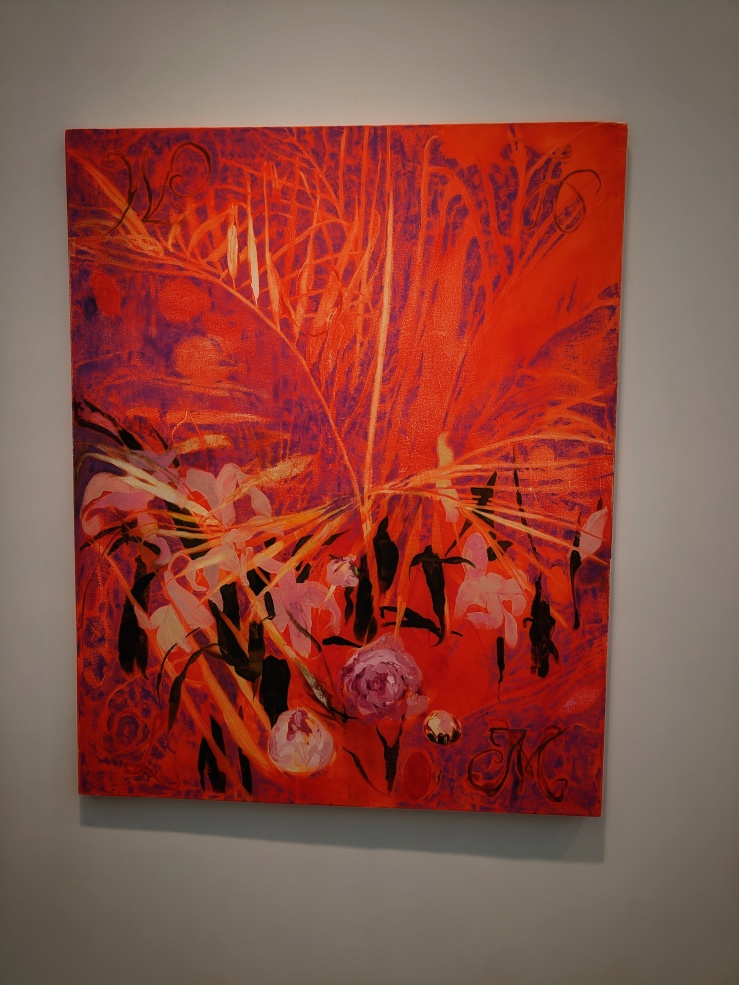
  • Elsa Muñoz, Botánica Apokaliptica (Pecha Projects) – The side room of the new Brandt Gallery – which has been killing it in general this year – provides a space for more angular, challenging work. This, my first exposure to Muñoz, was a rich, poetic, haunting collection of pieces that really spoke with one another.
  • Carol Tyler, Write it Down, Draw it Out: The Comics Art of Carol Tyler (Billy Ireland Cartoon Library and Museum) – Not just one of the best exhibits I’ve seen in the Billy Ireland (which consistently impresses me), one of the best curated (by her daughter Julia Green with additional exhibition labels by John Kelly) exhibits and one of the most successful examples I’ve seen of using the gallery space itself and integrating ephemera to tell a story ever, in any medium. Still thinking about this astonishing exhibit.
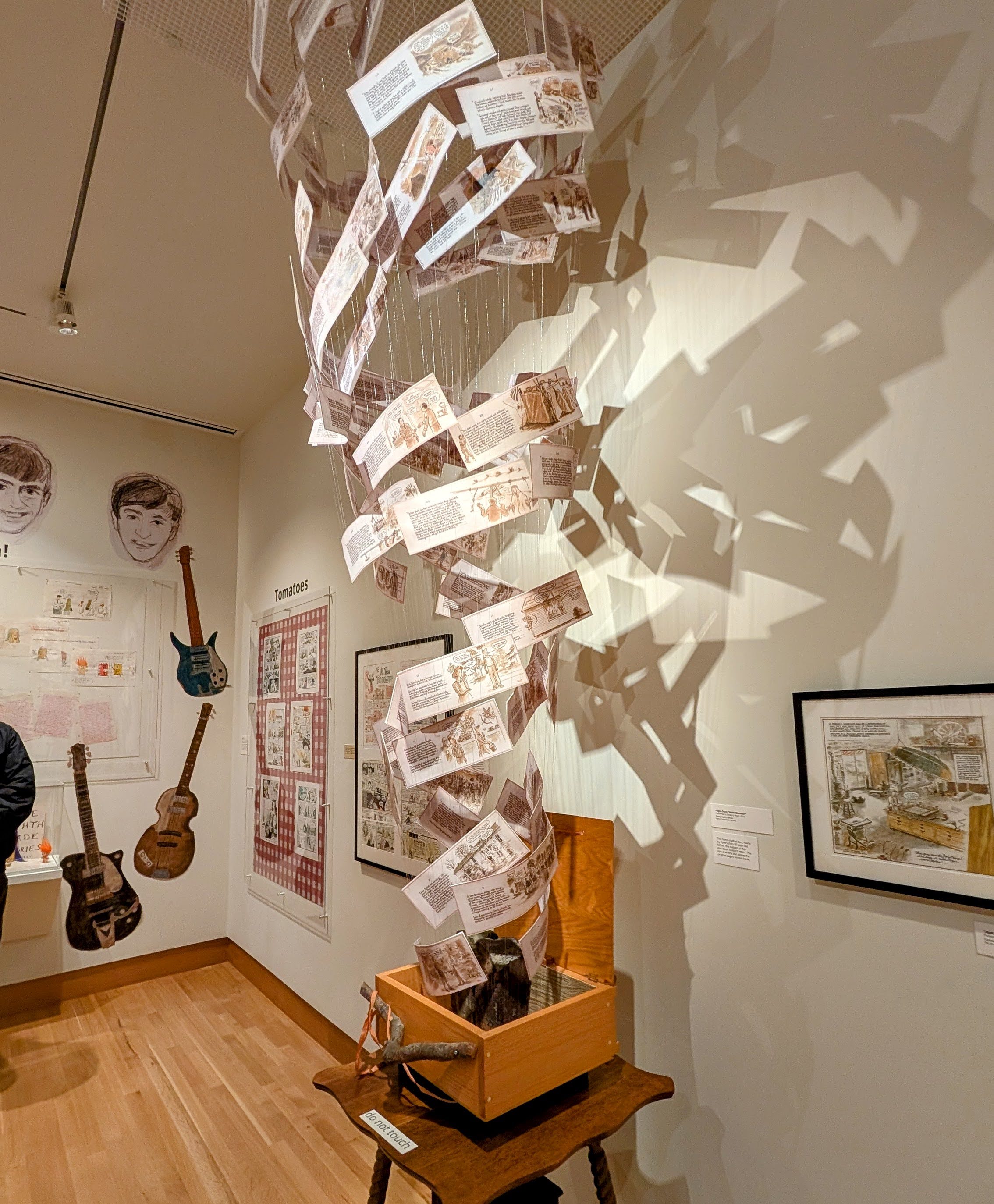
Carol Tyler at Billy Ireland
  • Richard Lillash, Interior Spaces Beyond the Surface (Brandt Gallery) – I knew Richard Lillash mostly as a musician from his role in Don Howland’s blown-out-blues duo The Bassholes, though I knew I he was a visual artist. This witty exhibit that played with thoughts of Chagall and de Chirico and direct references to other art was revelatory.
  • Maren Hassinger and Senga Nengudi, Las Vegas Ikebana (Columbus Museum of Art at the Pizzuti) – An astonishing tribute to long-term collaboration and community, seeing the way these two artists developed independently and came together, even on different coasts. Also, a beautiful reminder that the Pizzuti is back.
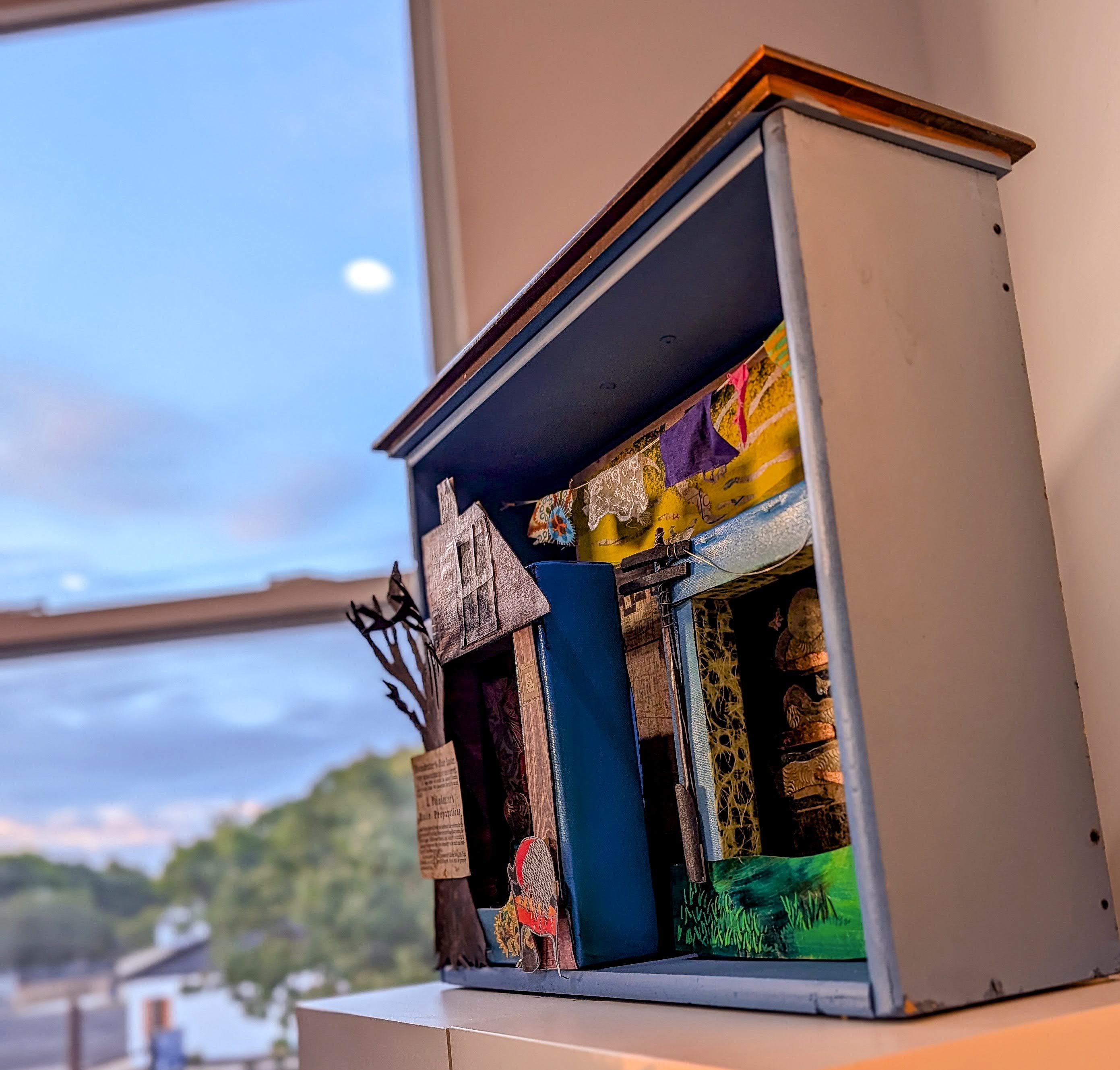
  • Tiffani Smith, GreaseNTheRoot (Streetlight Guild) – Streetlight Guild killed it this year; every time I walked through the door, I was richly rewarded. In particular, the gallery exhibits bore the fruit of tending community, curation as an act of love, and a reminder that love means holding people and work to higher standards. Tiffani Smith’s collages and sculptures pulled together threads of Black history, personal ancestry, and a keen eye to the ways those forces shape the present and future in a way I’d never seen before.
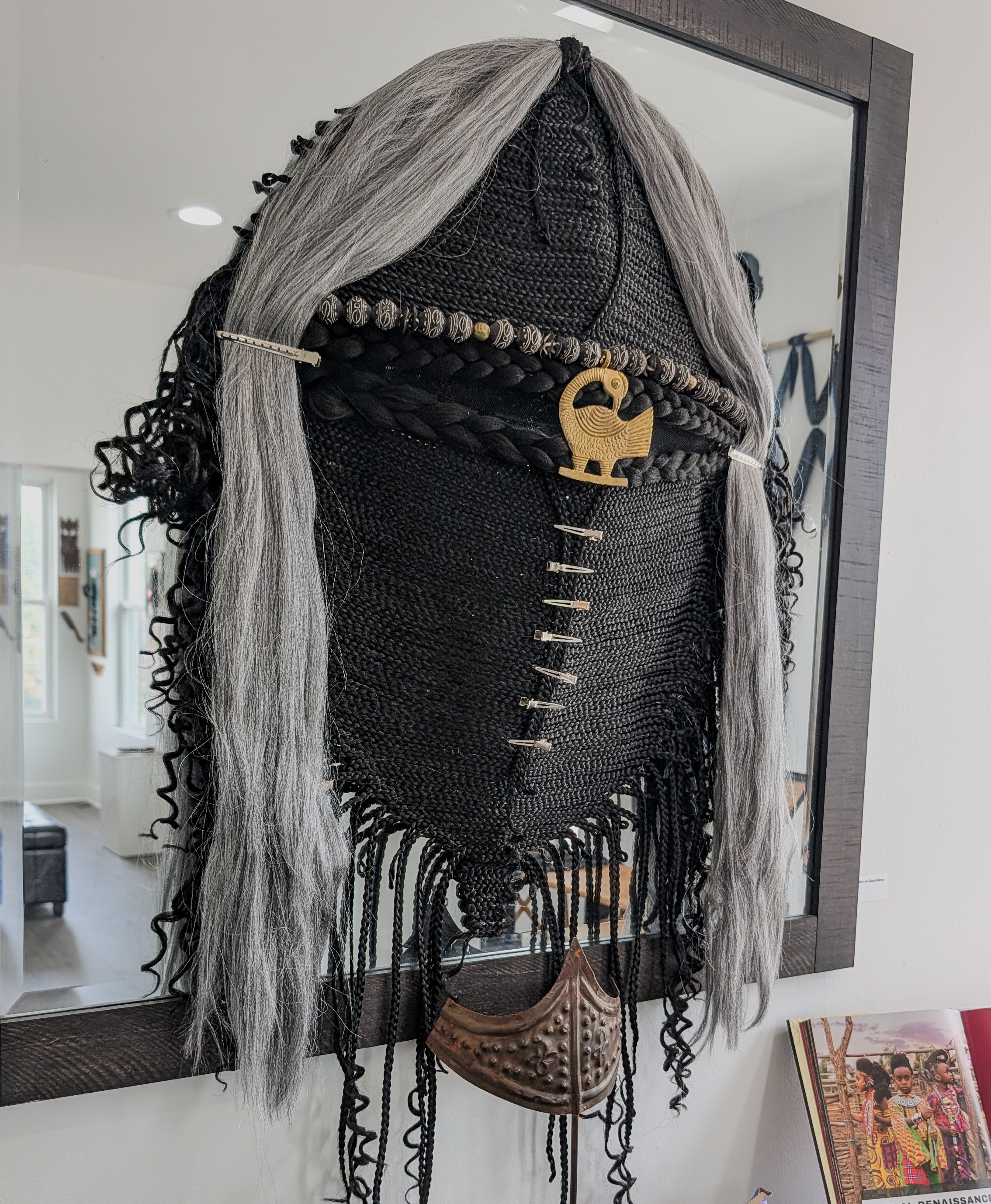
Tiffani Smith at Streetlight Guild
  • Tiffany Lawson, What If I Told You It Was Freedom (Streetlight Guild) – I was already a fan of Tiffany Lawson’s work, but this astonishing exhibit expanded, sharpened, deepened everything I love about the way she brings specific narratives to vibrant, surprising life. Hearing Mark Lomax (in the solo recital that made my live music year’s best) give introductory remarks about the difficulty of “making dope shit… Genius, we all know geniuses, but this…[gestures around] this is dope.” Not only do I agree with that sentiment wholeheartedly, but months later, that memory is a reminder of what a special situation Scott Woods has created with Streetlight Guild – where one of our town’s preeminent artists of decades can say it about one of our rising stars, and it just happens on the regular. Years and years of diligent community building and care were required to make this “just happen” and that should get called out a little more often.
  • Susan Watkins, Susan Watkins and Women of the Progressive Era (Dixon Gallery and Gardens, Memphis) – Beautifully curated exhibit of an artist who’s less well known than she should be with her archive tied to a single museum. This acted as a corrective and also helped put her work in context.
Tiffany Lawson at Streetlight Guild
  • Katie Davis and Jennifer Nicole Murray, Saturated Solace (Sarah Gormley Gallery) – This year Sarah Gormley struck me with the thoughtful way exhibits are put together, the careful, incisive ways the artists dialogue. My favorite example – and there were several exhibits that were in heavy contention – paired Katie Davis, whose layered, mood-thick abstractions I’ve loved for a long time, with someone new to me, Jennifer Nicole Murray whose collages and unsettling realistic paintings merged a sharp point of view on the world at large (snatches of memes and TikTok catchphrases colliding) with inner lives in various stages of turmoil.
  • Harry Underwood, Mostly True Stories (Lindsay Gallery) – Lindsay Gallery also settled into its downtown location and never let up, everything I saw there was a winner. This combination of bucolic, idealized “golden age” scenes and text undercutting any sort of gauzy nostalgia burned into my brain and is still teasing me as I write this.
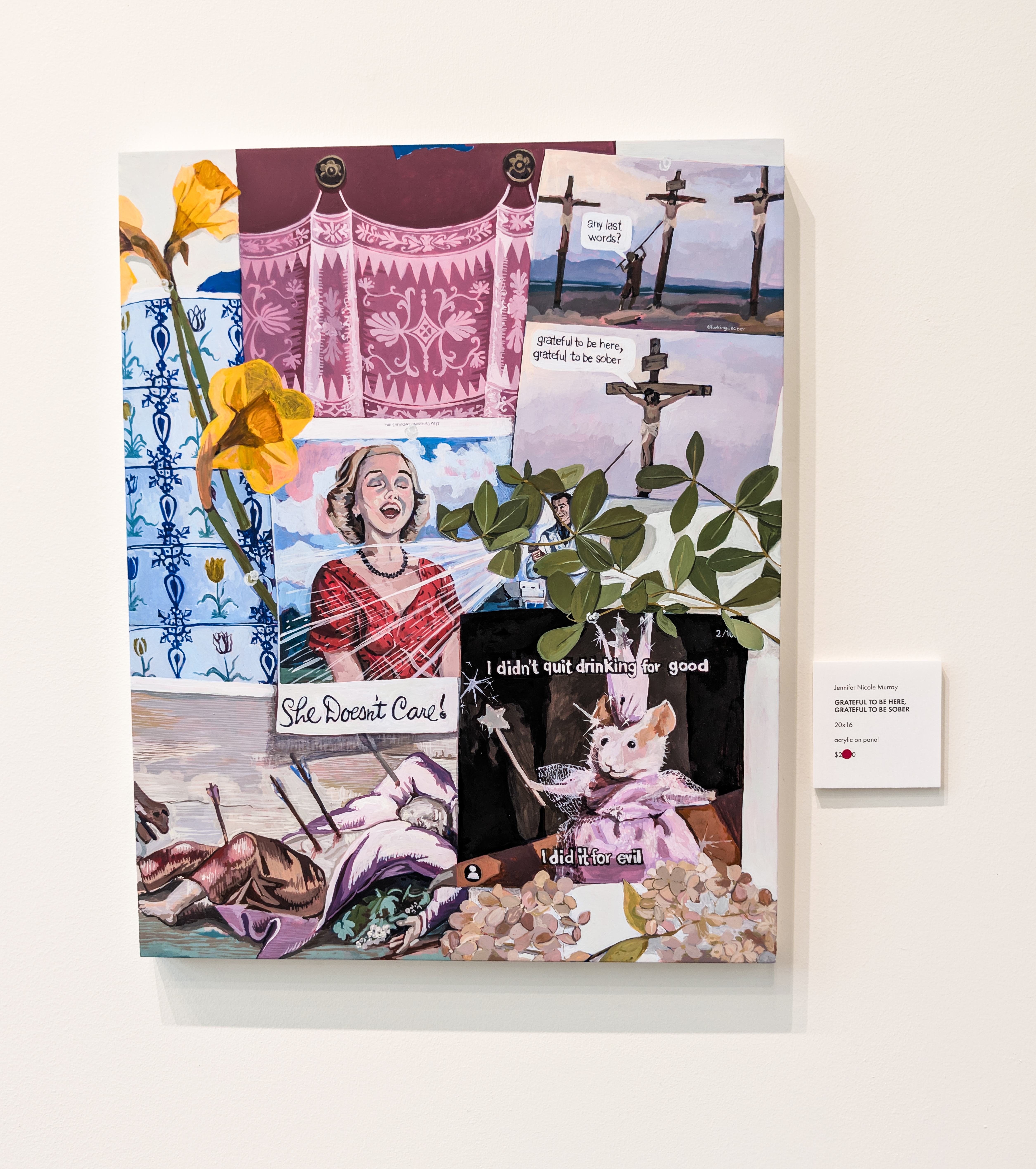
Jennifer Nicole Murray at Sarah Gormley
  • LaShae Boyd, A Letter to the Liberated Child (Brandt Gallery) – This show hit as hard as a sledgehammer but wielded by a dancer. The amount of intricate painterly craft and technique combined with the deep trauma inherent in the stories being told was an astonishing combination.
  • Veronica Ryan, Unruly Objects (Wexner Center for the Arts) – The play between containers and space in this largest exhibit I’d yet seen by this British sculptor beguiled me, unsettling and poetic and meditative. I came back to this show at least hair a dozen times and it kept revealing secrets.
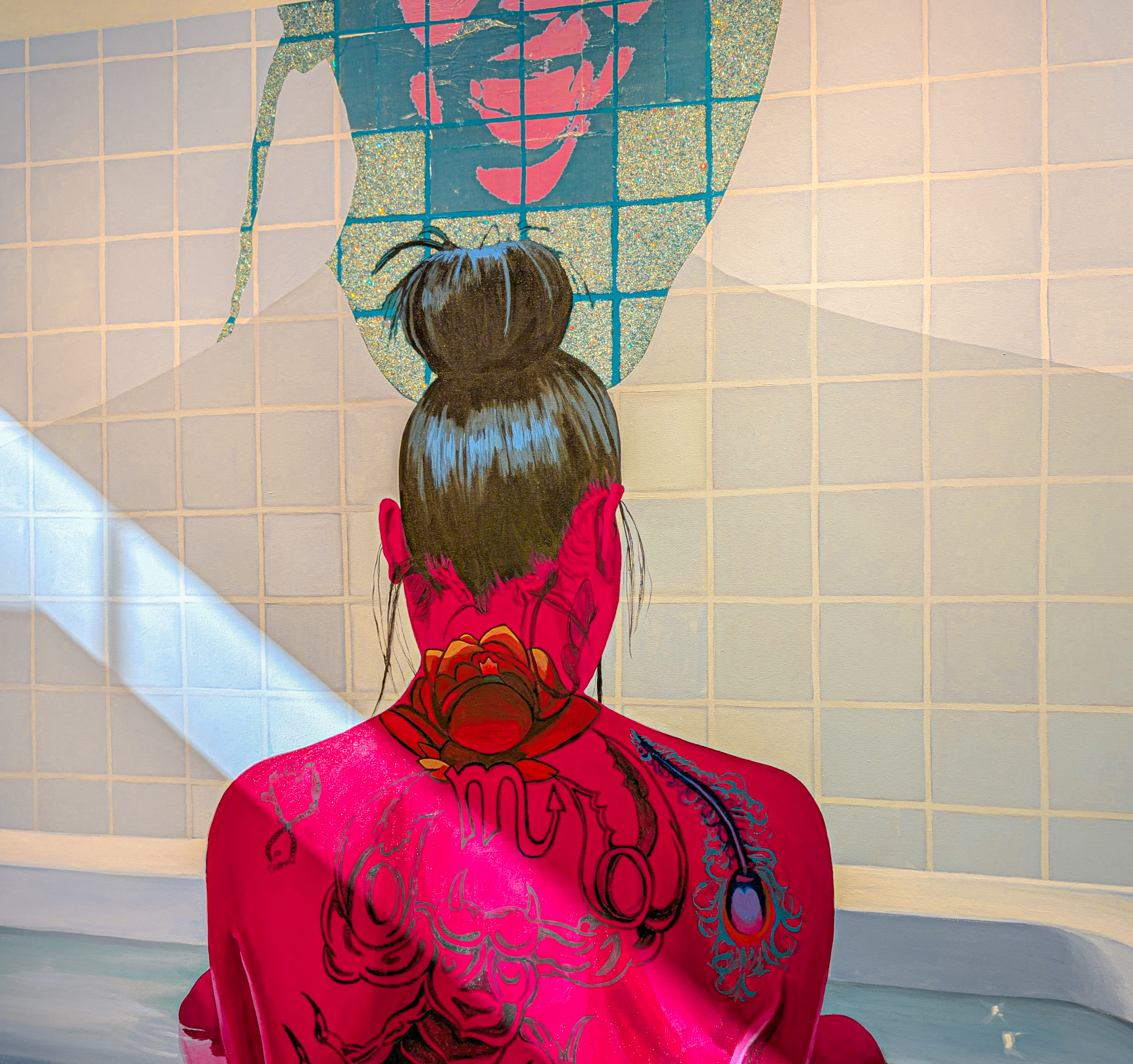
LaShae Boyd at Brandt Gallery
  • Nanette Carter, Afro Sentinels (Wexner Center for the Arts) – The new sculptures here in its eponymous series were astonishing but what I loved most were the juxtapositions, the interplay and the way pieces spoke to one another.
  • Florian Meisenberg, Florian Meisenberg (No Place Gallery) – No Place killed it in general this year but this impossible to categorize show of recent work by this Berlin-based painter took the cake for me.
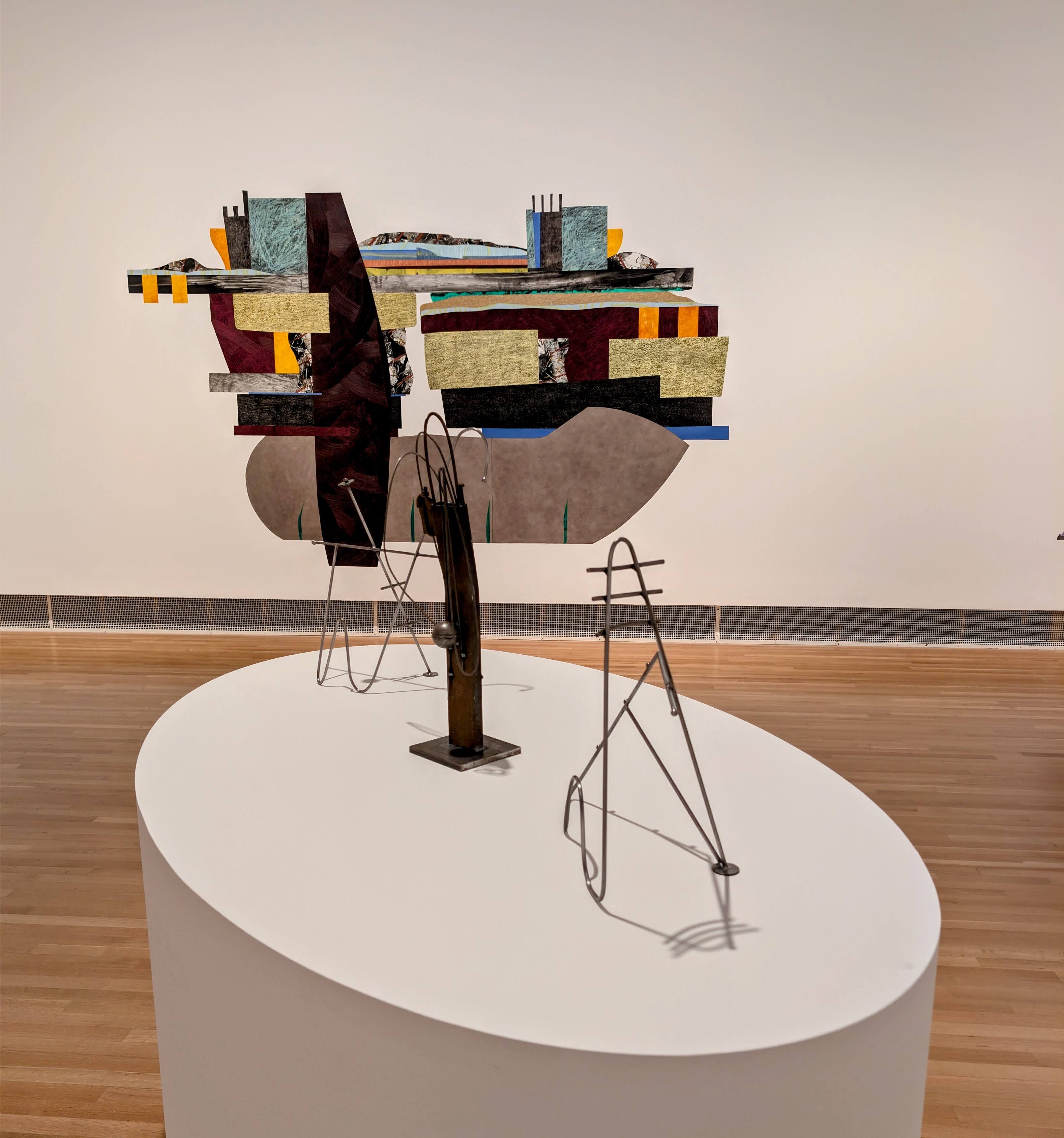
Nanette Carter at Wexner Center
  • Laura Sanders, Survivor Skills (Beeler Gallery at CCAD) – This exhibit of Sanders’s hyper-realistic paintings evoked powerful narratives of resilience and strategies.
  • Sarah Fairchild, The Gilded Wild (Beeler Gallery at CCAD) – Fairchild’s play with textures and materials had their best yet showcase in the large room of this Beeler show.
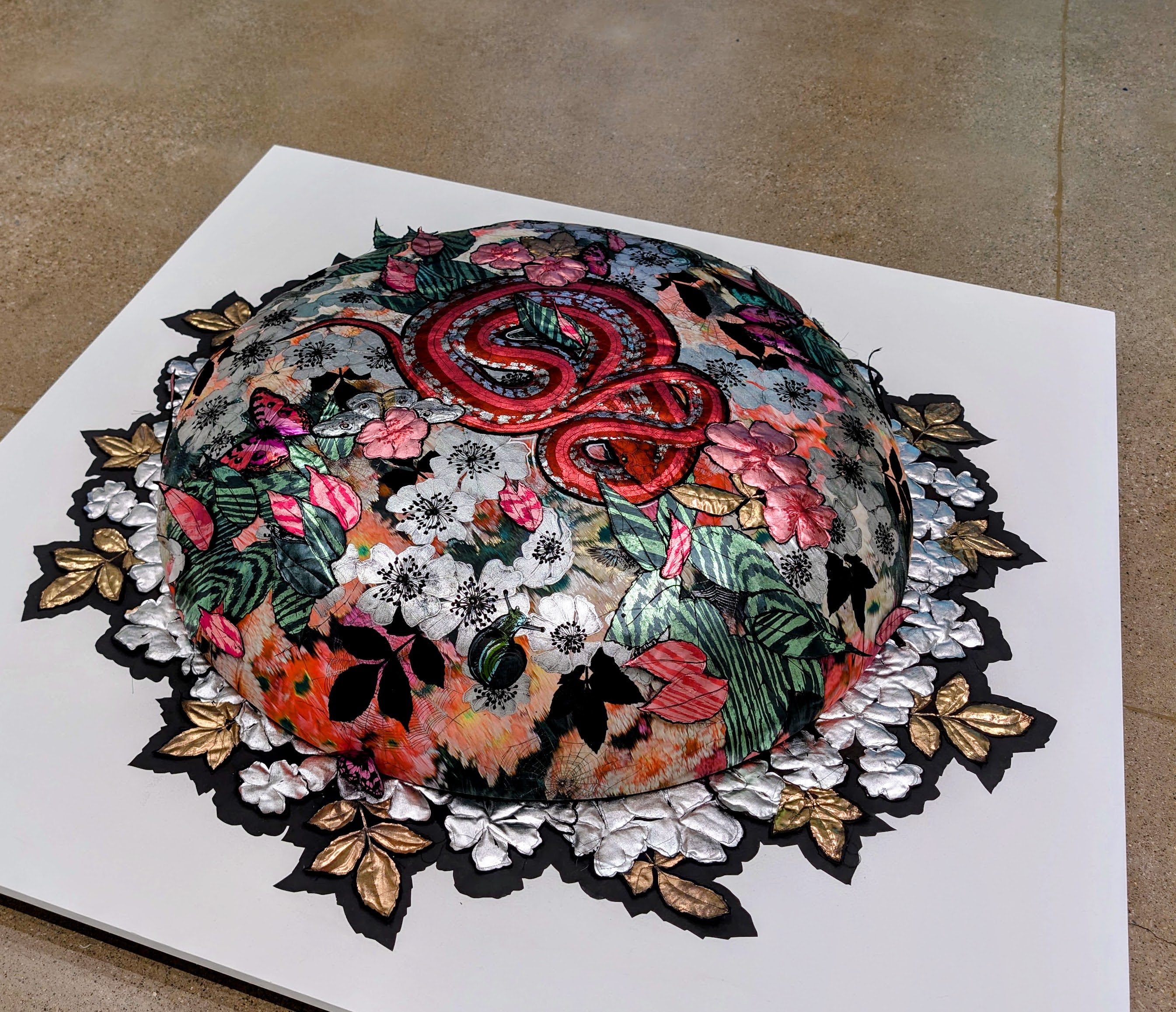
Sarah Fairchild at Beeler Gallery

Categories
Best Of visual art

Best of 2024: Visual Art

What an astonishing year for visual art this was – 64 exhibits in 6 cities, and very little of it let me down. I got my head turned around repeatedly and – for what’s in my town – I often came back again and again to drink from that fountain.

I want to take a few seconds for an elegy with the hope of rebirth for Skylab. I had dear friends who ran it over the years – I just saw one last weekend – and from the first time I went at 19 (ish), I knew my city was better for it. For that kind of a DIY space to hold on in a rapidly changing downtown for 27-ish (I feel like Berry Van Boekel and a couple of other people started hosting art shows in 1997 but I could be off by a few years) years is a marvelous achievement in itself.

Just as worth celebrating is the way it shifted with the interests of the residence but kept the quality so fucking high. The one exhibit on here I knew would be on this list within seconds of walking through the door, and it was of a lineage with the art I drank lukewarm cans of cheap beer and took in during my early 20s but for today. The music shows weren’t rage soaking out of my pores to Sword Heaven and Skeletons anymore, but the dance floor for Melanie Pagani one night I slipped into dance away the memory of a terrible play I saw was packed and the music was spectacular. If you have a few dollars, give to their relocation GoFundMe: https://www.gofundme.com/f/help-skylab-gallery-find-a-new-home

As with the other lists, everything here is in chronological order (the three Ming Smith exhibits are grouped based on the first one of those I saw), in Columbus unless otherwise stated, and any photographs are by me unless otherwise stated.

From An-My Lê’s Two Rivers at Moma, January 2024
  • An-My Lê, Two Rivers; MoMA, NYC – My first exhibit of the year, while in town on an impromptu trip around APAP, also coincided with a Members guided tour with a curator of this fascinating mix of installations, sculptures, and photographs drawing lines between war games and her family’s exodus from Vietnam, smashing decades and locations together in ways that included art history and a point-of-view. Staggering.
  • Various Artists, 24/7; Seventh Son Brewing x 934 Gallery – This ticked every one of the senses of community I’m often hungry for – Seventh Son’s welcoming spirit, 934’s interest in mixing up artists of various backgrounds and styles, and a use of the space that still sticks with me.
  • Various Artists, Y’all Don’t Hear Me: The Black Appalachia; University of Tennessee Downtown Gallery, Knoxville – It’s odd writing this blurb right after hearing the great poet Nikki Giovanni died since Big Ears Festival was the last place I saw her read (her hometown, to a packed 1,000+ room at the Mill and Mine), and this group show in tribute to Giovanni they put together the next year was already echoing in my mind. A beautiful cross-section of the black community in Appalachia that doesn’t get spoken of as often as it should and dazzling work.
From Y’all Don’t Hear Me, UT Downtown Gallery, Knoxville, March 2024
  • Kara Walker, Back of Hand; Poetry Foundation, Chicago – Any time I get to see new Kara Walker, I’m overjoyed and the Poetry Foundation was the ideal space for these gargantuan, moving works on paper.
  • Nicole Eisenman, What Happened; MCA, Chicago – I knew a little of Nicole Eisenman’s work but this retrospective did an astonishing job of putting the scope of her interest, her tweaking of art and social history and the way that history and community are vitally important. A show that reminded me to love the world over and over again, without shirking any of its ugliness.
  • Laura Sanders, Her Habitat; Contemporary Art Matters – Finally made it to Rebecca Ibel’s new downtown gallery this year, which was as strong as her previous space. The enormous canvases in Sanders’ show hit me with the way every scene feels suffused with light from the inside out. These paintings feel hyper-realistic at first but – like the plays of Annie Baker or Branden Jacobs-Jenkins – the realism almost bends into surrealism as it gets to a deeper psychological truth.
Nicole Eisenman, MCA, Chicago, April 2024
  • Pallavi Sen, Dream Time; No Place Gallery – No Place Gallery has been the most consistently striking – for my tastes – gallery in Columbus for years and Pallavi Sen’s watercolors surging with overlapping patterns and an intriguing sense of repetition, was a highlight of everything I saw this year; I went back three times and never got it but loved sinking into these shapes.
  • Joan Jonas, Good Night, Good Morning; MoMA, NYC – This was the finest example I’ve ever seen of translating performance art – especially the way documentation changed over the decades – into a formal museum space. Gargantuan, overwhelming rooms that conjured the power and intensity of Jonas’s work but also made room for intimate, punch-you-in-the-face direct interaction with these pieces.
  • Various Artists, The Harlem Renaissance and Transatlatic Modernism; Metropolitan Museum, NYC – I’ve been enamored by The Harlem Renaissance since a middle school English teacher turned me into Langston Hughes and Zora Neale Hurston, but this exhibit took the visual arts component of that movement – artists I knew pretty well like Archibald Motley and James Van Der Zee, and so many who were outside of my radar – and connected it to the larger world in a way I spent hours in and could have spent twice as long.
  • Melissa Zexter, Momento; Secret Studio – Secret Studio has turned me onto more of my favorite artists over the last few years than any other Columbus gallery. Melissa Zexter’s embroidered photography struck a nerve with me immediately while opening up an entire universe to me.
  • Various Artists, Clouds Are So Beautiful That I Can Bite My Toes; Skylab – This group show curated by Amari-Grey was an exposure to younger artists I didn’t know before walking through that door with work that knocked me sideways individually but built power and beauty through the conversation among them. Ducking out of the – also great – street fair atmosphere below, celebrating the massive hanging art Current and with my favorite DJs The Coming Home spinning into something knottier, more ambiguous, but still a celebration of life, was a reminder of how crucial Skylab has been as a place, a reminder, as Sun Ra said, “There are other worlds they have not told you of; I wish to talk to you.”
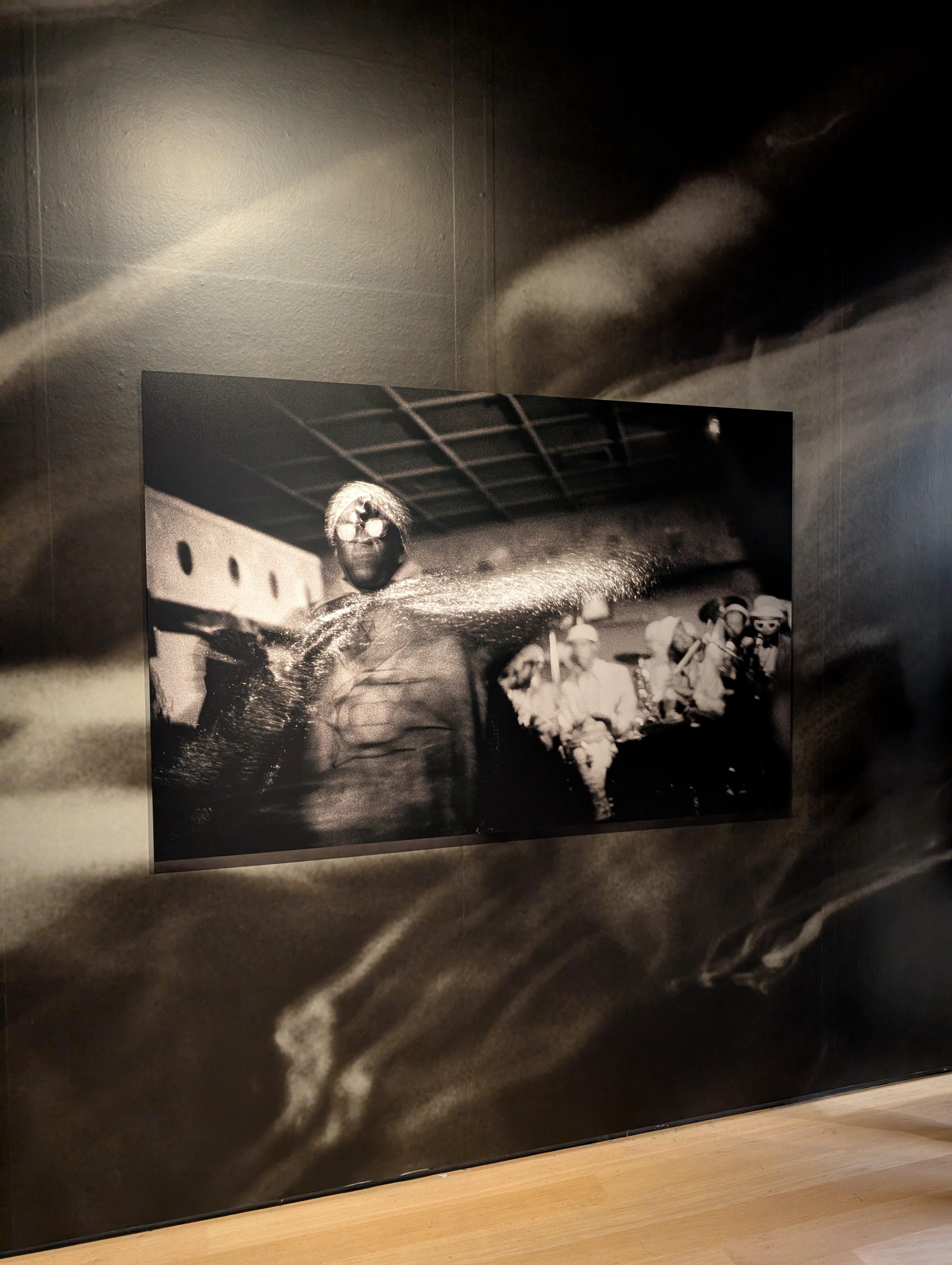
  • Ming Smith, August Moon and Transcendence at the Columbus Museum of Art; Wind Chime at the Wexner Center for the Arts; and Jazz Requiem – Notations in Blue at the Gund Gallery at Kenyon University – Having all three of these venues present Ming Smith (not born in Columbus but grew up here, not far from where I spent my childhood in the Hilltop) and showing different sides of her art was my single favorite visual art experience this year. The early trip to Africa juxtaposed against the stellar new installation at the Wex, the personally chest-cracking-open look at the Hilltop and the Ohio State Fair in 1989 in Transcendence, and the deep dive into Pittsburgh through the lens of August Wilson in August Moon at CMA, and the perfect conjuring of traveling and jazz icons, many of whom she knew personally, in these Bresson-y moments at the height of their power juxtaposed with the pause right before or right after being on stage at the Gund. This was probably one of the top ten experiences of my life, going through galleries and thinking about art. The kind of work that holds up just as much nerding out with people deep into their critical bag and taking my Mom and watching her be dazzled.
Ming Smith, Jazz Requiem – Notations in Blue at the Gund Gallery, November 2024
  • Rotimi Fani-Kayode, Tranquility of Communion; Wexner Center for the Arts – Another photographer whose work I knew slightly but this broad yet hyper-focused look at his work, curated by Mark Sealy, the director of Autograph, the London space/collective Fani-Kayode co-founded, was an explosion of myth (in a larger sense and also self-mythologizing), desire, fury and beauty.
  • Hannah Fitzgerald, There Are No Lies That Change the Version of You I Had; Urban Arts Space – Among my favorite parts of what Urban Arts Space has been bringing to town are artists I may have seen one piece of in a group show, and giving them a wider space to spread out. My favorite example of that this year – and there were several contenders – was Hannah Fitzgerald’s bodily, disorienting sculptures that recalled Louise Bourgeois, Paul Thek and Alina Szapocznikow, but with a completely unique feel and powerful point of view as they unpacked her relationship with her Mother.
  • Andrea Morales, Roll Down Like Water; Brooks Museum, Memphis – The Brooks in Memphis always has something that makes me overjoyed I made a couple of hours for it whenever I’m in that city I love, and they outdid themselves with this magnificent show of photographer Morales, one of the best explanations of Movement Journalism I’ve ever walked through and one of the most beautiful examples of clear-eyed empathy. Every turn I made here hammered me in the sternum.
Andrea Morales, Roll Down Like Water at the Brooks Museum, Memphis, September 2024
  • Lester Julian Merriweather, Ana*Log; Crosstown Arts, Memphis – Another favorite spot in Memphis over the last several years is the Crosstown complex, the rare renovation of an older building (once an enormous Sears distribution center) that feels like it’s doing things right, including its art gallery, classrooms, public radio studio, and clinic. This first exposure to Merriweather’s canvases winked at Jack Whitten, one of my favorites who I’m surprised I don’t see more influence from throughout the art world, but in a contemporary and personal way. These collaged and gridded abstractions struck a deep chord in me.
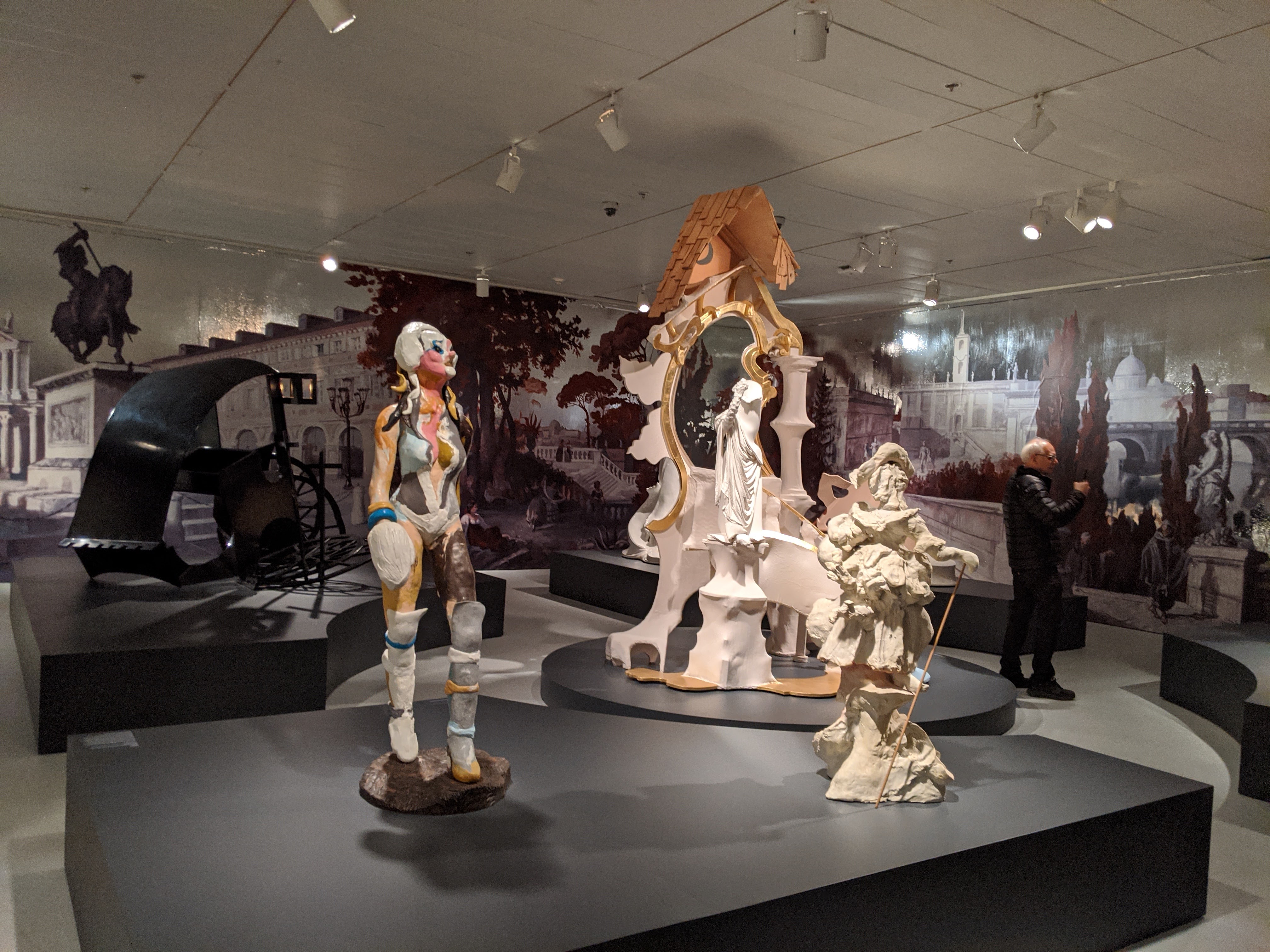
  • Cameron Granger, 9999; Queens Museum, NYC – I’ve been a fan of Cameron Granger for a few years – his show at No Place Gallery made my Best Of in 2022 and I still think about it and a film screening he set up at 934 Gallery last year, so I had to make it to the Queens Museum for his first solo museum show. This so far exceeded my expectations it left me floating through the park back to the train and – in a weekend I saw so much work that rocked me – may have been the finest thing I saw in those three New York days. The film at the center of the exhibit reminded me of the potential I saw in science fiction as as kid, to make metaphors real and force us to confront them, to explode our histories and our anxieties, and that only rarely delivers on.
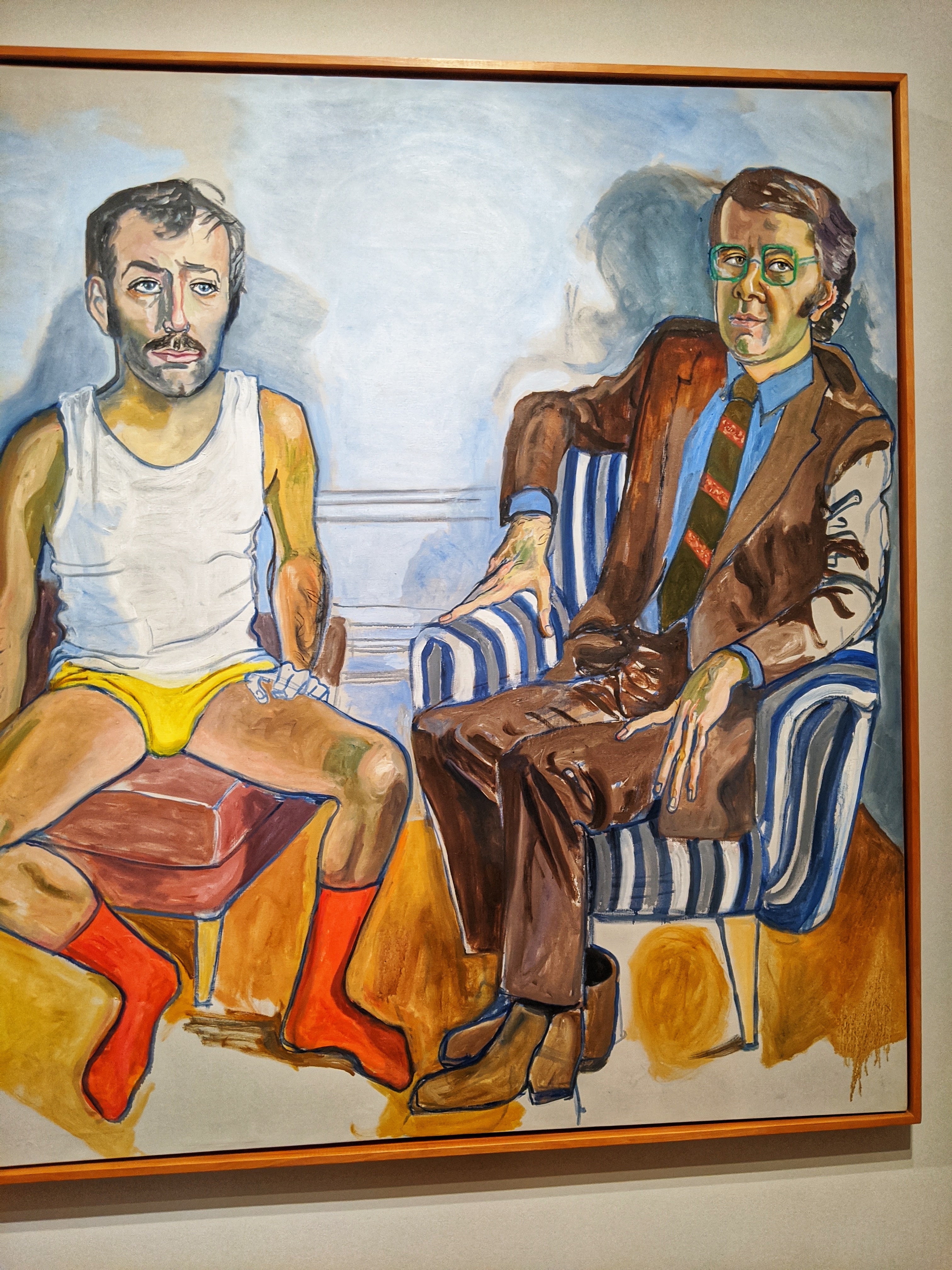
  • Elizabeth Catlett, A Black Revolutionary Artist and All That It Implies; Brooklyn Museum, NYC – An artist I’ve loved for a long time, this expanded my understanding of Catlett into other genres and media and (as was a theme for so much of the work that stuck with me over the course of this year) and a beautiful example of empathy that’s not mushy or soft-focused.
Edges of Ailey, Whitney Musem, December 2024
  • Alvin Ailey and Various, Edges of Ailey; Whitney Museum, NYC – Alvin Ailey cast a long shadow over pop culture, not just dance, in a way only a few choreographers have, and this Whitney exhibit did an astonishing job putting him in context and dialogue with influences, peers, the social world of New York, and the AIDS crisis, in a joyous and painful explosion that highlighted the craft and struggle of the work and the power and ecstasy of being in this big gallery with one another.
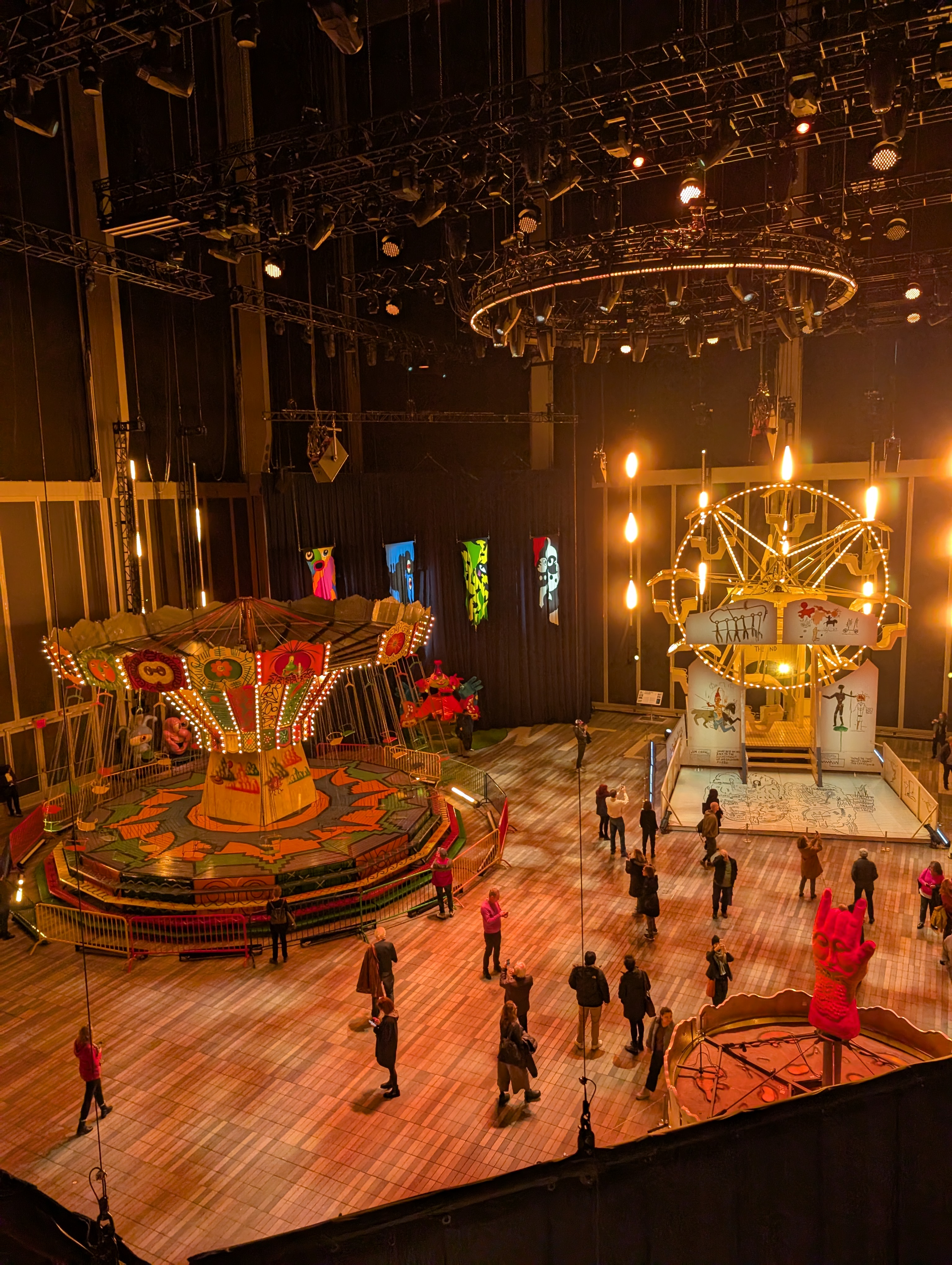
  • Various Artists, Luna Luna: Forgotten Fantasy; The Shed, NYC – Props to Anne for finding this, I only knew this recreation of Andre Heller’s Modern Art Carnival was displayed in New York. The best use of enormous art space The Shed I’ve ever seen, and a remarkable act of love in restoring these delightful pieces.
Luna Luna: Forgotten Fantasy at The Shed, December 2024
Categories
Best Of visual art

Best of 2023 – Visual Art

What a marvelous year for Visual Art. 125 or so exhibits, over nine cities, giving me peace or disrupting that peace. Leaving me unable to speak or filled with an irrepressible urge to tell someone, everyone, about them, or sometimes both at the same time.

All photos are by me, with no claim made to the underlying rights to the artwork. Everything listed here is in chronological order based on when I saw it (or in some cases, like the Wexner Center, No Place Gallery, and Streetlight Guild shows, based on the first time I went). 

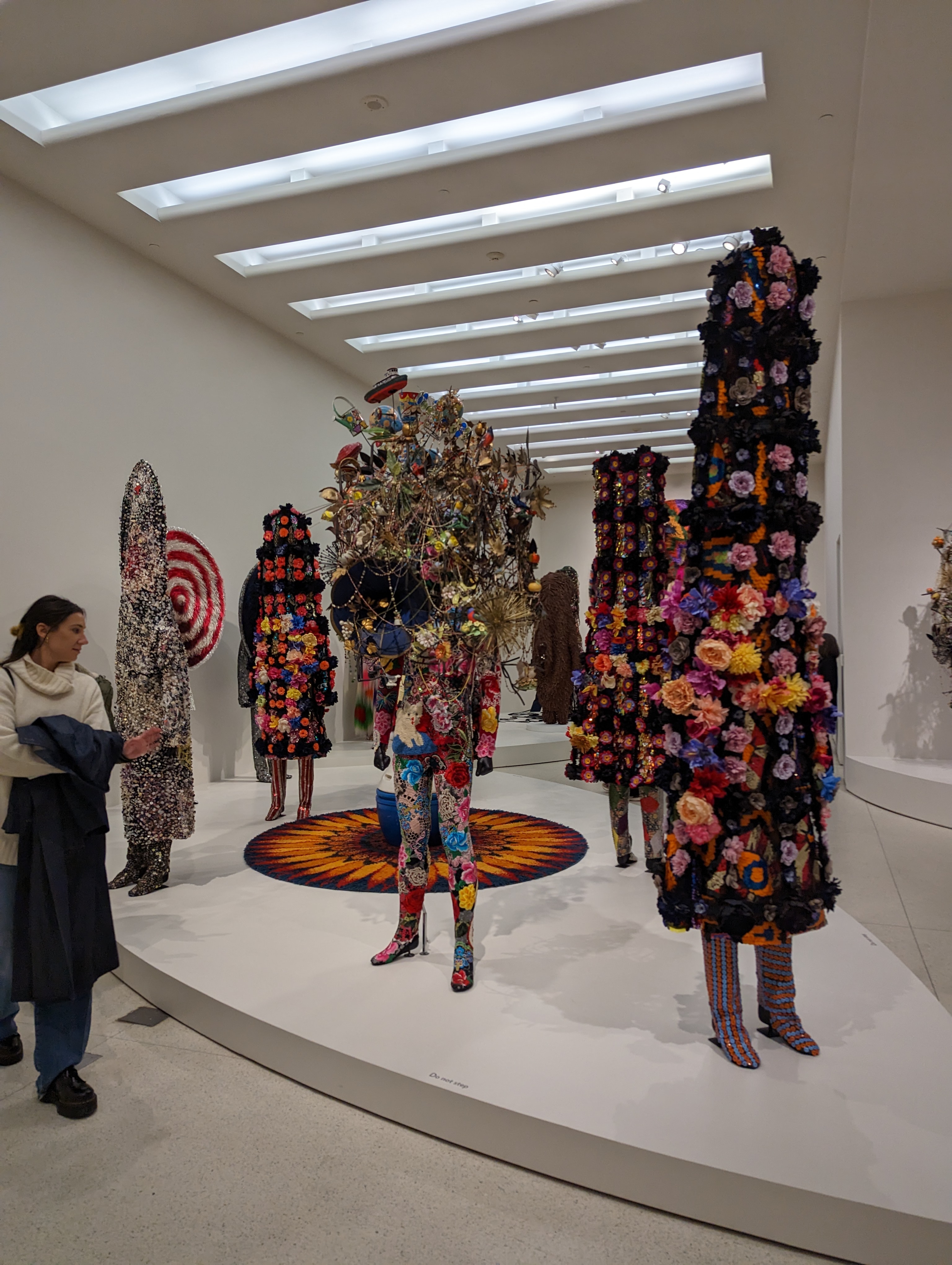
Woman in a white turtleneck sweater looking at an array of soundsuits made by the artist Nick Cave on a curved platform.
Nick Cave, Guggenheim
  • Nick Cave, Forothermore (Guggenheim, NYC) – I was overjoyed that my APAP/Winter Jazzfest/work trip overlapped with the last weeks of this dazzling retrospective of the American artist Nick Cave filling the side galleries of the Guggenheim. There was so much to love in this massive collection showing off the various sides of his work. My favorite part of this was the way it led the audience through the thornier, more jagged pieces of his work before the catharsis of the better-known sound suits which really underlined the sound suits’ beauty and joy as an act of resistance, of asserting his power and dignity.
  • Felix Gonzalez-Torres, S/T (David Zwirner, NYC) – Another more expansive look at an artist I’d been a fan of for a very long time. This retrospective took over three of David Zwirner’s massive gallery spaces, including finally assembling two pieces (both labeled “Untitled” with different subtitles) had had fully planned before his death. Gonzalez-Torres’ ability to transmute the basic objects of our lives, to abstract and expand, has never been as moving for me as it was on this blustery New York afternoon. Just recalling, it clicked through my bones like pins snapping into a lock.
  • Susan Phillipsz, Separated Strings (Tanya Bonakdar, NYC) – Susan Phillipsz’ film of the story of Pavel Haas, a composer who wrote and performed a piece while in Auschwitz and was killed anyway, played on a two-channel installation and a sound installation isolating the violin part on multiple speakers in a bright room upstairs, floored me. This is what I want from most installation art and only seldom get.
Mixed-media collages of two women on canvases, connected by a large cloth ribbon.
Tiffany Lawson, Streetlight Guild
  • Tiffany Lawson, Contemporary Colored Deluxe (Streetlight Guild) – Streetlight Guild is killing it in every respect. Music, poetry, education, but especially for visual art: this is the kind of permanent, visible home Columbus’s fertile black art scene hasn’t had for a while, and the crowds, whenever I come, seem to back me up at how much we’ve all missed it. I liked everything I saw here, but this concentrated dose of Tiffany Lawson’s witty, nuanced, narrative-informed-but-never-constrained collage work was one of my favorite discoveries (I know, I know, I should have known more of her work earlier – sometimes I’m slow) of the year.
  • AK Burns, Of Space we are… (Wexner Center) – All three of the spring exhibits at the Wexner Center worked for me, but the A.K. Burns – showing all four of his Negative Space films and building installations and ephemera around them, situating the storytelling in these moving, chilling environments – just stuck to my ribcage and never quite let go.  This as a whole – believe I came back to watch each movie in the galleries – fulfilled the promise I grew up searching for in science fiction and only found fleetingly.
  • Bobby T. Luck, Was it Your Trigger Finger? (Pizzuti Collection at Columbus Museum of Art) – This two-room installation skewered vintage US military recruiting propaganda, institutional racism, government bureaucracy, and so much else in a way that balanced its wit with tear jerking, landing perfectly placed piledrivers.
  • Sydney G. James, Girl Raised in Detroit (MOCAD, Detroit) – Another look into the past, both James’ personal past and a wider social and political past, balancing a tear-jerking and nostalgic installation with enormous and unsparing mural-style tributes. Breathtaking and bracing.
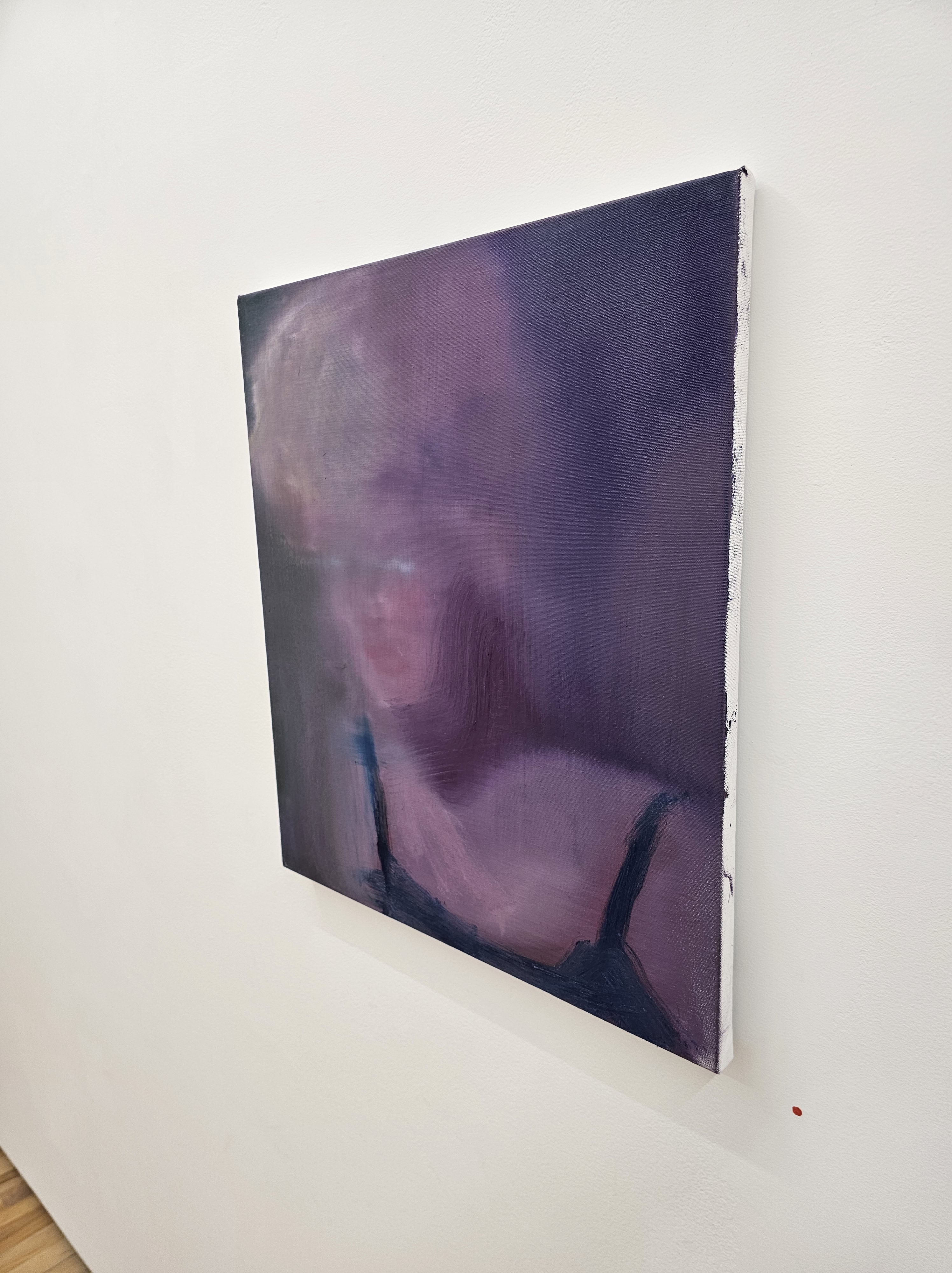
Blurry painting of Madonna impersonator on a white gallery wall
Caleb Yono, No Place Gallery
  • Caleb Yono, Impersonator (No Place Gallery) – Hoisting the torch for uncompromising art in downtown Columbus proper, No Place Gallery put out one stellar exhibit after another. My favorite was this – occasionally blurred – myriad of paintings of Madonna impersonators, drenched in atmosphere and pulsing with energy.
  • Claude Monet and Joan Mitchell, Monet/Mitchell: Painting the French Landscape (St Louis Art Museum, St Louis) – The scholarship at this spellbinding rapture of an exhibit at one of my favorite US Museums was second only to the rapturous beauty both Monet and Mitchell evoked. The connections between what each artist found in the countryside, far away from Paris and New York, are as intense as the different paths and techniques they deployed in the service of that building. 
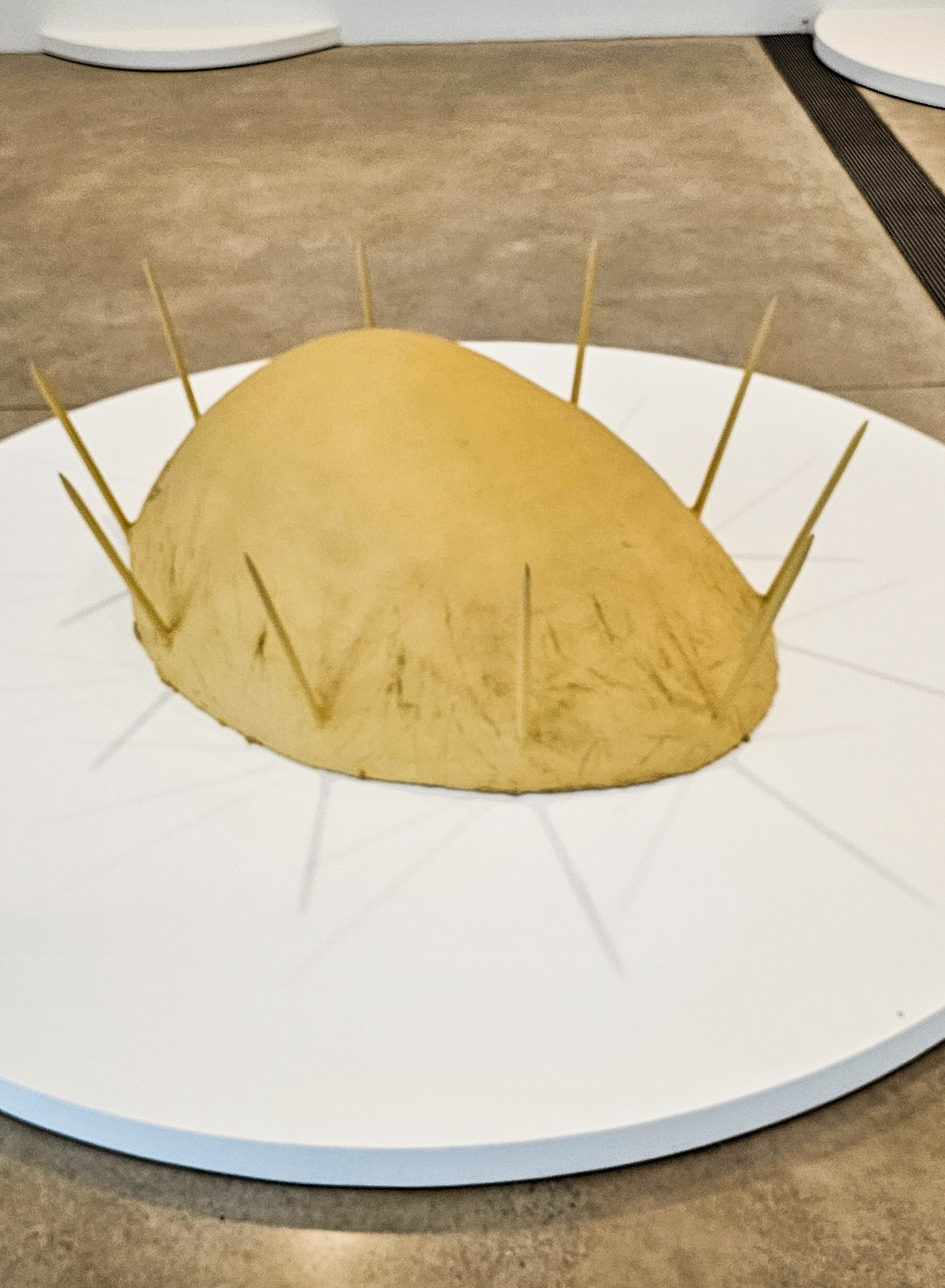
  • Faye HeavyShield, Confluences (Pulitzer Art Foundation, St Louis) – The Pulitzer has always had a special place in my St Louis heart, basically, next door to the better-known CAM STL (also great), finding interesting connections to avant-garde artists of different backgrounds, time periods, and media. I had the pleasure of a phenomenal tour led by curator Tamara Schenkenberg, the perfect introduction to an artist I’m ashamed to say I knew nothing about before walking through the door. This wide-ranging retrospective was bursting with wrenching work that used highly modern techniques to get at the power and the pain of Faye HeavyShield’s overlapping histories and color the world in ways I knew but didn’t know and ways I knew but wished weren’t what they are. A show – and conversation – that still haunts me as I look back on this year.
Rounded sculpture, flat on the bottom, in beige, with pointed spines jutting out of its perimeter
Faye HeavyShield, Pulitzer Art Foundation
  • Various Artists, Irrepressible Soul (Urban Arts Space) – Iyana Hil (creator and co-curator with Dr. Terron Banner, Mario Hairston, and Christopher Hearn) did an astounding job here, bringing together artists whose work I already knew and loved, like William Evans, Cameron A. Grainger, and L’Ouverture Jones with artists I’d never heard of into a tapestry of black and Afro-Diasporic arts. As someone who’s been going to the Urban Arts Space since the building opened, I believe this may be the best single exhibit I’ve ever seen there. Plus – and it’s my eternal regret I didn’t get to the satellite events – tying the work here together with other Columbus black cultural institutions, from the King Arts Complex to Sole Collections, was a wonder.
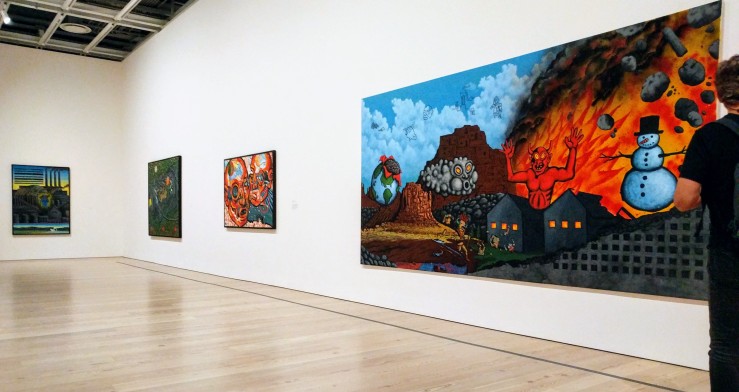
  • Juane Quick-To-See Smith, Memory Map (Whitney Museum, NYC) – My first conscious exposure to Juane Quick-to-See-Smith was at one of my favorite public art events anywhere, Counterpublic 2023 in St Louis, so it was even more of a joy to see this enormous retrospective at the Whitney when Anne and I went to New York late summer to see Greg Cartwright play. The playful but deadly serious tones captured an America that was always on the surface for the people being oppressed, but it uses defiance as a path to hope, sunlight cracking through moldering walls.
  • Sahar Khoury, Umm (Wexner Center) – The Wex’s fall exhibits were also all extremely strong. Still, Khoury’s collaged sculptural and installation pieces inspired by the legendary Egyptian singer Umm Kulthum kept me coming back, always finding something new in the glitter and the scuffs.
Long Gallery room with a chalk drawing with names Hattie McDaniel and Bill Robinson at the end, less visible chalk drawings on the left wall, show flyers on the wall in the room visible to the left.
Gary Simmons, MCA
  • Gary Simmons, Public Enemy (MCA, Chicago) – A work trip to Chicago let me catch up with some dear friends, have some strategy sessions with coworkers and also catch a couple of astonishing art exhibits on lunch hours – the benefit of being right downtown. The MCA is always more than edifying when I get there – they turned me onto Doris Salcedo and so much more – and this Gary Simmons’ mixed-media grappling with racism and its after-effects, twisting every symbol just artfully enough that it wasn’t the version I expected, landed hit after hit.
  • Remedios Varo, Science Fictions (Art Institute of Chicago, Chicago) – The Art Institute of Chicago also blew me away with this early surrealist who relocated from Spain to Mexico City with the outbreak of WWII. Exactly the stew of midcentury elements I’ve loved but at an angle, I wasn’t expecting, in the first major museum I ever fell in love with.
A woman and her daughter looking at an arrangement of photographs on a gallery wall.
Various Artists, Columbus Metropolitan Library Main Branch
  • Various Artists, Columbus Metropolitan Library at 150 (CML Main Branch) – Not just here because our house was in one of the photos taken and selected by Dorian Ham as part of this exhibit, but that was the kind of surprise that won me over. The perfectly chosen artists for this – people I’ve been a big fan of for a while, like April Sunami, Rob W. Jones, and Tera Stockdale, and those whose names I didn’t even know – and the pieces were woven into an evocation of the sense of community I still love about Columbus, even when it pisses me off or lets me down. A flag-planting about the role libraries have played in that and still play. 
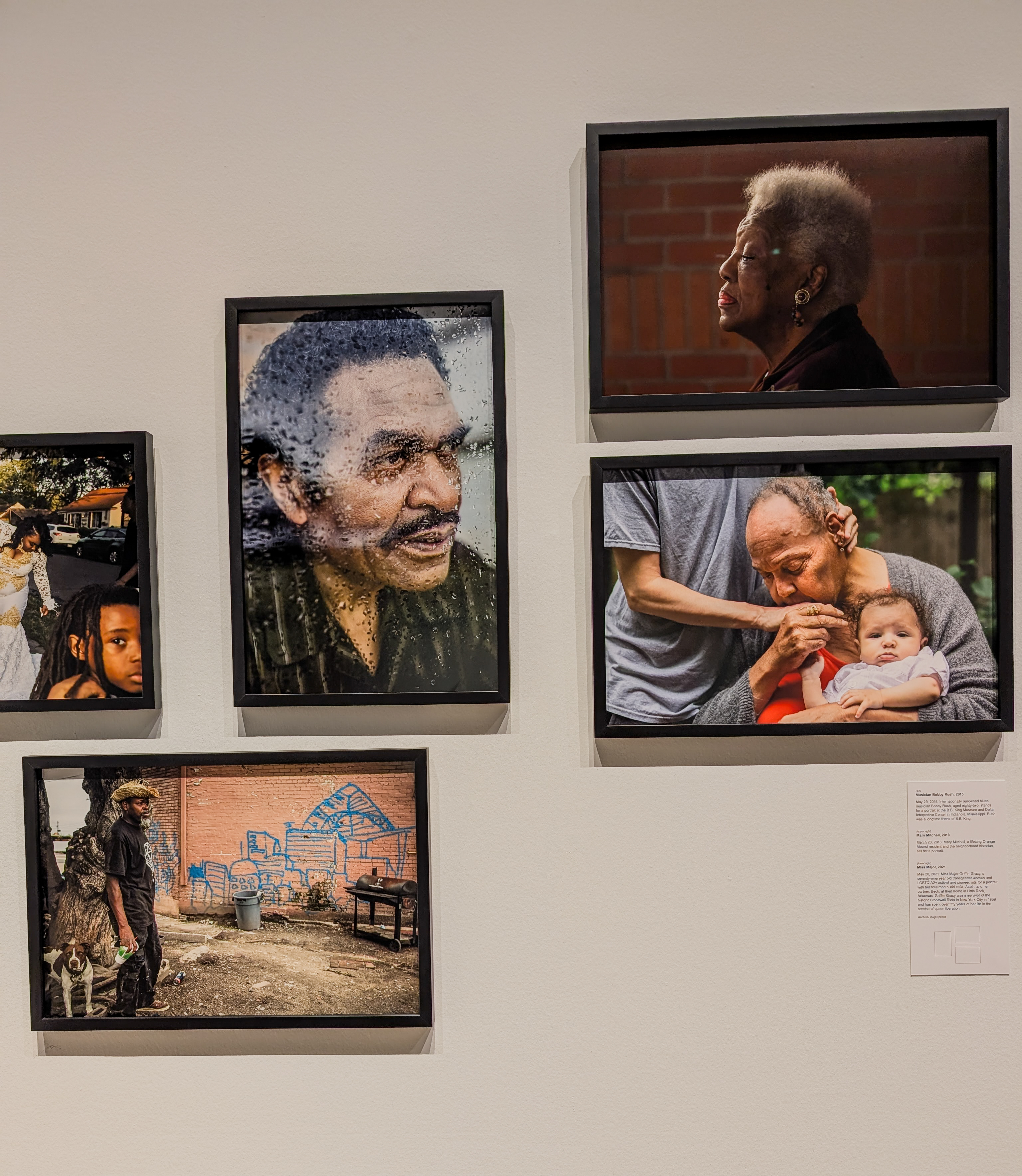
  • Various Artists, Black American Portraits (Brooks Museum, Memphis) – The Brooks does astonishing work; over the 10 years I’ve been visiting regularly, it’s become a must-see part of my Memphis trips. This touring exhibition, which originated at LACMA and was curated by Dr. Patricia Daigle and Efe Igor Coleman, took me through thematic rooms to shine a light on a shifting black experience that always rightfully resists being restrained or easily named.
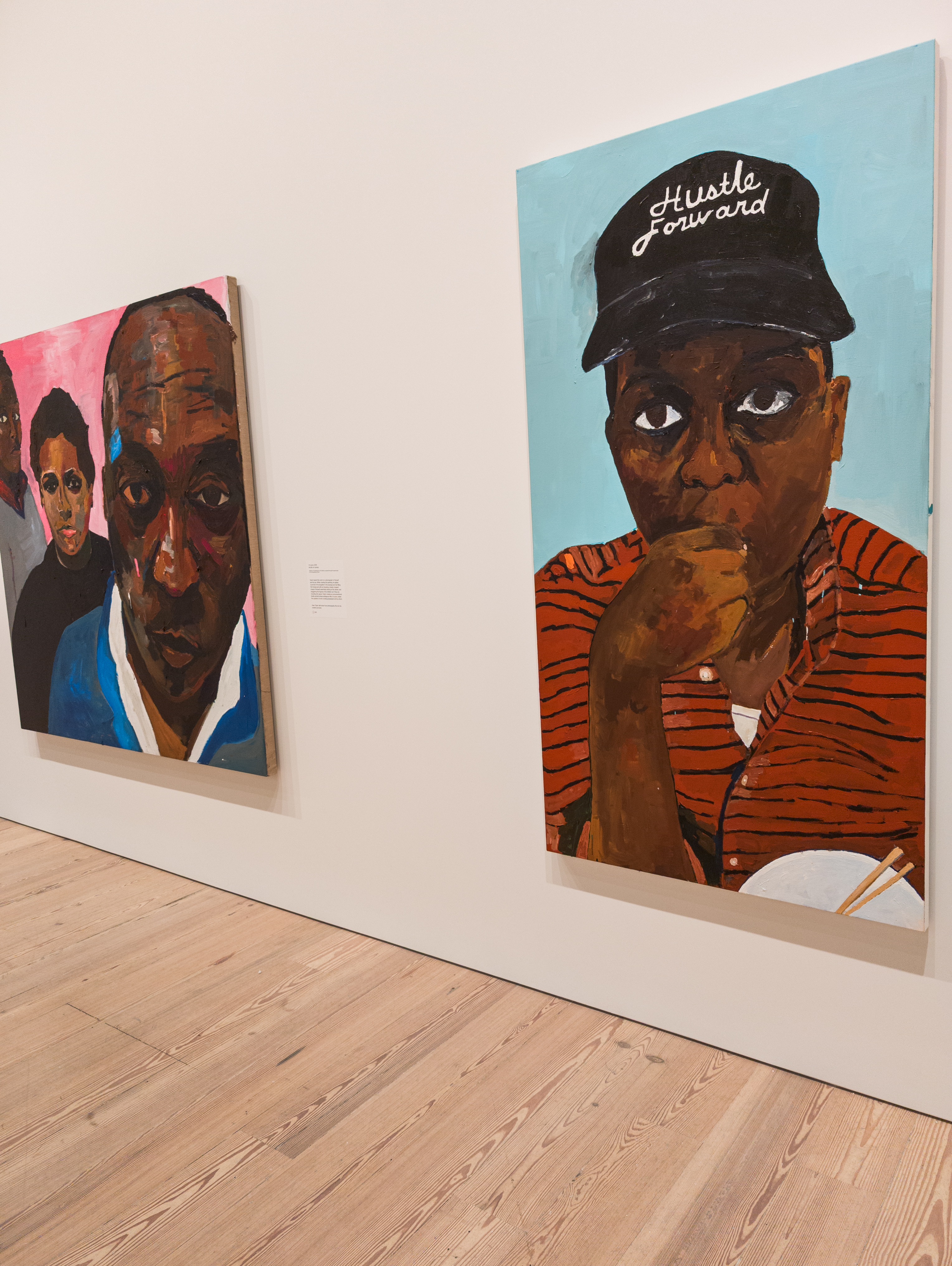
Two large photos on the wall of the Whitney, one three black people arrayed (from left to right) a man in the background, a woman in the middleground, and a man in the foreground. The other, a man wearing a hat that says Hustle Forward and an orange and black striped shirt with a bowl with chopsticks in front of him
Henry Taylor, Whitney Museum
  • Henry Taylor, B Side (Whitney Museum, NYC) – Another hat tip to the Whitney – in a season where everything was good, from a look at one of my polymath inspirations Harry Smith doing the almost impossible to the finest wide-lens look at Ruth Asawa I’ve ever seen; to a gut-wrenching group show; this deep dive into painter Henry Taylor vibrated every nerve ending in my body. 
  • Ben Shahn, On Nonconformity (Reina Sofia, Madrid) – Most of what we did in Madrid and Barcelona wasn’t new exhibitions; first time in cities of course I’m spending a lot of time in the Prado and looking at Gaudi. But the Reina Sofia is the kind of contemporary art museum – and I love all the US versions, don’t misunderstand – I could really only compare to Centre Pompidou. I was that wowed. And I liked everything on display, but this extensive, almost exhausting, retrospective of Shahn’s work took him out of my previous understanding of his art in Diego Rivera’s slipstream and made it fully formed and three-dimensional in my brain.
  • Laura Ramírez Palacio, S/T (PlusArtis, Madrid) – Anne and I stumbled here when the other modern art gallery we intended to hit was closed. In a thriving gallery scene, this was the exhibit that wouldn’t let me go. Gone too young, Palacio crafts a mythoautobiography in drawings with clear referents, but I couldn’t ever quite put my finger on it. I staggered out of the gallery, pretty much only wanting to talk about this.
Loosely arranged selection of black and white drawings
Laura Ramirez Palacio, PlusArtis
Categories
Best Of visual art

Best of 2022: Visual Art

I repeatedly say that these year-end lists are foremost an exercise in gratitude, and, as I said in 2021, visual art was the thing I missed most during the lockdown and one of the great boons of the travel we did this year. Visual art slows me down, at least a little, and reminds me of the Mary Oliver line, “Attention is the beginning of devotion.” It’s become one of the main tenets of my art diet, and something dazzled me everywhere I turned.

All of these are in chronological order and in Columbus unless otherwise noted. All photos were taken by me unless otherwise noted.

Faith Ringgold, New Museum, NYC

Diane Fox, Unnatural History (Red Gallery, Knoxville) – The return to Big Ears was the indisputable highlight of my musical calendar (Winter Jazzfest was canceled due to the surge, Gonerfest returned in late 2021) and I was overjoyed to see an enhanced visual art element, both in official venues (some really strong work in my hotel lobby) and at other spots around downtown and Old City Knoxville. My favorite was at the Red Gallery along Jackson Avenue. Diane Fox takes photographs of dioramas in natural history museums to create a look at how we frame anthropological history and our relationships to animals over the years that I couldn’t get out of my head.

Various Artists, Black Life As Subject Matter II (Riffe Center Gallery) – The Ohio Arts Council gallery in the Riffe Center is one of Columbus’s most underrated gems and early May’s group show, curated by Willis “Bing” Davis and produced/circulated by Ebonnia Gallery was a kaleidoscopic work at not just black art but the way white America and the “mainstream” art world have given their lives a fair shake, and pointing at ways a more equitable and sane narrative is possible. And the opening had a warmer, more community oriented feeling than art openings almost ever do, aided by music by Derek Dicenzo on bass and Chris Brown on piano.

Terry Adkins, Terry Adkins (Paula Cooper Gallery, NYC) – This first retrospective of artist Terry Adkins since Adkins passed away in 2014 gave me a brilliant jolt of energy and shamed me for not knowing this artist’s work first. Sculptures and videos actively reshaping history and the world around Adkins.

Frédéric Bruly Bouabré, MoMA, NYC

Frédéric Bruly Bouabré, World Unbound (MoMA, NYC) – Another artist I sadly didn’t know anything about and a breath of fresh air, the kind of show MoMA’s scholarship really shines with. This late artist (died in 2014) from Cote d’Ivoire, tried to summarize and preserve every piece of information about the known universe, including creating his own alphabet. It’s a magic-drenched tribute to the power and beauty of observation, of looking as deeply as you can.

Henri Matisse, The Red Studio (MoMA, NYC) – Another exhibition that uses MoMA’s scholarship to its fullest and a rare new look at perennial MoMA artist Matisse by assembling the pieces Matisse painted in his masterwork The Red Studio. It’s another tribute to seeing, to really understanding, to collecting the things that help feed our own art and keep them close.

Faith Ringgold, American People (New Museum, NYC) – Probably my favorite show of the entire year. I knew Ringgold’s work and I’d seen what I thought was a pretty strong cross section over the years but this cornucopia of her potent, dazzling work, recontextualizing and re-visioning American history was so beautiful and  such a punch in the gut that I did the full court press to get Anne to see it on a later day of our trip and so saw it twice, which has only happened once or twice before in 20 years of going to New York on relatively brief trips.

Cameron Granger, No Place Gallery

Clarence Heyward, Unseen (CAM, Raleigh) – There’s always something at CAM that turns me sideways, even when we’ve only been in Raleigh for a few hours I go out of my way to make a trip. Clarence Heyward’s portraits looked at his family, what being a black man and having expectations of filling those roles of protector and provider, in the face of lockdown and the high-attention murder of George Floyd as burning reminders of inequity and cruelty that have always been there. The expression on his daughter’s face in more than one of these still haunts me.

Various Artists, Ain’t I A Woman? (Museum of Contemporary Art, Madison) – My first trip to Madison, Wisconsin, since college was delightful front-to-back with a million great dive bars and a killer show commemorating punk label Dirtnap Records’ 20th anniversary. Their Museum of Contemporary Art provided a beautiful stop in the middle of the day with this group show, part of their Wisconsin Triennial, which took its title from the Sojourner Truth quote used as a bell hooks book title. Curated by Fatima Laster, this introduced me to so many great artists I didn’t already know.

Various Artists, Portal For(e) the Ephemeral Passage (Wexner Center for the Arts) – jaamil olawale kosoko was one of my favorite interviews I’ve ever done, in advance of his poetic dance peace Séancers, and his curatorial work on this piece, bringing together artists whose work I knew well like nora chipaumire and Keioui Keijaun Thomas with those I didn’t know at all, like Jasmine Murrell, tied together with kosoko’s powerful installation at the end, in one of the most satisfying overall exhibits I took in this year.

Cameron Granger, Heavy As Heaven (No Place Gallery) – No Place Gallery had a great year, building on a streak of great years. I’m sure I missed a couple of exhibits over the course of the year, but anytime my schedule lined up with their open hours, I was there, and it always paid dividends. My favorite thing I saw in that space – I’m not alone – and if I were doing more of a ranking, one of my three or four favorite things all year, was this excavation of Granger’s own past and the wider world – the frame of a small house inside the gallery leading to a devastating short film but also with texts lying nearby and a separate film specifically about gentrification in the gallery’s side room. I think I snuck in to see this three times before it closed, and it broke my heart and uplifted me every time.

Amina Ross and Lola Ayisha Ogbara, The Luminary, St Louis

Various Artist, Split My Sides (The Luminary, St Louis) – It felt really good getting back to St Louis this year for the joyous occasion of my good friend John Wendland’s wedding and it did my heart good to see my favorite art space – in a town full of a lot of my favorite art – The Luminary is still holding it down on Cherokee Street. Amina Ross and Lola Ayisha Ogbara delve deep into black trans and feminine experience with a variety of mixed media work that don’t make anything obvious, work that’s visceral and gripping but that rewards further meditation. That huge Ross installation/film nagged at me for days.

Gala Porras-Kim, Correspondences Toward the Living Object (Contemporary Art Museum, St Louis) – Gala Porras-Kim’s elegantly wielded daggers turn on the problematic process of museum collections of sacred or beloved artifacts avoids easy answers for layers of complication upon complication, in a way that uses and benefits from the amount of space and the curatorial structure of a museum exhibit instead of some other gallery spaces.

Julie Mehretu, Cleveland Museum of Art

Various Artists, Front 2022 Triennial (Various Spaces, Cleveland) – I loved the earlier iteration of Cleveland’s multi-venue Front Triennial and was a little afraid the pandemic would have been its death knell but it returned strong in 2022 and the sampling Anne and I did, on a quicker than usual trip centered around a great Compulsive Gamblers reunion show at the Beachland gave me Renee Green’s work interspersed with other artists at MOCA, Julie Mehretu’s architectural explosive drawings in direct dialogue with the CMA collection, SPACES’ international work in Oh, Gods of Dust and Rainbows and so much more.

Various Artists, New York 1962-64 (Jewish Museum, NYC) – I’m a huge fan of this transitional period of post-war modernism and the Jewish Museum always does a great job of zooming in. In this case, they simultaneously shone a light on a window where New York was at the very center of the art world but also on Alan Solomon’s tenure as director, helping shape the Jewish Museum into the powerhouse of contemporary art it is today. A moving reminder of how much community matters and how one person can shift a narrative, can change the course of time.

Danielle McKinney, Marianne Boesky Gallery, NYC

Lorna Simpson, 1985-92 (Hauser and Wirth, NYC) – I thought I knew photographer Lorna Simpson’s work pretty well but this deep dive into her early work was revelatory. The way she looks at masks from the inside, from hair, from the way we invent ourselves and, in particular, how black feminine identity gets shaped was exactly the kind of stab in the heart I needed. Powerful, every-more-relevant work.

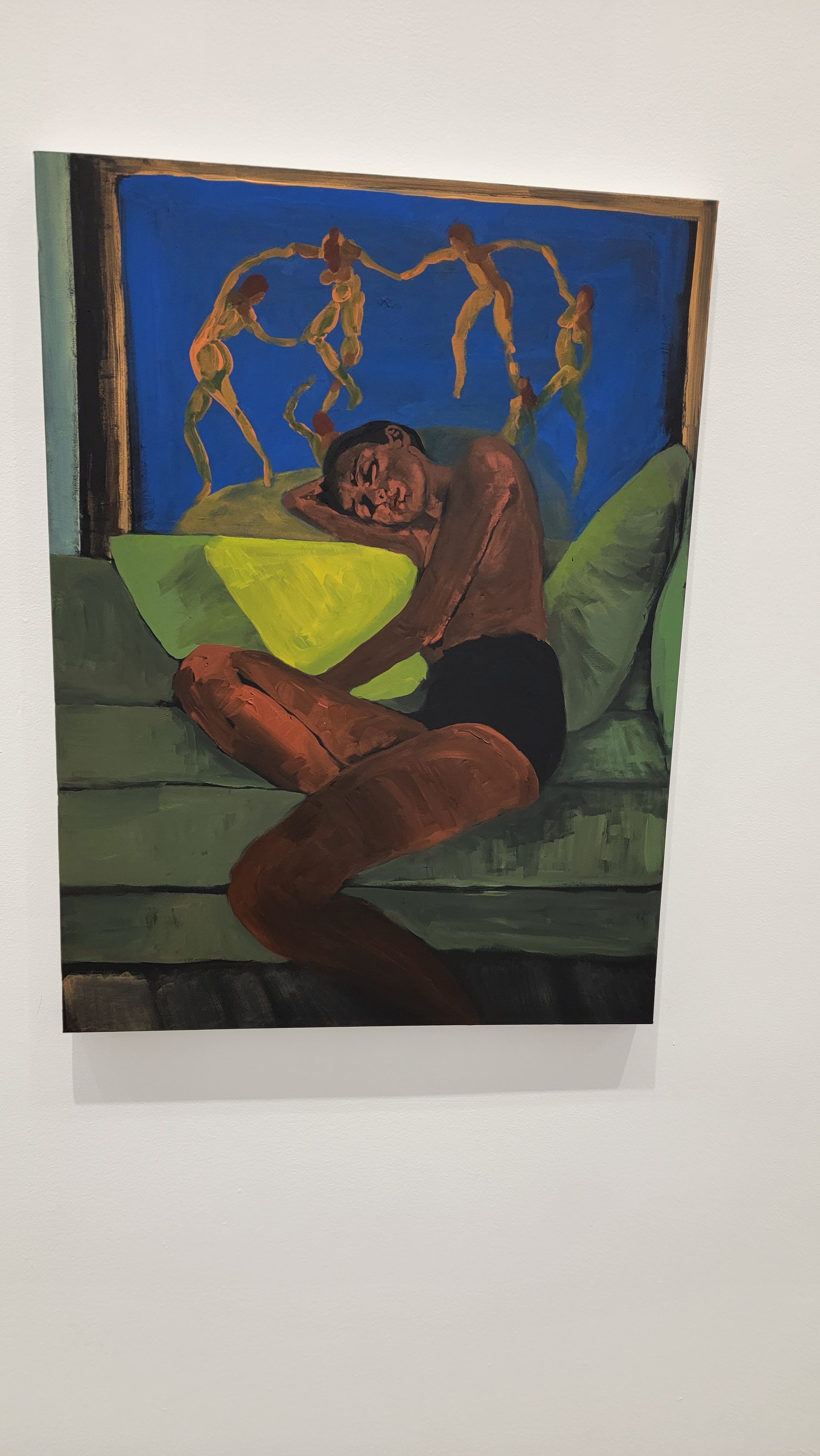
Danielle McKinney, Golden Hour (Marianne Boesky Gallery, NYC) – McKinney’s work made me think about portraiture in a different way, looking at black women in quiet, intimate moments but undercutting the thought that it’s natural, reminding me that everything in art comes through layers of thought and intention, in some cases directly – like placing one figure under Matisse’s The Dance – and in others with subtler hints at patterning and shapes. The brush strokes hint at a throb, electricity going through everything and illuminating the world.

Hank Willis Thomas, Jack Shainman Gallery, NYC

Hank Willis Thomas, Everything We See Hides Another Thing (Jack Shainman Gallery, NYC) – I’ve been a sucker for the images that hide and reveal at the same time – I read Kenneth Koch’s “One Train May Hide Another” as a teenager – for a long time, and Thomas does that beautifully as well as engaging with technology in a way I don’t think I’d ever quite scene, engaging with cell phone photographs to expose pain and turmoil – and hope – underneath placid, accepted reality, almost banality, of test patterns and color fields.

Tania Pérez Córdova, Generalización (Museo Tamayo, Mexico City) – I loved Mexico City so much it’s almost impossible to pick a single favorite moment, but the Tamayo, one of the best contemporary art museums – from layout to curation to the building itself – I’ve ever been to, and the solo morning I spent there, is high on the list. I felt the vibration of Córdova’s work almost immediately and realized I’d first encountered the Mexico City-born artist at the MCA Chicago about six years ago. This larger retrospective about changing our perceptions of the world – melting down musical instruments and reconstructing them, melting ice in concrete blocks with the molds of people’s faces like death masks… as powerful and poetic a voice as I can think of.

Carlos Motta, Your Monsters, Our Idols (Wexner Center for the Arts) – I knew Motta’s work a little, but the panoply of visions with this strong, surging voice at the top of the Wex ramps killed me. Linking body horror and S&M with liberation and claiming space for oneself and always in a way that was beautiful, no matter how unsettling.

Katie Forbes, Documenting a Movement (Bridge Gallery) – Katie Forbes’ work around the Black Lives Matter protests is a testament to putting in the time and bringing her craft to something that’s important. Her willingness to be vulnerable and be on the ground – some of the photos, like a police officer pepper spraying someone whose hands are up, are uncomfortably close – and her empathy, the desire to know the people here without salaciousness, is an astonishing gift to this town.

Tania Pérez Córdova, Museo Tamayo, Mexico City
Categories
"Hey, Fred!" dance live music visual art

Things I’ve Been Digging – 02/01/2021

Soul Rebels Brass Band, taken from stream and edited

Soul Rebels Brass Band featuring Roy Hargrove at Brooklyn Boowl, presented by FANS

FANS’ streaming arrangement with Brooklyn Bowl and jamband outlet Relix has given many of us the opportunity to see killing archival sets and throw some money at hurting bands and venues right now.

This 2015 end of a three-night run that paired New Orleans funk titans the Soul Rebels with trumpet master Hargrove was sticky, sweaty rapture. Nothing’s ever as good as being in a room with those slurred, fiery notes washing over a crowd that feels like one undulating body but the sound and videography here gave a hell of a taste.
Watching this, I flashed back to a visceral, burning memory of seeing Soul Rebels Brass band take the Newport to church opening for Trombone Shorty, on a December night, as they raged through tunes like Michael Jackson’s “Rock With You,” D’Angelo’s “Spanish Joint” and originals like “Turn It Up.”

From left: Lance Johnson, Hakim Callwood, Moxy Martinez, and Nina West; promotional image provided by Columbus Museum of Art

Wonderball at the Columbus Museum of Art

For the last few years, Wonderball has been one of the best parties in town. The CMA is setting the standard for museum fundraisers with integration of the work in the galleries, multidisciplinary performances, and outreach to the various corners of the vibrant Columbus scene.

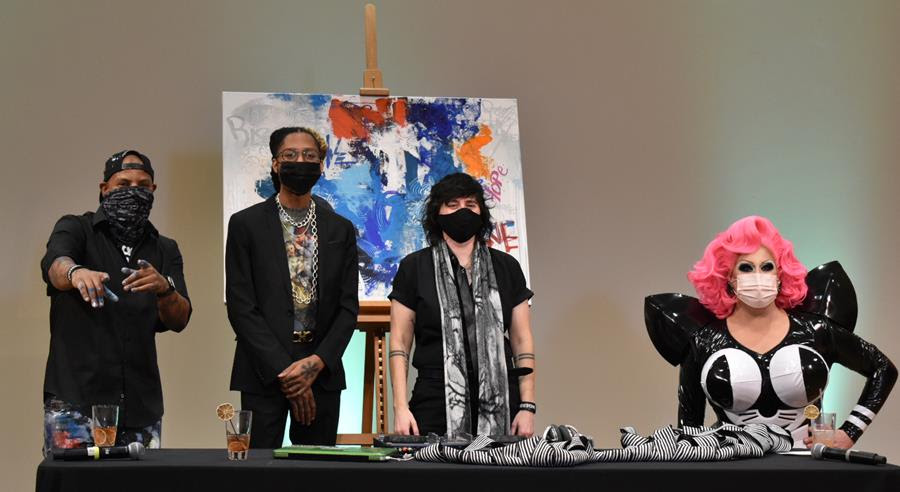
Their digital pivot this year, born of sad necessity, had the same homespun charm and brilliant execution of past years and I was overjoyed to watch it in the backyard of a couple good friends. Fantastic co-hosts Hakim Callwood and Nina West (in a jaw-dropping Felix The Cat Clock dress) kept the show running live with Lance Johnson doing a live painting and Moxy Martinez providing beats.

Mixing live and pre-recorded pieces, they treated us to a gorgeous poem by Cynthia Amoah. They filmed myriad genres of dance throughout the galleries including Amelia Gondara & Micaela Gonzalez, Griset Damas-Roche, and my favorite, Shades of Color with Donald Isom and Brianna Rhodes dancing a duet to Jason Moncrief’s flute playing in dialogue with one of my favorite Kehinde Wiley pieces.

As one of the friends we were in person with said, “An advantage of doing it this way is you can really watch a full performance. There’s no pressure to get out of people’s way to let them see or feeling like you have move on quickly so you don’t miss something else.” And it really was a great side effect of this change.

Many of the DJs who make Wonderball such a terrific party brought their A game. Trueskillz and Aloha spun a vibrant worldbeat set. Heatwave’s DJ Adam Scoppa and DJ Lady Sandoval tore through some classic soul 45s. Ty “Nordiq” Williams laid blissful, throbbing electronica on us.

Nothing is the same as when we can all be together but anything that lets us mark these important events while staying safe is to be applauded. Anything that does it with this kind of aplomb, grace, and sense of fun is a damn miracle.

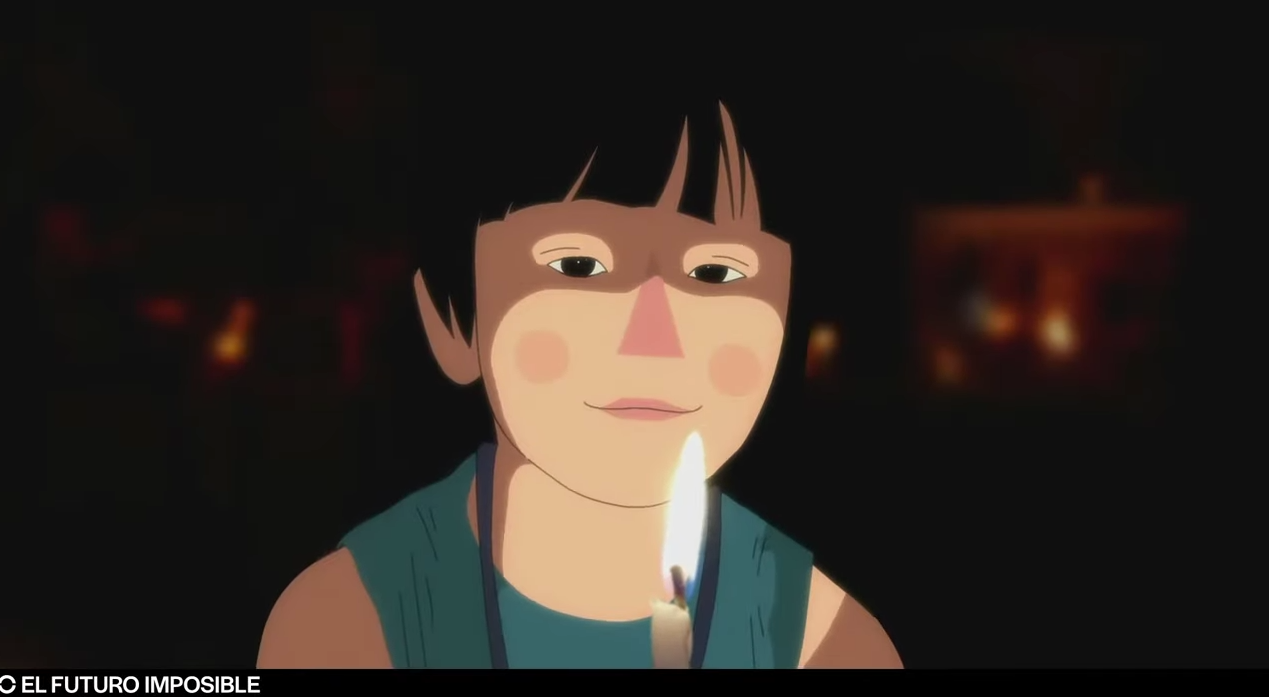
El Futuro Imposible, taken from stream of The World Around Summit 2021

The World Around Design Summit presented by the Guggenheim

One of my favorite things is hearing smart people take on the world, especially in a field I know very little about. The Guggenheim put together an international virtual festival of architecture and design and it made my heart soar to watch people actively engaged with where we are and where we’re going.

Lines from this sent me to my notebook and kept nagging at me throughout the weekend.

Alice Rawsthorn said, “By sharing constructive design issues on Design Emergency, we can persuade more people, decision-makers especially, to see design as we do: as a powerful tool to address social, political, economic, ecological challenges and to place it at the forefront of the post-pandemic reconstruction. Design isn’t a panacea for any of [our] challenges but it is one of our most powerful tools with which to tackle them if – and it’s a big if – it’s deployed intelligently, sensitively, and responsibly.”

That attitude that everything can be a tool to address the world and make things better for people with creative thought is something I try to carry with me and I’d never had it crystallized like so clearly.

I’ve thought about the Anthropocene a lot lately, it showed up in the Under The Radar pieces I wrote about a while ago, and Feral Atlas added fuel to the fire with “The great programs for the conquest of the Earth promised modern ease and happiness but in their inattention gave us a heap of terrifying, if unevenly spread disasters.”

How do we see things at the level of impact they are without crumbling into despair? I don’t know an answer but I know we have to. I’m still unpacking these three sessions and luckily they’re on Youtube indefinitely, another side benefit of all of us being stuck in our homes:

Categories
Best Of visual art

2020 Best Of – Visual Art

Vija Celmins, Met Breuer

This year was a reminder not to wait to do things – tell people you care about them, start on that project, go to that exhibit. With the other three categories I’ve used on these memory exercises for the last 20ish years, there were digital workarounds that gave me a taste of what I was missing, tiding me over. Visual Art didn’t work that way for me.

I sampled, and I’m thrilled so many galleries and museums transitioned to or enhanced their existing online presence, with exciting work from David Zwirner, the Frieze fair, all manner of things in Europe. Still, I had a hard time connecting with it. It was like flipping through Artforum to me, good to know what’s going on that I can’t see, but I never felt like I experienced the pieces.

The impetus of the Available Light motto “don’t wait” came to light. When things shut down, I was glad in ways I can barely articulate that I spent the time and money on a New York trip for APAP and trips to Cleveland and Louisville (neither of which were primarily for visual art but I worked some in) all before March. At the same time, I hesitated a month for the new Wexner exhibits, and the window slammed shut when I wasn’t expecting (and they were things I desperately wanted to see). So, as usual, whenever things open again, don’t wait. Find what you’re interested in and lunge at it.

Everything is in Columbus unless otherwise noted. Photos were taken by me unless otherwise noted.

  • Various Artists, Art After Stonewall (Columbus Museum of Art) – This tracing of the aftershocks of the Stonewall Riot, through early Gay Liberation and the darkest, most enveloping days of the AIDS crisis was a monumental undertaking and the finest use yet of the CMA’s new wing. For me, one of the highlights was the prominent placement of Columbus’s role in the gay art movements being documented here, including a lump-in-my-throat wall of Corbett Reynolds, his busts, and ephemera from his nightclub and his Red parties.
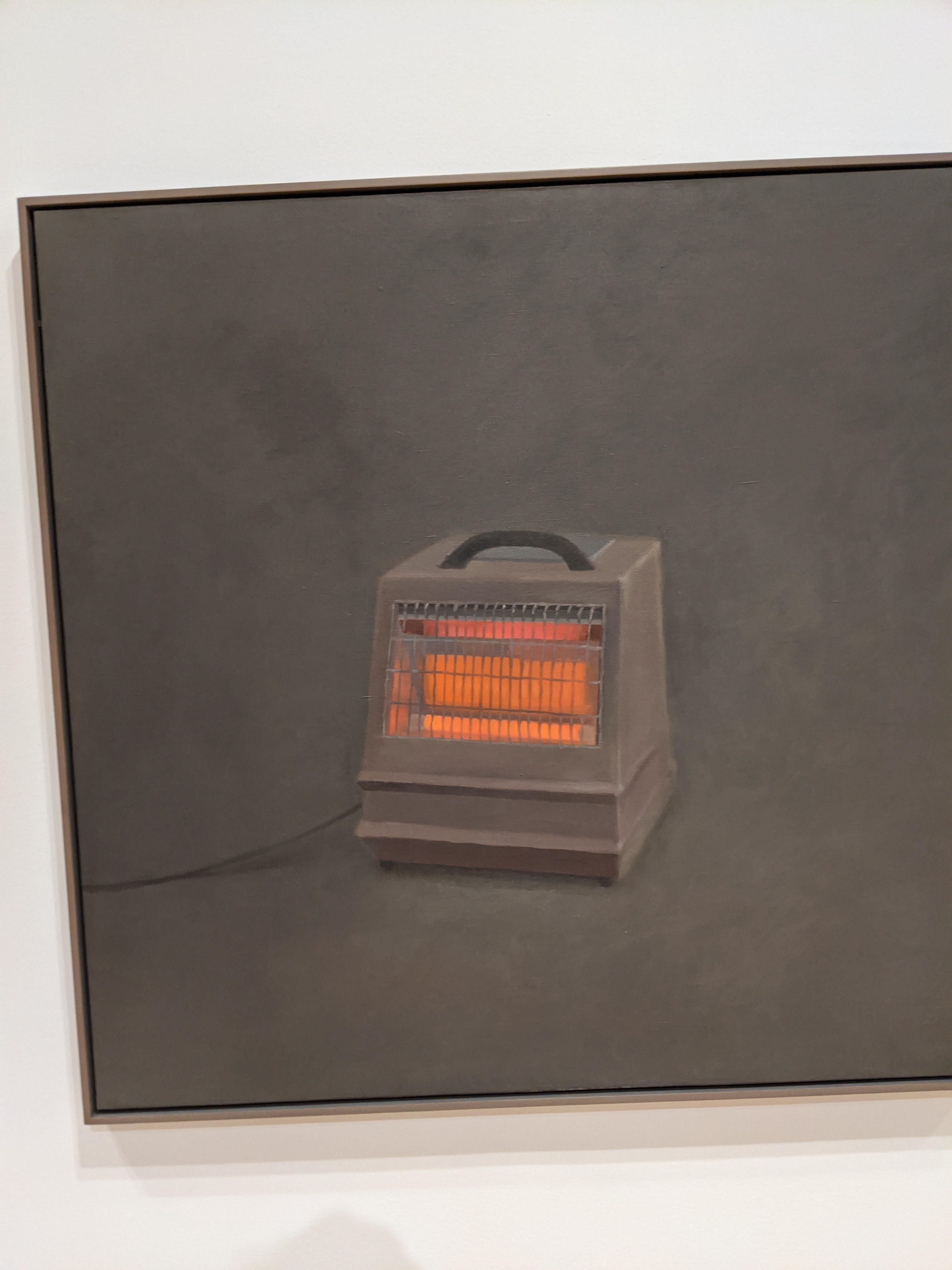
  • Vija Celmins, To Fix The Image in Memory (Met Breuer, NYC) – The Metropolitan Museum of Art’s rental and repurposing of the previous Whitney Museum never quite found its footing but presented some spectacular exhibitions. Maybe my favorite was the last time I’ll ever get to visit – they announced in June the satellite building will not reopen after lockdown – this jaw-dropping retrospective of Vija Celmins. To Fix The Image in Memory took us through luminous renderings of household objects, as though lit from within, to intricate studies of the night sky. Whispered words of apocalypse and hymns to understanding, reminding me again and again of Mary Oliver’s maxim that “Attention is the beginning of devotion.”
  • Expanded Museum of Modern Art (NYC)- I’m always skeptical when something I love – even when it has problems I’ve grumblingly come to live with – changes. But my heart sang when that skepticism burned off scant minutes after walking into the reconfigured MoMA. The flow between the collection crackles and sparks conversation in ways it seemed to restrict or calcify before. The various rooms assembled by artists sizzled with panopticon energy (on my visit I especially loved the Amy Sillman). I want to get back to my favorite city for at least 100 reasons but the biggest one is to luxuriate in the new MoMA some more. 
Rachel Feinstein, Jewish Museum
  • LaToya Ruby Frazier, The Last Cruze (Wexner Center for the Arts) – LaToya Ruby Frazier is a shining, fascinating example of how an artist can pay witness, how empathy and a willingness to take a community seriously, always pays off. This look at the Lordstown, Ohio, GM plant and its workers dazzled me. I was touched watching some of the workers documented here walking through the exhibit and thought about how art institutions can serve multiple functions at the same time.
  • Margaret Kilgallen, that’s where the beauty is (MOCA, Cleveland) – My last trip to another city before lockdown found Cleveland as enriching as ever – you’ll also see it on the Live Music list – and this Kilgallen retro exploded her celebration of niche scenes and an endangered love of what’s hand-crafted and unique. A wild party and a thoughtful call to introspection.
  • Rachel Feinstein, Maiden Mother Crone (Jewish Museum, NYC) – This Feinstein survey dug deep into myth, desire, and narrative in ways that repelled easy answers and snap judgments. Huge sculptures and sparkling installations, bouncing their energy off each other and absorbing what the observes walking through the Jewish Museum had to give, then throwing it back at us, reshaped and a little more alive.
Rashid Johnson, Hauser & Wirth
  • Rashid Johnson, The Hikers (Hauser & Wirth, NYC) – Hauser & Wirth rarely disappoints me – even more so with their excellent new cafe and bookshop – and when I entered on a sunny January day for the (very good) Mike Kelley pieces, I was knocked sideways by my first real exposure to Rashid Johnson. These massive tile mosaics and collages, which reminded me a little of Jack Whitten, captured a dread and anxiety in a way I found moving but also somehow uplifting. 
  • Felix Valloton, The Painter of Disquiet (Metropolitan Museum of Art, NYC) – Valloton struck me as a cross between Bonnard and Toulouse-Lautrec and it was fitting seeing this look at his work in the same room where I really got Bonnard for the first time. Rich, narrative work, unsparing in its judgment of its characters and their desires but enraptured by them at the same time. I spent most of my time at Bemelmans after walking through this writing about it and trying to make sense of how deeply it spoke to me.
  • Burt Hurley, Loose Nuts: Burt Hurley’s West End Story (Speed Museum, Louisville) – I’m an incredible sucker for genre work before the genre is supposed to have existed. Hurley’s satire of urban Louisville assumed later comic book styles we take for granted and found its own solution to those same storytelling problems in ways I’ve never seen before.
Rachel Harrison, Whitney Museum
  • Rachel Harrison, Life Hack (Whitney, NYC) – I’m ashamed to admit I knew very little of Harrison’s work when I walked into the Whitney trying to squeeze the most into this last day of the trip but these vibrant, brutal surreal pop explosions shook me and reverberated against everything else I saw that Sunday (it makes appearances on both the theatre and music lists).
  • Various Artists, Edith Halpert and the Rise of American Art (Jewish Museum, NYC) – No exaggeration: I cried four or five times doing this. This kind of tracing movements through one or more focal points is a unique speciality of the Jewish museum and this look at how a collector and gallerist can be a focal point in making people sit up and care and a linchpin of a community that didn’t really exist until she stood up and made it exist was a reminder I deeply needed at the moment. And a reminder I always need.
  • Sadie Benning, Pain Thing (Wexner Center for the Arts) – Sadie Benning’s previous exhibit at the Wex is one of my favorite things I’ve ever seen in 25 years of regular patronage and these tiny images, implying film at one minute and suggesting the twists of a kaleidoscope, resisting any simplisticy reduction, beguiled and baffled me. I wished I could have seen this another dozen times.
  • Various Artists, Songs in the Dark (Tanya Bonakdar, NYC) – Tanya Bonakdar is a gallery I make a point to hit every trip if something’s up and this group show reaffirmed everything I love about its stable of artists and its curatorial practice. A look at the current fraught moment and its complicating factors without – in accordance with Brecht who it references in the title – ever making the viewer despair. Work by artists I already loved like Ernesto Neto, Rivane Neuenschwander, and Olafur Eliasson bumped up against new to me art by Hannah Starkey and Mehschach Gaba.
  • Jessica Segall, 100 Years, All New People (SPACES, Cleveland) – This look at immigration, composed of elements Segall collected at the borders, was a tomb and a monuument to human ingenuity, our ability to rise above anytthing that would hold us down or keep us still, but also an installation drenched in stillness and the terrible price these systems would exact from us.
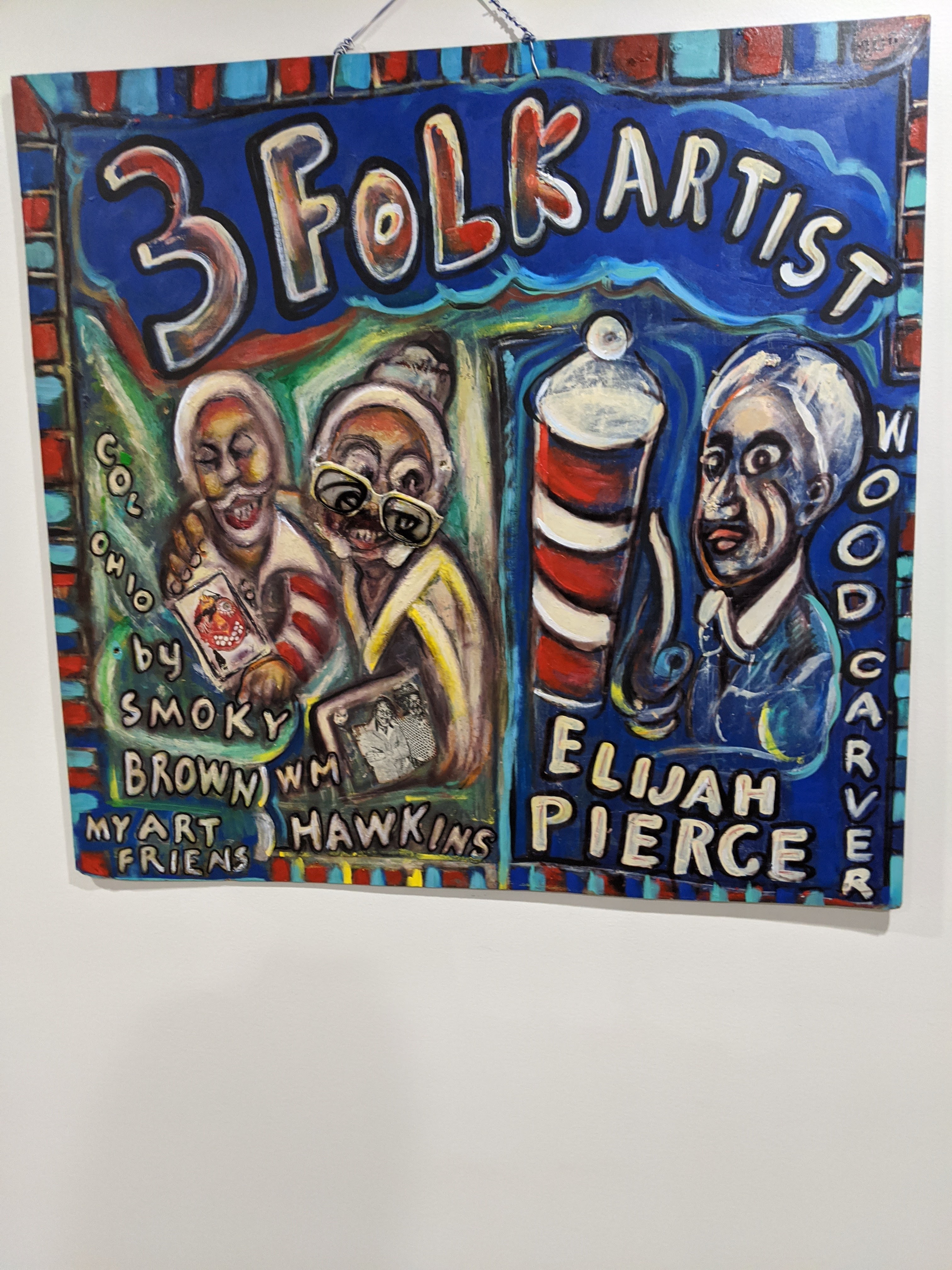
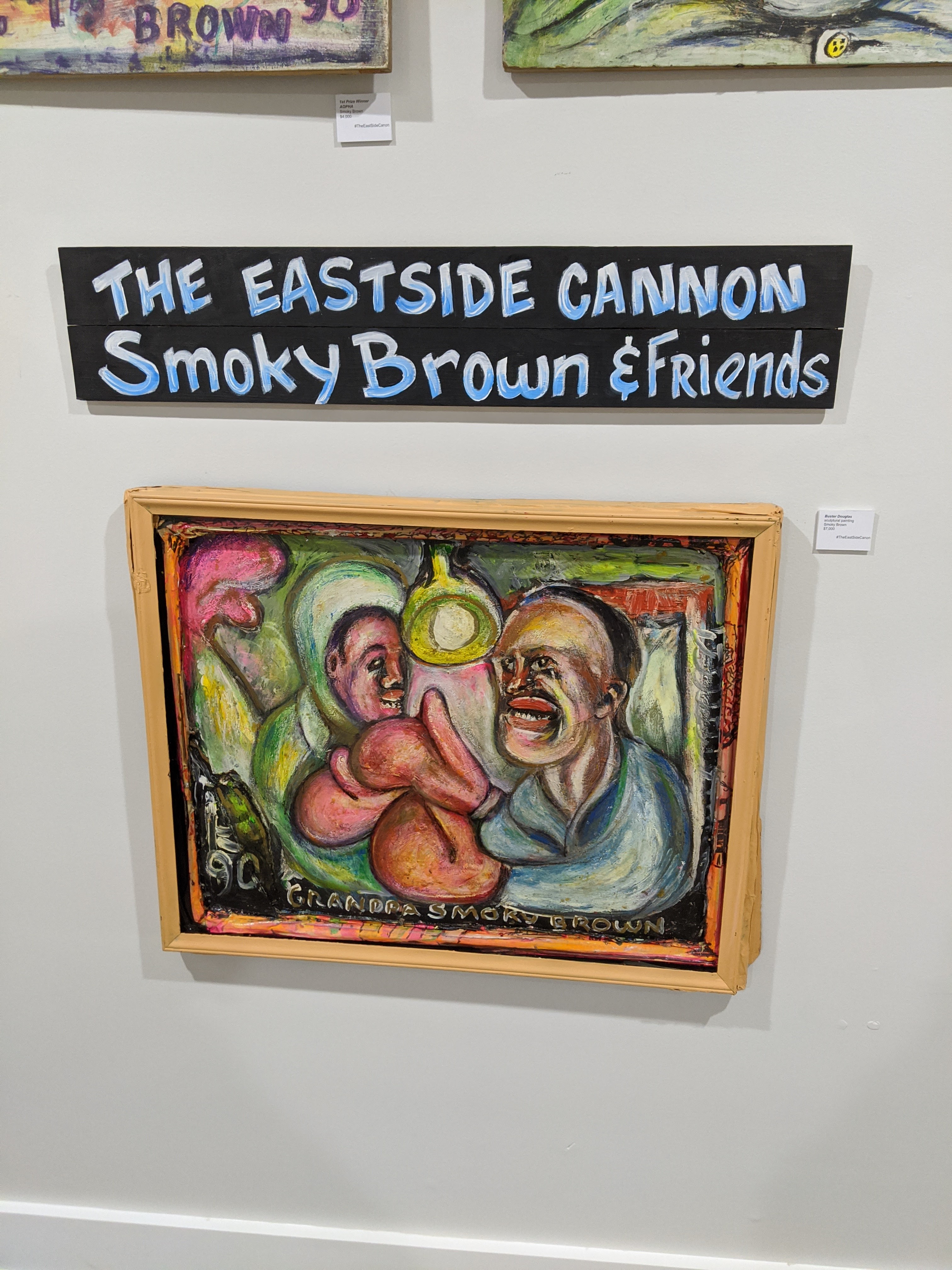
  • Smoky Brown and Friends, The Eastside Canon (Streetlight Guild) – Streetlight Guild, under the guidance of Scott Woods, has been the most exciting single Columbus art development in the last few years. The gallery exhibits are always worthwhile but this was special. One of the great guiding lights of local art, Smoky Brown, given a museum-quality show of work that was new even to someone like me who grew up here and thought I’d seen a lot of his work. Coupled with a selection of work from his collection. A lesson in valuing what’s around you and appreciating your friends and community.
LaToya Ruby Frazier, Wexner Center

Categories
Best Of visual art

Best of 2018 – Visual Art

“Attention is the beginning of devotion.”
-Mary Oliver

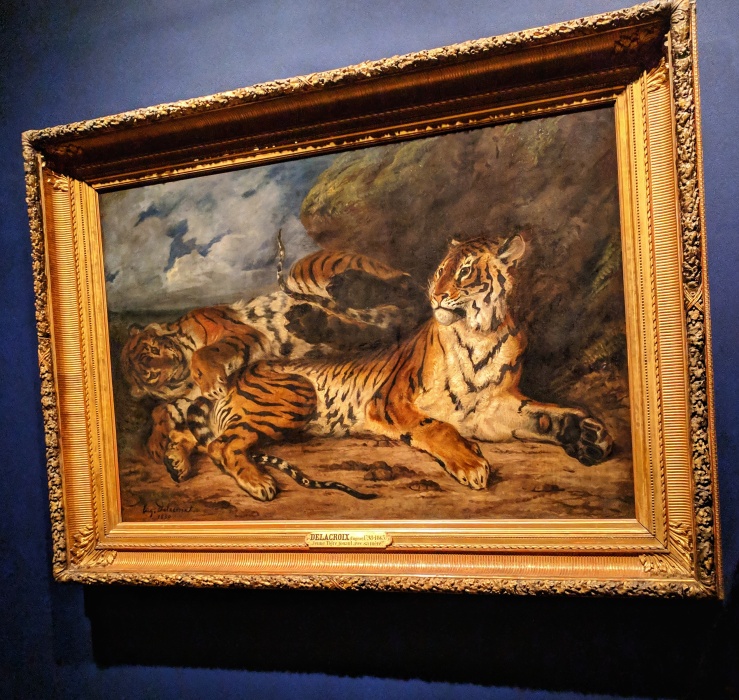
Delacroix, Metropolitan Museum of Art

This has been a year of incredible highs and incredible lows, the latter all self-inflicted. Wearing myself so far down I was susceptible to a week in the hospital with pneumonia. To spraining an ankle so hard I was in a boot for two weeks. But one thing that always helps center me, that lights and maintains the fire called wanting to go on, is attention. And no cultural activity centers me more, nothing puts me in my place, nothing bows the strings in my soul like trying to focus on visual art.

And I will say this in all three posts but the best macro-gratitude exercise I undertake every year is keeping track of what I see/listen to (I need to be better about tracking what I read) and going over it at the end of the year. I took in around 75 exhibits this year and narrowing it down to 20 was hard. I am, always, very, very lucky.

Anyone else sparked by this or who bothers to read these, I appreciate you . Drop me a line, let’s talk about what we both saw or what I’m an idiot for leaving off. Everything here is in Columbus and any photo is taken by me unless stated otherwise.

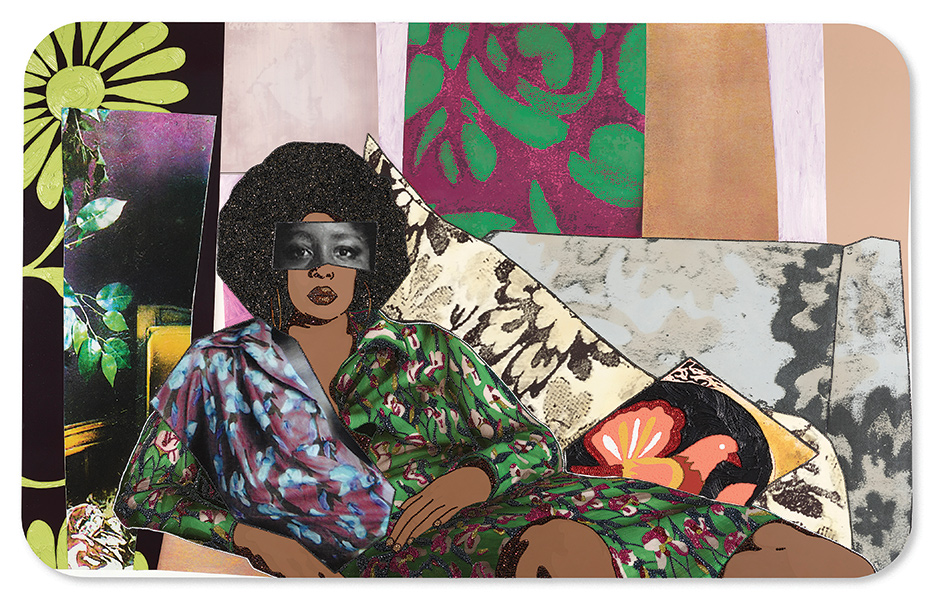
Mickalene Thomas, Afro Goddess Looking Forward, 2015, Courtesy of the artist via the Wexner Center, Copyright Mickalene Thomas / Artists Rights Society (ARS), New York

1. Mickalene Thomas, I Can’t See You Without Me (Wexner Center for the Arts) – I can’t think of an artist who better epitomizes taking all of art history and synthesizing it into a voice utterly, unmistakably hers, than Mickalene Thomas. The bounty of riches presented with I Can’t See You Without Me was like tapping into a deep vein and realizing it’s full of stars: completely personal, in touch with the world (and worlds behind the world) and full of monumental, magic beauty. Everything I love in art was in this show and while I visited it five or six times, I regret not seeing it seven or eight more.

David Wojnarowicz, Whitney Museum of Art

2. David Wojnarowicz, History Keeps Me Awake at Night (Whitney Museum of Art, NYC) – Dispatches from one era when the world was on fire still shone brightly in this dazzling retrospective of one of American art’s foremost poets of ecstasy and rage.

3. Yayoi Kusama, Infinity Mirrors (Cleveland Museum of Art, Cleveland) – I still remember the first time I saw one of Kusama’s Infinity Mirror Rooms, at my first Whitney Biennial. It was an eye-opening reminder of the power of repetition to unlock a world and a potent mix of serenity and discord. I came to love the permutations of her varied work over time, most prominently in a stuffed, ranging retrospective at the Whitney. but this hyper-focused touring show was a concentrated dose of the mix of sensations that first drew me in.

4. Kerry James Marshall, Works on Paper (Cleveland Museum of Art, Cleveland) – An epic-scaled domestic scene in panels fragmenting it like a comic strip and also recalling large Renaissance triptychs, was surrounded by other drawings in this tight, sharp show of an artist who only gets better.

5. Various Artists, Trigger: Gender as a Tool and Weapon (New Museum, NYC) – This ferocious trip through depictions of gender ended a January New York trip on a head-spinning succession of high notes, including Ulrike Muller’s jagged abstractions, a dazzling Mickalene Thomas video collage. This summed up everything I love about the New Museum when it’s clicking, work within the last 10 years – without cheaply valorizing youth – that summed up and exploded 40 years of the institution. A good sign for the future of the Wexner Center as the curator of this spectactular exhibit is the new director to succeed Sherri Geldin as director.

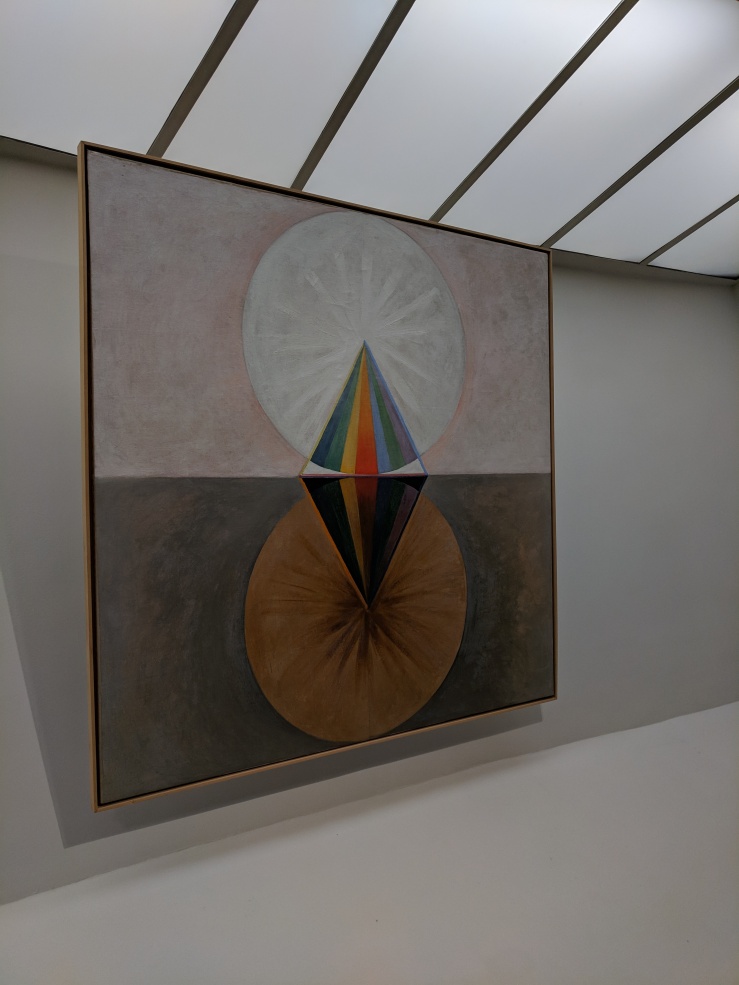
6. Hilma af Klint, Paintings for the Future (Guggenheim, NYC) – This hypnotic, transfixing, spiritual show cemented another contender for an originator of abstraction and opened my eyes to a voice I knew almost nothing about. A paean to the magic of drilling down into oneself with specific instructions not to show most of her work until 20 years after her death, working on instructions from spirits she communed with through a seance group. You couldn’t write af Klint’s story in a way that seemed believable but the art was as accessible as layered and elusive.

A Color Removed, SPACES Gallery

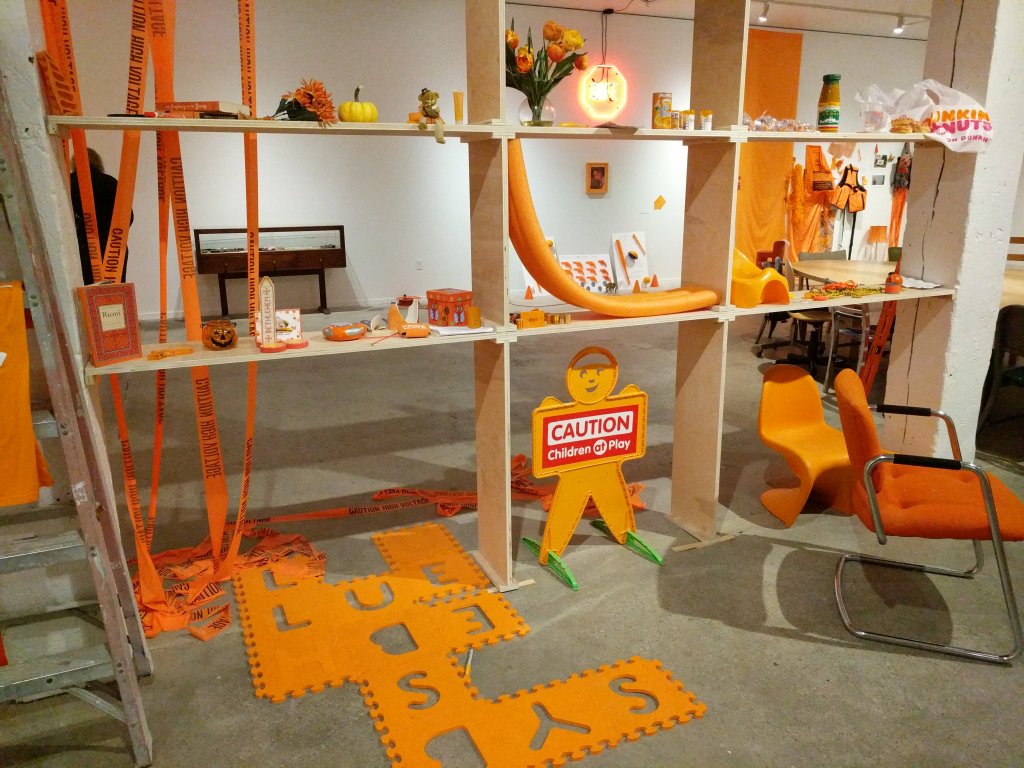
7. Michael Rakowitz with Amber N. Ford, M. Carmen Lane, RA Washington, and Amanda King with Shooting Without Bullets Youth Photographers; A Color Removed (SPACES Gallery, Cleveland) – Rakowitz in collaboration with a variety of local artists created an assemblage of the color orange, underlining the irony of trying to blame the deaths of children on the warning color or lack thereof. And it was one of the most devastating things I’ve ever seen in my life. A quiet temple to absence, loss, and rage.

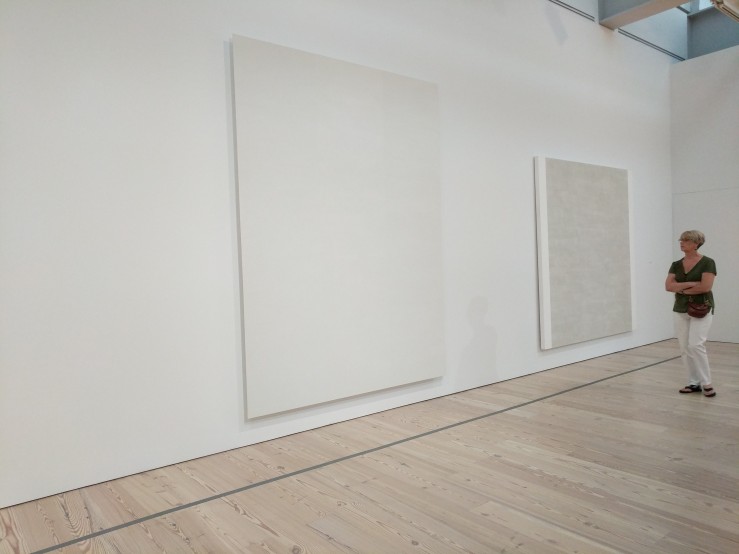
8. Mary Corse, A Survey in Light (Whitney Museum, NYC) – I walked into the Whitney that sweltering July day knowing I loved Wojnarowicz, steeped in him since I was a teenager. I had no such knowledge or preconceptions of Corse and her deceptively simple canvases pulled my breath right out of my body. Working with the most fundamental element not just of painting but of sight – light – she made me look at it in a different way that recalled the meditative work of so many earlier artists but was still like nothing I’d seen.

9. Eugene Delacroix, Delacroix (Metropolitan Museum of Art, NYC) – This presentation of one of the old masters I knew the least about was refreshing in a way art of that vintage doesn’t usually affect me. The breadth of his literary influences and the wide range of stylistic techniques were dazzling; a self-portrait casting himself as the main character in Scott’s Bride of Lammermoor led me to dub him the creator of the cosplay selfie. And it was not just the Musee de Nancy frame that led me to say, and my companions to repeat the rest of the weekend, “Delacroix is lit.”

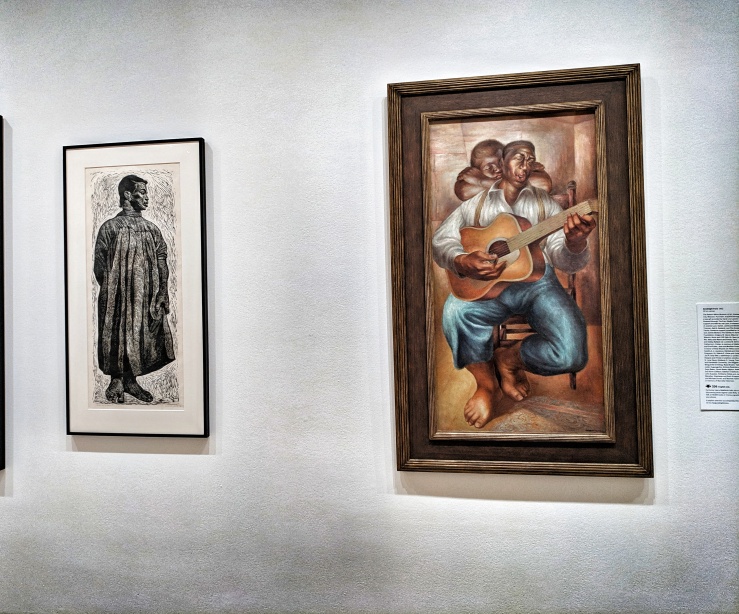
9. Charles White, A Retrospective (Museum of Modern Art, NYC) – Another artist I wasn’t as familiar with as I should have been, a 20th-century American, this selection of White’s work was the perfect thing to see upon first arriving in the city. Enormous, dazzling, powerful and rich with the contradictions and terror still reverberating through the fabric of daily life. Almost impossible to take in but refusing to let me go, demanding and not letting me off the hook.

10. Various Artists, Inherent Structure (Wexner Center for the Arts) –  The Wex hit a home run with this vibrant look at the ways contemporary artists continue to suck the marrow out of traditional concerns of abstract painting while tweaking and subverting it. One of the best-arranged exhibits I saw all year, where every corner I turned revealed something else about what I’d seen and what I was about to see without pandering to the obvious. Artists I already loved like Amy Sillman illuminated a gateway toward those I knew less (Angel Otero) and those completely new to me (Channing Hansen).

11. Carolee Scheenman, Kinetic Painting (MoMA PS1, NYC) – This expansive retrospective, going back to the ’50s, was a lesson in how not to weaken in rigor, in curiosity, in feeling. Scheenman did almost everything and did it all with blinding heat and depth that continually revealed itself. Shaming and inspiring and astonishing.

12. Marlon de Azambuja and Luisa Lambri, Brutalismo-Cleveland (Cleveland Museum of Art, Cleveland) – Another piece in the fantastic Front triennial, this collection of local materials in an iteration of de Azambuja’s ongoing series investigating Brutalism paired with Lambri’s photographs in something that was unsettling and perfectly in keeping with its surroundings (not just the Breuer wing of the CMA but Cleveland itself).

Phyllida Barlow, Hauser and Wirth

12. Phyllida Barlow, Tilt (Hauser and Wirth, NYC) – There was no shortage of art I saw this year that grappled with the way we in more privileged vantage points have realized the world doesn’t sit on its axis as comfortably as we once thought. Very little did it with the same arresting punch as British artist Barlow. A queasy circus singing a melody in its own voice, a voice that haunts me weeks later and I want to hear more of. Seeing the nods to Brutalism in these pieces transported me to the de Azambuja earlier on the list and the way those two artists of different nationalities exhibiting in different cities and different seasons spoke to one another in my head was a tribute to trying to see as much art as possible.

13. Sarah Lucas, Au Naturel (New Museum, NYC) – There’s a recurring theme in what shook me this year: artists I damn sure should have known better. Sarah Lucas epitomizes this, storied career as a sculptor I mostly knew as a name, one of the Young British Artists, with Hirst and Emin. This intense, witty, beautifully vulgar retrospective was everything I want art to be – speaking not just truth to power but a specific, personal, idiosyncratic truth.

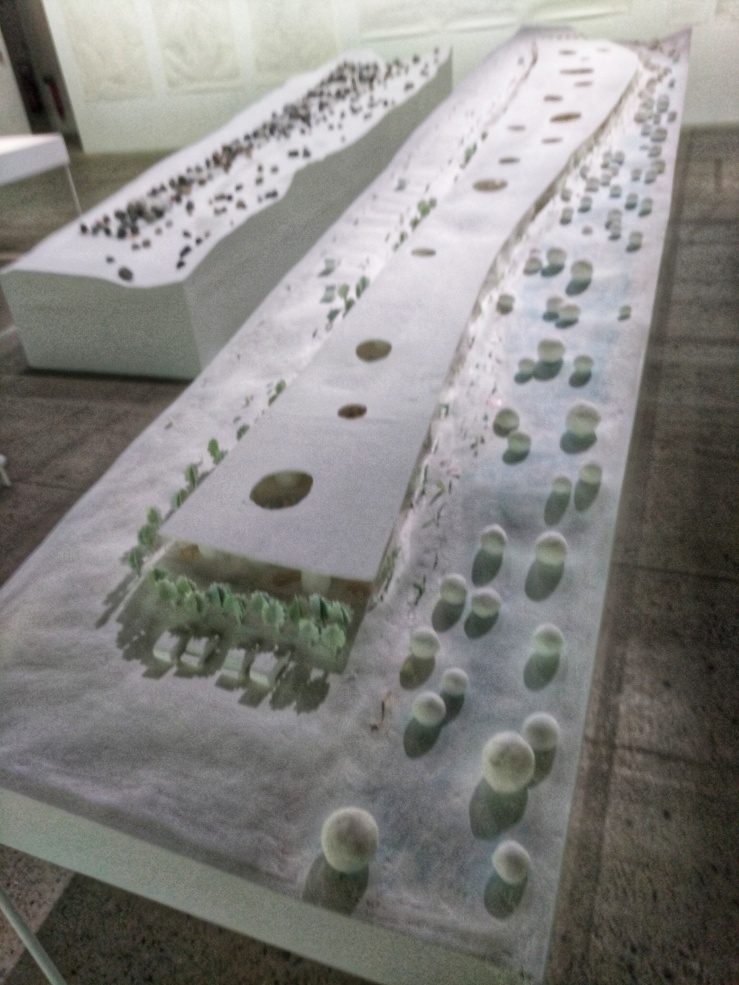
14. Junya Ishigami, Freeing Architecture (Cartier Foundation, Paris) – Most of my first trip to Paris was spent doing exactly what you’d expect – the Louvre, D’Orsay, Centre Pompidou, Shakespeare and Company, wandering boulevards, drinking wine, all spectacular. So I was surprised by how affecting I found this show of a visionary Japanese architect. Breathable open spaces that feel like the future; echoes of ’70s science fiction movies like Silent Running but also evocative of the flowing purity of a Basho line or the meditative canvases of Agnes Martin. I wanted to live here. Paris, sure, but also inside these models.

15. Cyprien Galliard, Nightlife (MOCA, Cleveland) – I’ve been a fan of Galliard’s since the Wex showed his photographs but I’ve never been as enchanted as by the swirling dive into the after-dark of this video installation. Rodin’s The Thinker shattered by a bombing (the version in Cleveland), a tree planted to celebrate Jesse Owens also in Cleveland, fireworks over the site of the 1936 Berlin Olympics where Owens, shuddering plant life around Los Angeles streets, all throbbing to a looped sample of the Alton Ellis classic Blackman’s Song, the original chorus of “I was born a loser” melting into the re-release of “I was born a winner.” I could have stayed there for hours

16. Martha Rosler, Irrespective (Jewish Museum, NYC) – Martha Rosler’s acerbic retrospective at the Jewish Museum was the kind of fresh air and reawakening to the atmosphere of terror around us I needed. Steeped in language and sharply aware of the limitations and obfuscations of every vocabulary, this was as immediate and accessible as a slap in the face but also layers upon layers.

17. Susan Phillipsz, A Single Voice (Tanya Bonakdar, NYC) – Phillipsz is the master of the subtle, disorienting environment and one of the finest artists at using sound in a gallery setting. An installation with film of a violin player playing a snatch of score from a Karl-Birgir Blomdahl opera, with 12 speakers bouncing the violin tones through the room and surrounded by canvases caked in salt and named after the Lachrimae. Defying description and intoxicating at the same time.

18. Jennifer Packer, Quality of Life (Sikkema Jenkins & Co, NYC) – Packer achieves a balance of the intimate and the explosive that’s unlike any work I’d ever seen. These breathtaking canvases all had an interiority that I found beguiling, coupled with potent colors and surprising juxtapositions that grabbed me by the collar and forced me in off the street.

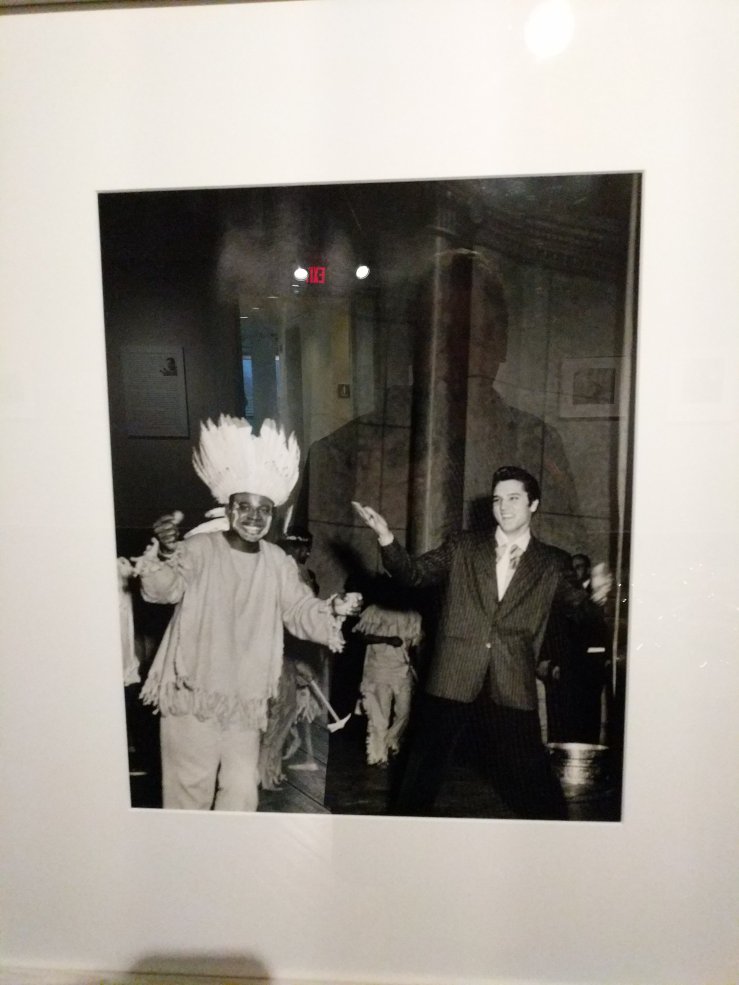
19. Ernest Withers, A Buck and A Half A Piece (Brooks Museum, Memphis) – Everything at the Brooks Museum this trip reminded me why it’s a must-stop in Memphis, the Jaume Plensa work very nearly made this list. But that slice of Memphis photographic history on the main floor wouldn’t let me go. Withers was a master at documenting cultural life (like the photo of Rufus Thomas and Elvis Presley above), civil life (with arresting images of the civil rights movement like the SCLC conference) and day-to-day “ordinary” life the way we should always see them: as parts of the same fabric, not discrete plants grown in their own pots.

20. Various Artists, All Too Human: Bacon, Freud, and a Century of Painting Life (The Tate, London) – It’s no surprise Francis Bacon and Lucian Freud were massive to me from the moment I was first aware of them; so seeing this retrospective on their home turf in my first trip to London was amazing. But more than that, this retrospective accomplished the tricky feat of showing these names as the nucleus of a burgeoning movement without overly inflating or denigrating the lesser-known student works. It painted the kind of picture that normally I’d have to buy the catalog to come close to.

Categories
live music

Things I’ve Been Digging – 06/24/18

Every holiday is really about the passing of time but I’m a particular sucker for days that explicitly honor time. Case in point: the Summer Solstice. As the local Community Festival drifts away from me as a demographic (there’s no bitterness there: events should change or they wither and die) there’s been a rising of other options that sing with summer’s sticky sweetness.


photo_20180621_235034-01
Megan Palmer and Band at Dick’s Den


Megan Palmer (June 21, 2018, Dick’s Den)

One of my favorite singer-songwriters, bandleaders, and artistic expats, it’s always a joy when Megan Palmer comes back to Columbus. The nights at Dick’s Den are extra special because it’s where she first bowled me and so much of this town over. The gloriously loose – on stage and in the crowd – late set we caught at that home reaffirmed that power.

Palmer still puts together a righteous, crack band whenever she’s in town, including usual suspects guitarist Brett Burleson, longtime vocal foil Jen Miller, and drummer of all trades Jimmy Castoe. That selection of players highlights the beautiful, quicksilver quality to slip between genres and times, tying everything together with her voice. Over the years, Palmer’s sharpened her lyric writing into one of the finest examples of open-hearted empathy without that understanding ever turning to weakness or a mealy-mouthed exercise in “both sides.” At the same time, her melodies grew looser and harder to define, amplifying their shimmering quicksilver qualities and leaving more space for other players.

Burleson’s fills attacked the same “problem” as Luther Perkins but approached them in a surprising, refreshing way. At one point, on one of my favorite of her older songs, “Please Don’t Come Back,” it clicked that the arrangement took Bob Wills as a starting block then opened to embrace everything Wills influenced in the idiosyncratic wing of the 20th century’s popular music including Willie Nelson and even a little Ornette Coleman. This music was washing my face in the fountain of life (or as Tom T. Hall said, the morning dew).


attach904_20180623_144930-01
This Moment in Black History at Happy Dog (photo by Anne Courtney)


Cold Sweats and This Moment in Black History (Happy Dog, Cleveland, June 22, 2018)

Every few years, Cleveland gives the world one of the greatest rock and roll bands we’ve ever seen. Currently holding the crown – though I’m not discounting there could be a bunch of kids I haven’t see yet – is Bim Thomas’ crowning achievement Obnox. One of my all-time favorites also features Bim, on drums, This Moment in Black History. I hadn’t seen them in probably six or seven years and in the periodic reunion we saw at the Happy Dog to kick off our flying Cleveland weekend.

Hooky, vibrant, righteous, full of intertwining hooks and sticky grooves. The kind of late night dance floor riot most of us search for from dancefloor to bar room and back. Opening, Cold Sweats from NYC did a modern take on post-hardcore with lacerating guitar and a swinging bounce that got the crowd dancing.


photo_20180624_000229-01
Pierre Kwenders and Band at the Cleveland Museum of Art


Summer Solstice 2018 (Cleveland Museum of Art, Cleveland, June 23, 2018)

Anyone who wants to throw a museum fundraiser should look to the Cleveland Museum of Art. A and I went about five years ago and had a blast, including spontaneously running into American treasure Baby Dee. The next year it sold out at the member presale and has ever since.

This year I finally bit the bullet and got a membership and I’m pleased to report every change they’ve made since made it better. Manageable lines, reasonable (for a benefit) drink prices, and splitting the bands between (mostly) live acts on the terrace and (mostly) electronic in the atrium for a better dance floor, we were here for four hours and I loved every minute of it. There’s a special magic in ducking in from a sweaty dance floor and realizing you’re the only two people in a room full of Van Gogh and Cezanne. Or you’re in a politely humming crowd grappling with Danny Lyon’s photographs of the human and aesthetic cost of gentrification or Kerry James Marshall’s massive, encompassing woodcuts.

Moroccan electronic artist HAT (Hatim Belyamani) wove music out of film footage shot by his collective, remix ←→ culture, remixed to highlight the individual cultures they were taken from and into something spine shifting and hip-swaying. HAT made it impossible to ignore the cultural building blocks that gave birth to these pulsing club tracks and worked it into something easily graspable and that resisted being nailed down. His work echoed the Brutalismo-Cleveland exhibit upstairs by Spanish artist Marlon de Azambuja which also used locally sourced materials to comment on brutalism and society.


photo_20180623_214026
Yemen Blues at Cleveland Museum of Art

Yemen Blues was one of the finest dance bands I’ve ever seen. Led by Ravid Kahalani, the six piece band wove funk and salsa together with traditional North and West African melodies in a refreshing, wild party. Hello Psychaleppo came at traditional music, the ecstatic Syrian music Samer Saem Eldahr grew up with, with a similar mix of reverence for the original and delight in reinvention that kept the dancing audience in the palm of his hand. Pierre Kwenders blew my hair back, he’s one of the greatest soul singers I’ve ever seen. He and his quartet cooled it down a little and turned up the level of sexy as they closed the night with a blend of Congolese rumba and the current wave of stiletto sharp, introspective R&B


photo_20180623_231800
Marlon de Azambuja: Brutalismo-Cleveland

Categories
Uncategorized

Best of 2015: Visual Art

“God, limit these punishments, there’s still Judgment Day –
I’m a mere sinner, I’m no infidel tonight.

Executioners near the woman at the window.
Damn you, Elijah, I’ll bless Jezebel tonight.

The hunt is over, and I hear the Call to Prayer
fade into that of the wounded gazelle tonight.

And I, Shahid, only am escaped to tell thee.
God sobs in my arms. Call me Ishmael tonight.”
-Agha Shahid Ali, “Tonight”

This year was so soaked enough in death you almost had to wring it out. There was a lot to be sick over. Personally: the other Grandfather, a dear friend Valerie, friends’ parents and lovers and best friends. And that’s all before the camera pulls back to look at the larger world – the larger world where terror hit closer to home than usual, people gunned down going to a show or the recent vandalism and suicide at the Wexner Center causing the After Picasso show to close early. That, of course, speaks to privilege because for much of the world death is never as far away as it, luckily, is for me, and my grey year doesn’t even move the needle on a larger scale.

For me, visual art has always been linked with the act of memory and the act of bearing witness. Its permanence (and in some cases, its deliberate eschewing of that permanence) gives it some of its meditative quality. My heart breaks for anyone there when the event happened in December and anyone who might have been there and, of course, the person who chose that place to end it. Even before the most recent event, the art that drew me to it, that made me want to tell somebody, that made me want to argue with it and wrestle with it, played right into the preoccupation with death I didn’t consciously realize I had this year. But more than that, it was a balm. It was fuck it, this matters. It was this is still standing. It was fight to rememberIt’s a reminder to keep trying.

As with all of my Year End summations, everything is in Columbus unless stated otherwise.

  1. Doris Salcedo, s/t (Museum of Contemporary Art, Chicago) – On a grey, unseasonably cold day in Chicago in the middle of a great trip, this Colombian artist made me feel like someone was standing on my chest in a room full of knives. From the opening piece, Plegaria Muda, with its wooden tables the audience has to squeeze between and growths of vegetation coming out of the tables like a field of gravestones but still shot through with fragile life, on, this took my breath away. Sculptures using silk and human hair, abandoned doors concrete. It was a death mask for the world and a shrine, apocalyptic and very, very beautiful.
  2. Alberto Burri, The Trauma of Painting (Guggenheim, NYC) – This was the kind of show that left me kicking myself I didn’t know Burri’s artwork better beforehand. It gave me the same feeling as Giuseppe Ungaretti’s poetry, though his poet countryman is an earlier war, with its use of the surreal to crack open your chest and its fantasies about shipwrecks instead of the way you see you friends die. Molten plastic, welded metal leaving the seams obvious enough they look like blisters, burlap sacks as an indictment of capitalism. Everywhere I turned my mouth got dry and tears came to my eyes.
  3. Jack Whitten, Five Decades of Painting (Wexner Center for the Arts) – There’s been a lot of talk about the Wexner not having a permanent curator in a while (they still have curator-at-large Bill Horrigan) but I have to say they’ve done a great job working around those limitations this year. This Jack Whitten retrospective showed a singular voice working through, challenging, and recombining every interesting art trend of the 20th century and stripping away what didn’t apply to what he wanted to say. My favorite pieces were the portraits/tributes that combined painting and mosaic and found objects in a way that made blood hot in my veins, especially the tribute to Amiri Baraka (a flawed, complicated guiding light for me, always). Memory writ appropriately large.
  4. Elaine de Kooning, Portraits (National Portrait Gallery, Washington DC) – Knowing Elaine de Kooning’s work more by reputation (and a couple examples at MoMA), this series of portraits was revelatory. Obviously, especially for being at the National Portrait Gallery, this retrospective moved in tighter and tighter circles toward the famous JFK portrait but that gleams with sunlight and the way a beautiful sunny day throws the greens and yellows of the garden you’re in all around, fracturing what you see and what you can’t quite make out. These, all of them, are full of mystery and secrets and magic that gets closer, you think, to who the people being depicted were than maybe they’d ever shown.
  5. Shirin Neshat, Facing History (Hirshhorn Museum, Washington DC) – I’ve been a fan of Neshat’s work for a long time so this retrospective was like gorging myself on something almost too rich to consume. The way she grasps the macro elements of history, history’s pain and the way it disfigures people with the twinned fires of love and hate but also it’s beauty, and the way she understands people is a marvel. Gorgeous works you can get lost in, a lot to say about the way the world gets created with our creation of language (this theme also resonated with me in several things on my theatre list coming soon). This was a series of varying punches that left me staggered.
  6. Walid Raad, s/t (Museum of Modern Art, NYC) – Walid Raad’s collections of photographs, videos, sculpture and fictional histories, gobsmacked me and left me babbling. It made me think a lot about the horrific situations in Lebanon over the years and how someone around my age would have processed that, and, weirdly, it made me think of the recent controversy in science fiction. This is a brilliant example of how fictionalizing and fabulism (for the latter, Raad’s “merged” sculptures from the middle east transported to the Louvre) can been tools (scalpels or daggers or stilettos or garrotes) to slice into your heart. And an example of how many stories those tools can be good for telling with emotional maturity and an eye to how big and fantastic (and sometimes fantastically horrible) the world really is.
  7. Various Artists, Sitter: Portraiture in Contemporary Photography (CCAD Contemporary Arts Space) – The CCAD space has been killing it the last few years and this year, with this (before the renovation) and the work after the renovation to create a better flow for the galleries has made it a force to be reckoned with for modern art in Columbus. This group show of 27 photographers really dug deep into what portraiture means now and was full of alive, striking, political, rich, sexy, intense work.
  8. Pablo Picasso, Picasso Sculpture (Museum of Modern Art, NYC) – I’m on the record as not being the biggest Picasso fan. All credit to his craft and his influence but most of his work I just don’t love. This was an exception. Seeing this many of his sculptures together had a delirious, vertiginous effect that actually made me want to go deeper and stay longer and talk about it more. This was also, by far, the best arranged and curated exhibit I saw, Ann Temkin and Anne Umland made this arrangement of sculpture both feel excavated and timeless and flow in a way that felt intensely personal and real.
  9. Catherine Opie, Portraits and Landscapes (Wexner Center for the Arts) – Opie, long a favorite of mine (who also had work in Sitter), took a step into something almost resembling Renaissance painting with her photographs here. These rich, dark portraits of her social circle, often naked or half naked but with expressions and clean lines that summoned a deep distance encouraged me to look again and again. Just as intriguing are the blurred-almost-to-abstraction landscapes that break up the intensity of the gazes like a note of sensual dissonance. She’s not here to comment on the souls of these people and she’s not here to pass any judgment. There are no easy answers, no pat summations, in this body of her work and we’re richer having it.
  10. Charles Atlas, The Waning of Justice (CCAD Contemporary Arts Space) – Atlas is another perennial for me but this doomsday clock over gorgeous landscapes and abstract concepts leading into a room where the larger-than-life figure of Lady Bunny gave a moving, hilarious monologue across a whole wall that periodically dropped out to silence was astonishing. Concern with a disappearing world turned into an aching dance.
  11. Various, Open This End: Contemporary Art from the Collection of Brian Byrne (OSU Urban Arts Space) – In general I agree with the concerns about single-collector exhibitions. That said, my understanding was this was already donated to its final destination and I was blown away by this collection of art that wasn’t just blue-chip but was also violent, intense, irreverent and wise. The curation was really stunning with pictures about race facing off against each other, corners about death. This wasn’t easily digestible and with all the big names it didn’t make concessions to being palatable and we were all the better for it.
  12. Archibald Motley, Jazz-Age Modernist (Whitney Museum, NYC) – Motley’s fascinating mix seems to obviously point toward Thomas Hart Benton, Hopper, and Toulouse-Lautrec. What I saw most was Chagall, with an assured willingness to discard any piece of a tradition he didn’t need and use exactly what of it he wanted. But his work’s in no way derivative, it shimmers and vibrates with an electricity that’s all his own and these portraits and large scenes got better and better seeing in a large group. Any fine artist working with the black experience, especially in those days, is to be considered seriously but beyond those serious concerns this was sensual, intense work, looking at an era as it started to tip over.
  13. Anonymous, Mingering Mike’s Supersonic Greatest Hits (National Gallery of Art, Washington DC) – As with most good things I see, this was a suggestion of A., and it was astonishing. If you grew up a record nerd and a comic book nerd like me, this was an extra delight. Using the medium of painted record covers and show fliers, this fictional universe the artist known only as Mingering Mike created where the same songwriting credits popped up again and again and various musicians played with other groups fit together and was just off enough to have an interesting tension. Similarly to the Walid Raad, this secret history pointed toward an unknown pain with notes vaguely intimating draft dodging and the work drying up after the pardon when the artist could find a job, the characters going away when they aren’t needed anymore.
  14. Louise Fishman, s/t (Cheim and Read Gallery, NYC) – This selection of paintings was the best thing I saw in a long day wandering around Chelsea. Vibrant and full of sensuous dissonance, like a landscape run through a distortion pedal on these big canvases.
  15. Various, Fiber: Sculpture 1960-Present (Wexner Center for the Arts) – This exhibit that came to the Wex after a run at Boston’s ICA opened my eyes to a whole new medium in a way that doesn’t happen much anymore. I marveled at seeing the way textile work embraces and pulls against easy connotations of domesticity and explodes into something political and angry, totemic and erotic; seeing the way it enfolds history and points toward the future. I visited this maybe a dozen times and I could have done a dozen more.